Context study / Sogno di un filo teso
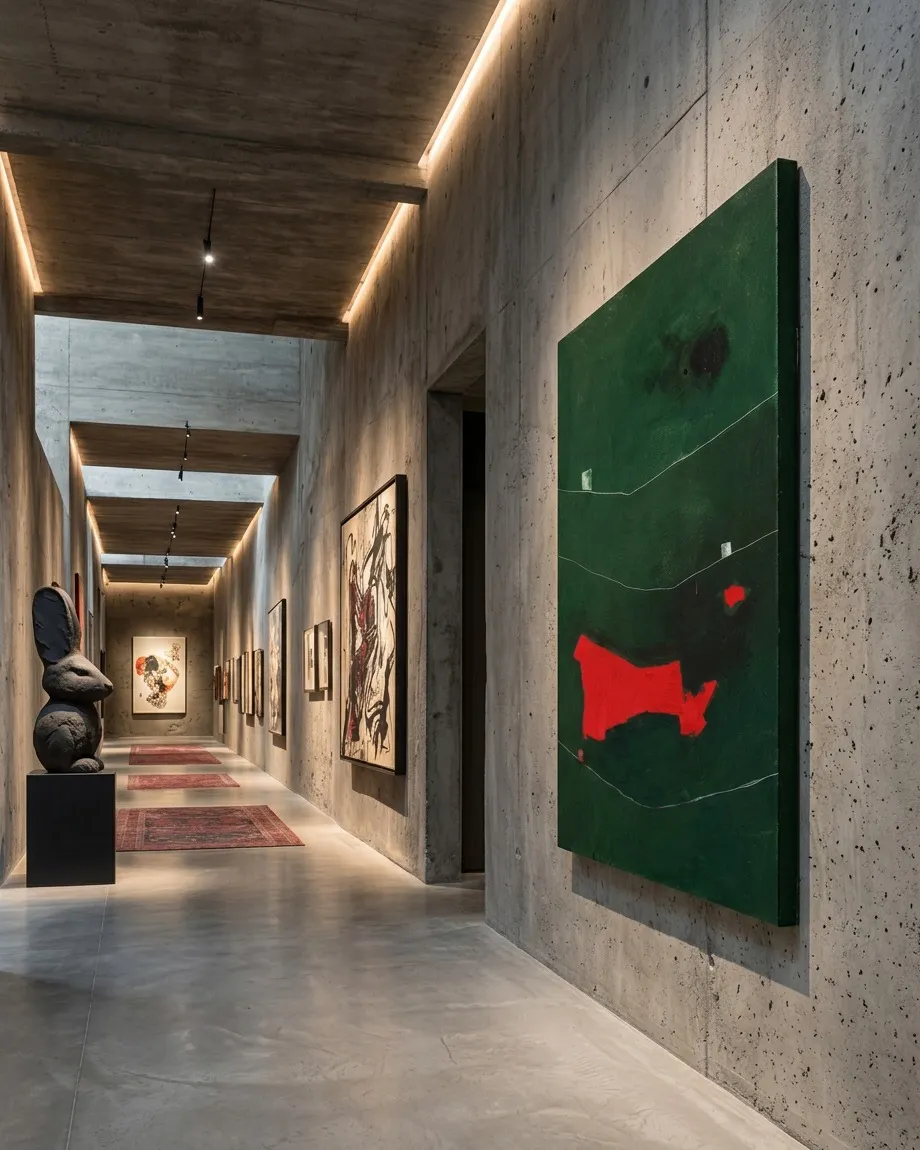
Sogno di un filo teso by Maurizio Valch in a contemporary art gallery
The composition of Sogno di un filo teso unfolds on a vertical field where the green color, dense and deep like the shadow of a forest, establishes a territory of chromatic negotiation. On this surface, belonging is not presented as a given fact or a peaceful occupation, but as an unstable conquest in the face of the immensity of the void. Three horizontal and highly subtle incisions traverse the plane, functioning as delicate structures of protection: true lifelines from which hang small geometric blocks, suspended tesseræ that challenge the gravity of the canvas. These tiny sentinels, arranged over the green abyss, contrast drastically with the imposing and overflowing presence of the crimson mass inhabiting the lower quadrant. This disparity of scales reveals a fundamental suspicion: that which the painting attempts to safeguard through its linear scaffolding is not the fixity or immobility of forms, but the latent vibration of an equilibrium always on the verge of breaking.
When I sink the stylus into the accumulation of green pigment, still wet and resistant, I experience the mark as a physical incision on a living body. Trust then becomes a strictly physical pulse, the tactile firmness of a hand that must cleave the material without absolute certainty that the resulting line will be capable of sustaining the visual and conceptual weight of the work. This act of manual subtraction is a struggle between resisting matter and limiting will. The "dream of the tense thread" is not an idealized abstraction, but a direct confession of the vulnerability inherent to my own pictorial practice; it is assuming that drawing a boundary is also opening a wound on the surface of the painting, a space where stability hangs by a thread as thin as the groove left by my tool.
In the lower half of the canvas, the intrusion of the large crimson spot introduces a material discordance that shakes the apparent calm of the green space. This organic mass, with irregular boundaries and an almost geological density, seems to actively reject the orthopedic and rational protection offered by the three incised lines. While the small tesseræ docilely submit to the geometry of the threads, the red block imposes itself from a logic of pure material autarky, suspended in its own gravity without the need for moorings. In this zone of friction, belonging and detachment redefine each other. The painting suggests that true nesting is not achieved by submitting to an external safety net or a fixed coordinate, but through the capacity to inhabit the void while sustaining one's own volume, accepting the weight and the fall as fundamental parts of presence.
This crimson spot is the trace of an internal stratum that has seeped through the green skin of the painting; an exposed organ, a physical memory of the territory that emerges after the excavation process on the canvas. For me, painting does not consist of illustrating an idea, but of embodying a belonging to an intimate landscape, untamed and alien to any rational domestication. In the solitude of the studio, the painting becomes the place where I learn to dispense with pre-fabricated guides and safe horizons. In the end, the work consists of stripping away the scaffolding and placing blind trust in the organic behavior of the pigment, in the actual wear of the materials, and in the eloquence of a surface that accumulates the time and effort of my own body.
Ultimately, Sogno di un filo teso merges the concepts of belonging, protection, and trust into a synthesis on the resistance of structures against the wear of space. Painting is not offered here as an illusionistic window of representation, but as a tactile and rough membrane where one is invited to contemplate the imminence of decline and the beauty of contained tension. The balance governing the work does not rest on the invulnerability of its support lines, but on the conscious acceptance of its fragility. It is the vibration of those tense threads, resisting in the midst of the immensity of the green silence, that endows the suspended matter with gravity and meaning, reminding us that sustaining oneself in the void is always an act of silent resistance.
- Original artwork
- Sogno di un filo teso
- Actual dimensions
- 31.5 × 47.2 in / 80 × 120 cm
- Presentation
- Digital contextual visualization
Context references
paintings for exposed concrete walls · hallway interior decoration with large paintings · abstract art in contemporary brutalist spaces · ideas for hanging large vertical format paintings
About this visualization
This visualization places the artwork within an architectural context to help collectors and viewers imagine its presence in a real space. It is an interpretive reference, not an exact reproduction: the original work remains the sole authority for scale, color, surface and material presence.