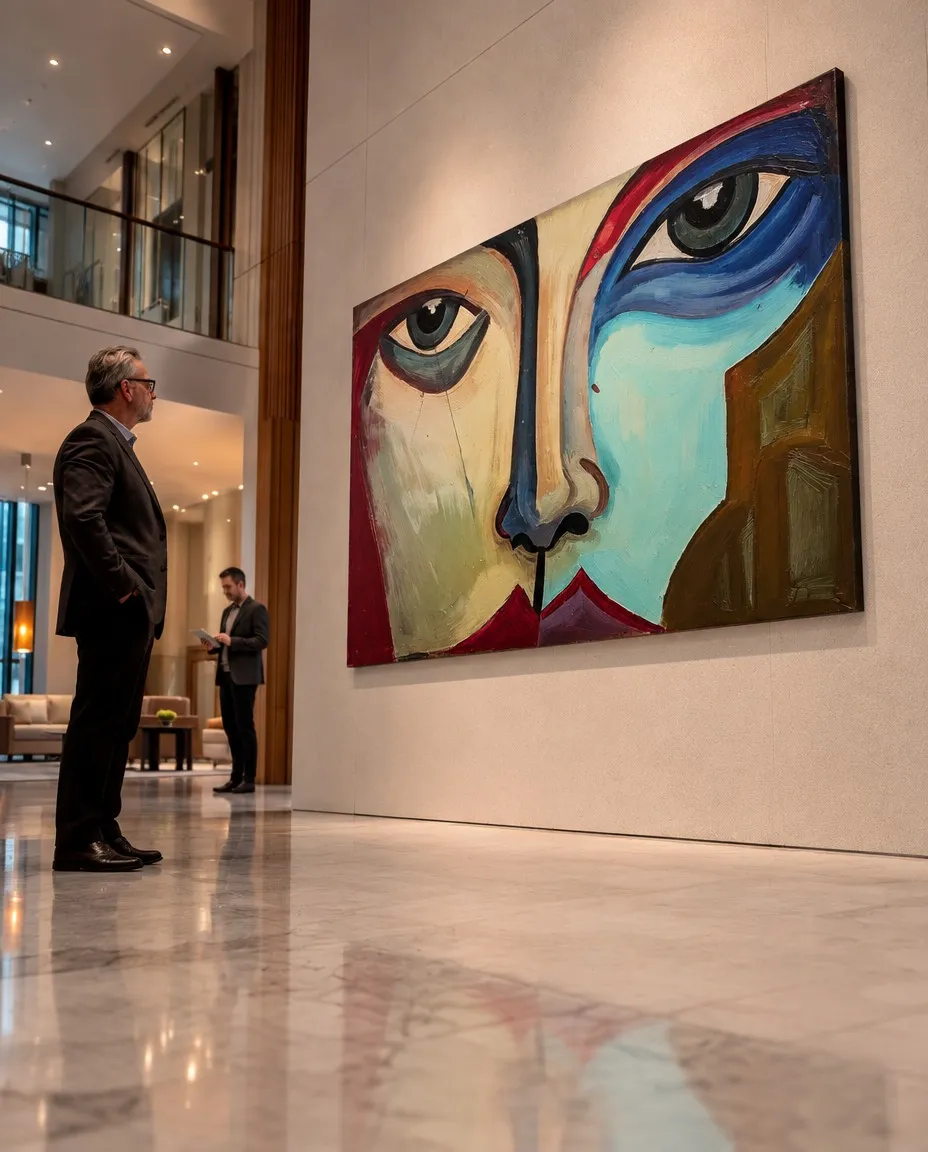
Context study / SIMULACRUM
SIMULACRUM by Maurizio Valch | Monumental Abstract Face
At 210 centimetres wide, this canvas confronts the viewer not as a traditional portrait, but as a vertical architectural structure, a painted wall that returns the gaze. The composition is organised around a symmetrical yet profoundly dissonant division: on the left, a dense, dark carmine block of colour establishes an earthly weight, while on the right a cool, electric turquoise-blue mass predominates, supported below by an ochre and olive area that acts as a brutalist-looking foundation. This formal division evokes the notion of the social mask or persona examined by Carl Gustav Jung, who studied how the individual constructs a protective shield against the outside world at the cost of their own fragmentation. At the same time, the forced coexistence of such discordant chromatic zones on a single support recalls the theories of George Gurdjieff, who described the mechanisation of the contemporary subject as an assembly of separate fragments or selves lacking real unity. The face does not present itself as a unified identity, but as the record of multiple conflicting forces held beneath a single surface.
In applying oil and acrylic to this surface, my technical intention was not to represent a particular psychology, but to construct a material territory in which pigment could acquire the consistency of a crust or relief. I remember the physical resistance of palette knife and brush as I drew the thick black line that vertically divides the nose and mouth; this line functions as a crude seam, a border holding together two incompatible chromatic worlds that would otherwise collapse. The most complex element to resolve was the incision that vertically cuts through the left eye, a linear stroke interrupting the continuity of the plane, which I made with the firm suspicion that the painting had to register the violence of its own constructive process. Working in that area, I repeatedly doubted the density of the impasto, seeking to ensure that the material did not behave in a merely illustrative way, but rather as the support for a formal tension struggling to remain intact at the very point where it threatens to divide completely.
The presence of the mask, whose cultural memory extends from the prosopon of ancient Greek theatre to Etruscan funerary objects, operates on this canvas as a device of visibility that conceals as much as it reveals. This tension between what is shown and what is withheld is connected to the thought of Osho, who examined how structures of social conditioning compel the individual to adopt rigid roles that stifle their original vitality. On the surface of the work, the mask does not appear as a superficial accessory, but as the only physical territory through which the subject manages to become visible to the outside world. The almond-shaped, disproportionate eyes, framed by firm dark lines, do not seek to establish an empathetic dialogue with the viewer; their gaze projects toward an infinite point devoid of coordinates, reversing the dynamic of contemplation by making the viewer the true object examined by the canvas.
I chose this painting’s title as my statement on the simulacrum, accepting the certainty that if we were to remove, by scraping, every layer of oil and acrylic accumulated on the canvas, we would not find behind them a true face, a pure essence, or a revealing secret. The simulacrum is the recognition that beneath the painting there is only more painting, more physical material, more gestural effort, and more layers of technical memory accumulated during the working sessions. The resolute silence emanating from this giant face is directly related to its monumental scale of 210 by 140 centimetres; I conceived these dimensions to force the viewer to step back, to establish a necessary physical distance that prevents a rapid or complacent assimilation of the art object, imposing a relationship of estrangement and respect before the painted material.
The painting’s formal resolution rests on a calculated instability between the soiled warmth of the left sector and the dry coldness of the right. As one approaches the canvas, the illusion of a face dissolves to make way for the reality of the materials: subtle drips of paint running down the canvas, lumpy accumulations of dry acrylic, and textures recalling the eroded surface of a stone exposed to the elements. The work avoids any easy turn toward well-meaning interpretations; there is no reconciliation of opposites here, nor any promise of harmony. Ultimately, the fixed gaze of the simulacrum serves as a reminder that identity is neither a static core nor an immutable essence, but an unstable territory in a constant process of construction, wear, and material erosion across the rough support of the canvas.
- Original artwork
- SIMULACRUM
- Actual dimensions
- 82.7 × 55.1 in / 210 × 140 cm
- Presentation
- Digital contextual visualization
Context references
SIMULACRUM Maurizio Valch · fragmented abstract face painting · large painting with blue and turquoise face · contemporary art with large eyes · abstract mask painting · textured painting with incisions · wall art for contemporary foyer · monumental abstract face painting
About this visualization
This visualization places the artwork within an architectural context to help collectors and viewers imagine its presence in a real space. It is an interpretive reference, not an exact reproduction: the original work remains the sole authority for scale, color, surface and material presence.