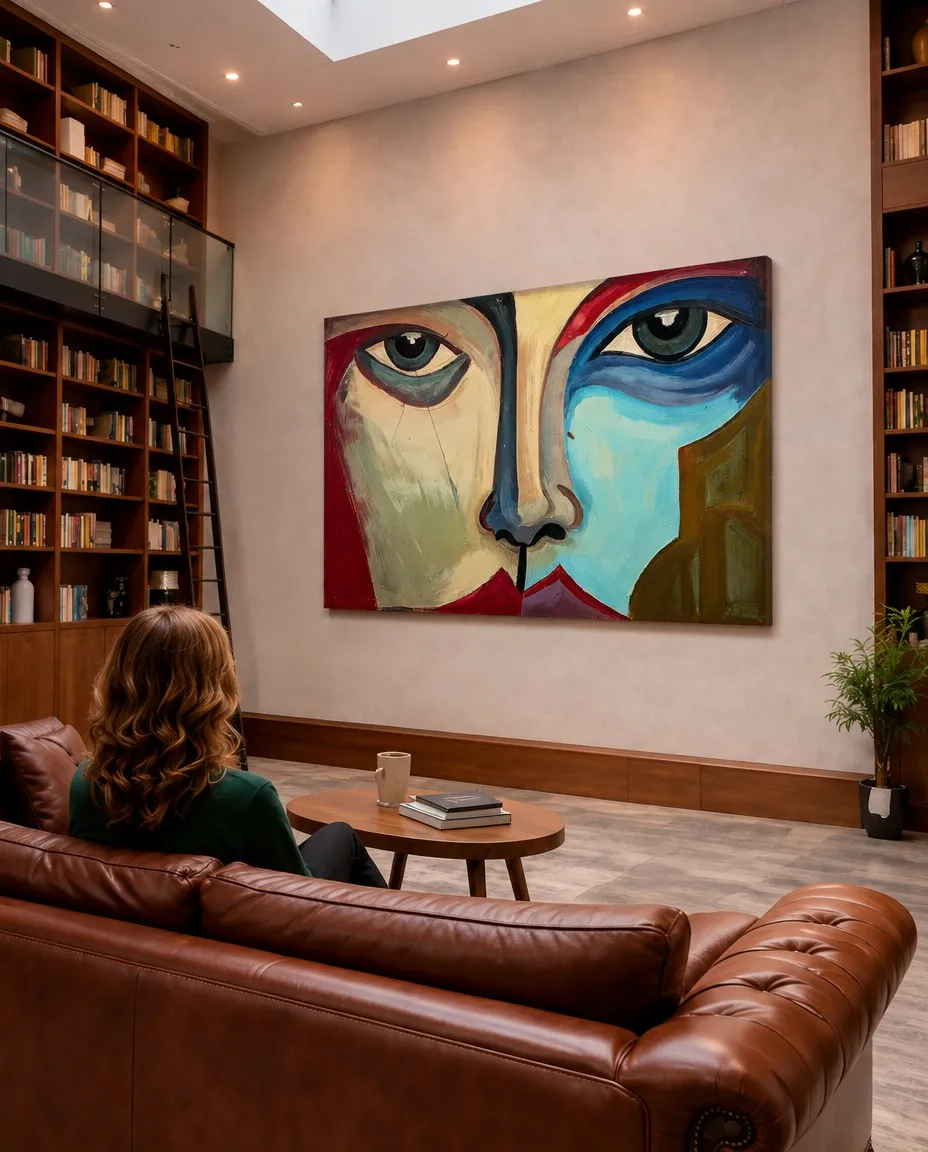
Context study / SIMULACRUM
SIMULACRUM, Abstract Face for a Library | Maurizio Valch
Within Maurizio Valch’s practice, where wasteland and tectonic abstraction often dictate the logic of the support, the emergence of this monumental 210 × 140 centimetre face is an anomaly that unsettles and reconfigures his poetics. Far from functioning as a physiognomic representation or a conventional portrait, “SIMULACRUM” unfolds before the gaze as a landscape fractured by a chromatic and thermal fault line. On the left of the canvas, a dense, almost oppressive heat accumulates, where sombre carmines and earthen ochres evoke an internal combustion of matter; on the right, by contrast, the surface suddenly cools beneath a sequence of steely blues and cutting turquoises. This clash of temperatures seeks neither balance nor chromatic harmony, but establishes a physical pressure within the painting, turning the temperature of colour into a geological force that deforms the features and divides the viewer’s gaze into two irreconcilable hemispheres.
When I pressed the palette knife into the figure’s left cheek, just below the eye socket, I was not trying to make a shadow, but to produce a cut, an incision that would interrupt the illusion of flesh. That pale groove, scraped directly into the accumulation of pigment, is my own gesture of abandonment: the precise moment when I renounced the tyranny of symmetry and the absolute control we usually impose on the canvas. By tearing through that area, I allowed the material to speak for itself, revealing the lower layers as one might strip plaster from an old wall. I do not know for certain whether what remains on this three-centimetre-deep stretcher is the simulacrum of a human face or whether, instead, I have constructed a textured wall that, tired of resisting the erosion of time, has decided to yield to wear and reveal its structural wounds.
The face has no ears, defined temples, or any other soft physiognomy suggesting vulnerable humanity; it is a compact block dominated by oversized almond-shaped eyes that fix themselves on space with mineral steadiness. In the absence of conventional organs of hearing, the work paradoxically establishes a dimension of radical listening. This is not acoustic reception, but a silent, somatic attention that the painting directs towards the room: the painting is not only seen, but seems to register the vibration and stillness of the air surrounding it. The nasal partition, raised like a monolith or a trench of dark lines dividing the canvas vertically, organises this emptiness and channels the silence of the setting, compelling anyone who stands before it to lay aside the noise of their own interpretations and submit to the mute resonance emanating from the canvas.
Working at this scale, more than two metres wide, compels me to confront painting not as a window but as a wall that demands my entire body. As I apply oil paint, with that impasto heat that slows drying and obliges me to work against the time of the material itself, I feel my initial studio intentions being buried under the accumulation of successive layers, just as dust and lime cover the strata of ruins along the Mediterranean coast. In this process of layering and friction, I experience a profound abandonment of my own condition as author; I cease to be the one who governs the painting and become a worker in its sedimentation. In the end, the face emerges from pictorial density not as my idea, but with a physical, independent sovereignty—a presence that holds itself by its own weight above the floor and looks back at me from a plane that no longer belongs to me.
In the resolution of “SIMULACRUM,” the unresolved tension between the dense heat of applied matter and the coldness of the suspended gaze ultimately generates a tactile edge, a boundary where the viewer is confronted without the mediation of psychological drama or narrative. The painting disobeys Valch’s established language of abstraction to embody a simulacrum that is not a copy of anything living, but an emphatic assertion of the surface and its stratified memory. It is here that the viewer’s listening before this face-territory completes the work’s true passage: pausing before this monumental wall of pigments, the external gaze reveals that what seemed a representation is in fact a raw, weighty, enduring presence that continues to vibrate long after silence has completely taken the space.
- Original artwork
- SIMULACRUM
- Actual dimensions
- 82.7 × 55.1 in / 210 × 140 cm
- Presentation
- Digital contextual visualization
Context references
SIMULACRUM Maurizio Valch · art for a home library · large abstract face painting · contemporary painting for living room · abstract face with large eyes · blue and turquoise wall art
About this visualization
This visualization places the artwork within an architectural context to help collectors and viewers imagine its presence in a real space. It is an interpretive reference, not an exact reproduction: the original work remains the sole authority for scale, color, surface and material presence.