Context study / SIMULACRUM
SIMULACRUM in an Industrial Loft | Maurizio Valch
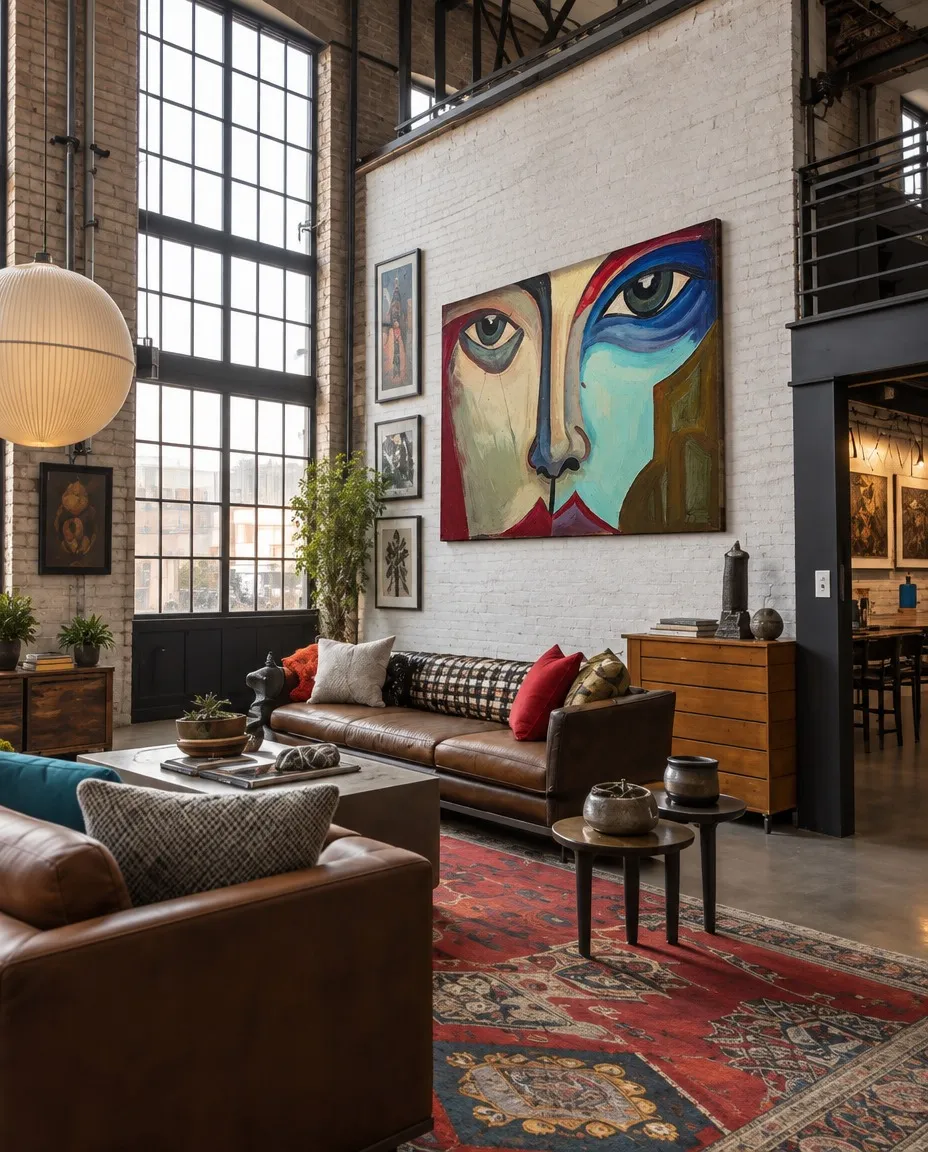
The monumental scale of SIMULACRUM, suspended above the exposed brick wall of this industrial loft, immediately shifts the hierarchy of the domestic space. It does not function as ornament or as a passive backdrop to everyday life; its presence, more than two metres wide, imposes a silent, almost liturgical gravity that reorganises the air around it. The two enormous, disproportionate, asymmetrical eyes, set against the wall’s textured pattern, evoke the structure of a secular apse. Dispensing with halos, crowns, and traditional religious attributes, the painting does not ask us to worship an external divinity, but to pause before the bare mystery of a gaze that precedes and exceeds us, turning the room into a threshold for silent contemplation.
When I worked on this canvas, I was not trying to illustrate a theory of the soul or reproduce the gaze of a saint. I was interested in anatomy as territory, in the possibility that a face might be a landscape that approaches the sacred without resorting to familiar temples. I remember drawing that central dark band, that division descending like an incision which both cuts and supports the two halves of the face: it was not an outline, but a boundary where thought comes to a halt. In painting these eyes, I felt that I was not constructing a subject, but opening two empty thresholds through which matter could look at itself, stripped of my own history and will.
The work’s chromatic organisation carries a tension recalling the enveloping atmospheres of Mark Rothko, where colour ceases to be descriptive and becomes pure emotional presence. Here, however, that atmosphere is embodied in a corporeal, material structure: the left side, in muted greens and weary earth tones, contrasts with the turquoise and marine abyss on the right. The vertical black axis separating these two worlds does not act as a mystical intervention that unifies space, but as a scar that acknowledges the fracture of existence. It is precisely in this unbridgeable division, in the impossibility of reconciling the two gazes, that the work brushes against the sacred: transcendence does not arise from perfect harmony, but from accepting a mystery that logic cannot resolve.
Looking at the painting now outside the walls of my studio, surrounded by natural light entering through tall windows and grazing the oil surface, I notice that the painting no longer belongs to me. The figure who needed to turn every painting into an epic or a display of strength dissolves before this autonomous gaze. It is a strange sensation: the maker withdraws, and only the work remains, a presence requiring somatic attention, a simple fact that rejects my psychological explanations. The canvas stands on its own, like a monolith that has learned to breathe the air of this room without asking permission.
The decisive encounter with SIMULACRUM takes place when the viewer recognises that the painting is not only an object of contemplation, but an active subject. The asymmetry of the eyes destabilises the analytical distance of anyone seeking to decipher a closed symbol; each eyelid seems to operate within a different temporal dimension, compelling us to move our bodies in order to sustain the gaze. The sacred here lies not in a doctrinal revelation, but in the experience of being seen in one’s essence, stripped of the interpretations that bury the real. In the end, before this immense wall, we are not faced with a representation, but with a secular epiphany: a membrane of contact where looking at the work is, ultimately, seeing ourselves look.
- Original artwork
- SIMULACRUM
- Actual dimensions
- 82.7 × 55.1 in / 210 × 140 cm
- Presentation
- Digital contextual visualization
Context references
SIMULACRUM Maurizio Valch · abstract face painting for living room · contemporary art for a brick wall · large painting for loft · industrial decor with colourful art · blue turquoise and red abstract face
About this visualization
This visualization places the artwork within an architectural context to help collectors and viewers imagine its presence in a real space. It is an interpretive reference, not an exact reproduction: the original work remains the sole authority for scale, color, surface and material presence.