Context study / SIMULACRUM
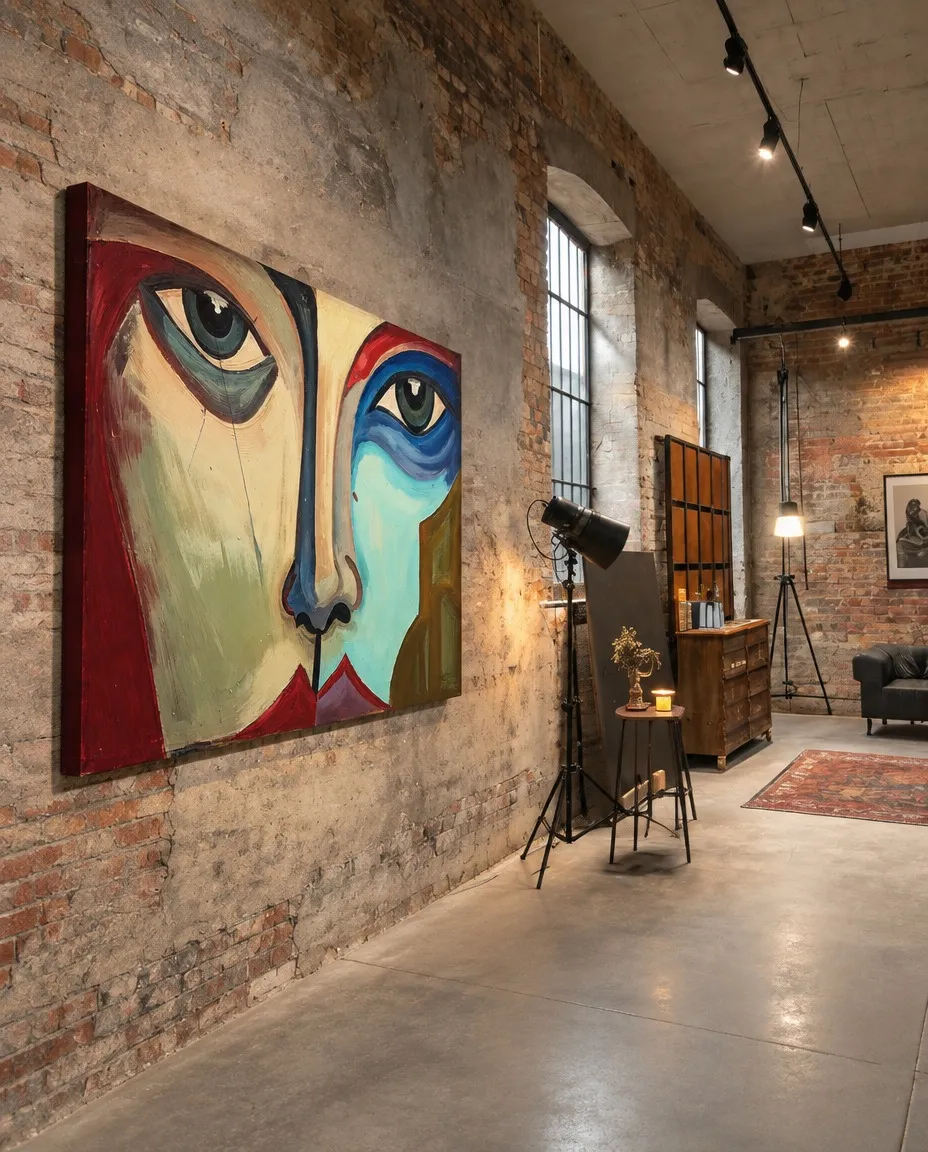
SIMULACRUM, contemporary painting by Maurizio Valch in a loft
Hung above the wounded canvas of the brick wall, SIMULACRUM offers not a story to decipher but an impact sustained in space by its monumental scale. Before the directed light that delineates its surface in this silent industrial atmosphere, the painting asserts itself as a block of pure presence, where the asymmetry of the fractured face neither recounts pain nor describes reconciliation. There is no before or after in these dissociated gazes; emotion condenses in the physical tension of the two halves sharing the same plane without merging. The viewer moving across the concrete floor does not encounter a representation of psychology, but the mute vibration of a state fixed in matter.
When I worked on the dark cut that divides this face, I was not seeking to illustrate an idea of inner fragmentation or justify my own movements from place to place. There is no hidden biography behind the heavy gaze of the left eye or the cool flash of turquoise; the painting proceeds by removing explanations, opening grooves in the pigment to see what remains when the intention to tell falls silent. I felt the need for the surface to behave like rough terrain, a skin registering the pressure of my own hands without needing to translate it into a diagnosis. In the end, painting this central axis was an exercise in restraint: drawing a boundary that stops the flow of thought and compels me to look at the bare fact of painting, free from the noise of my own theories.
The disparity between the two eyes demands an attention from the viewer that relinquishes synthesis. While the left side seems to withdraw into a murky glaze of greens and ochres recalling the patience of earth, the right eye accelerates in a blue curve of sleepless, almost mineral vision. This formal discrepancy evokes Jane Goodall’s warning about the need to observe the other without immediately projecting our frameworks of meaning onto them; the face does not “express” melancholy or threat, but suspends those categories in order to compel us to inhabit difference. The lines do not function here as merely descriptive contours, but act with the autonomous ambition Paul Klee attributed to the sign: they are living forces contesting the surface, mediating a conflict of times and speeds that the viewer assimilates physically before being able to name it.
I am often asked about the brown mass interrupting the right cheek, as though it required a word to return it to the order of the explainable. I could say that it functions as a refuge, a monolith of silence, or a belief that has acquired the weight of stone within the body, but any definition would ultimately suffocate its physical presence. For me, that form is simply a necessary obstruction, a zone where painting ceases to simulate a face and presents itself as a blind volume resisting light. I did not want the work to become a compliant mirror that the viewer could decipher in a second; I placed that block there as a reminder that there are parts of our own experience that refuse narration and become real only when we accept living alongside their impenetrable weight.
Ultimately, the force of this large painted surface lies not in what it reveals, but in the vibration of what it holds back. The split mouth, barely touching the lower edge of the canvas, refuses to utter a message or resolve the abyss between crimson and blue. In this setting of rough textures and elongated shadows, the work acts as a threshold where habitual interpretations of the self founder, giving way to a wordless presence. Emotion is not narrated because it needs no chronology to be real; it remains suspended in the interval separating the two eyes, compelling the viewer to hold their breath before an image that, rather than allowing itself to be possessed, returns the gaze from an absolute silence.
- Original artwork
- SIMULACRUM
- Actual dimensions
- 82.7 × 55.1 in / 210 × 140 cm
- Presentation
- Digital contextual visualization
Context references
contemporary art for industrial loft · large painting for brick wall · abstract face painting for living room · red blue and turquoise wall art · large-scale abstract figurative artwork · SIMULACRUM Maurizio Valch · industrial decor with contemporary painting · fragmented face artwork
About this visualization
This visualization places the artwork within an architectural context to help collectors and viewers imagine its presence in a real space. It is an interpretive reference, not an exact reproduction: the original work remains the sole authority for scale, color, surface and material presence.