Context study / SIMULACRUM
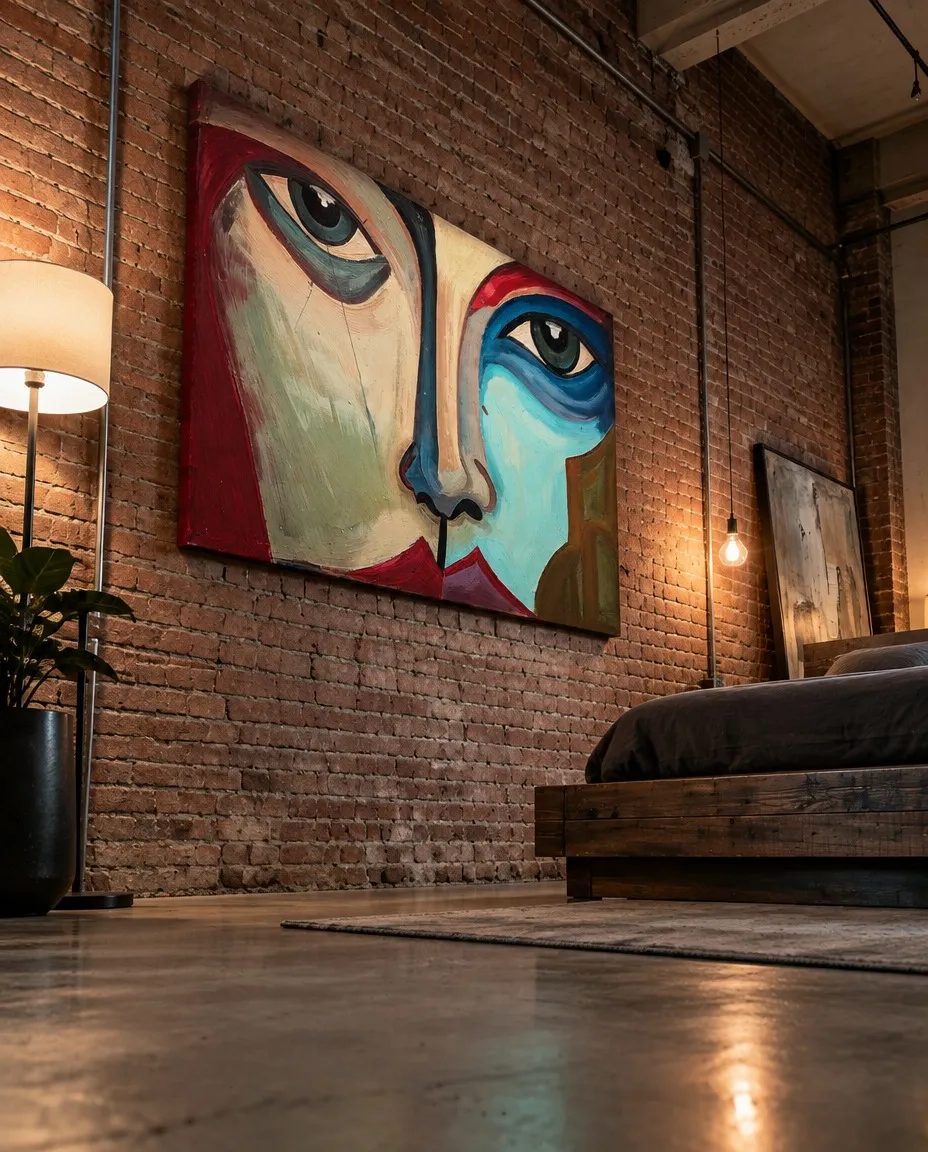
SIMULACRUM, abstract face art for an industrial interior
The imposing scale of SIMULACRUM (210 × 140 cm) establishes a presence that exceeds the format of traditional portraiture to become an almost architectural structure, a painted wall confronting the viewer directly. A vertical fracture divides the composition sharply: the left hemisphere is resolved in muted ochre and olive-green tones, disrupted by a severe linear incision crossing the cheekbone, while the right flank is immersed in dense blues, vibrant turquoises, and an earthy brown block of an almost Brutalist character that absorbs and conceals the line of the jaw. This formal segmentation refers directly to the history of representation and to the memory of the mask in European culture, a thread connecting classical tragedy with the enquiries of Carl Gustav Jung, the celebrated Swiss psychiatrist who defined the “persona” as a mask of collective mediation constructed to protect the individual and negotiate adaptation to the outside world. Thus, this colossal face is caught between the protective function of social armour and the imminent risk of internal suffocation, appearing not as a particular physiognomy but as the material testimony of a psychic splitting.
When I confront this monumental canvas, my work does not consist of illustrating an emotion, but of contending with the physical density of oil and acrylic, dragging matter across the surface to give it a dense, heavy body. The line cutting across the figure’s left cheekbone did not originate as a drawn stroke or a decorative contour; rather, it is a real incision, a wound I cut forcefully into the painted layer to reveal the stratifications of colour beneath the painting’s skin. By carving this cleft, I seek to make the face cease behaving as an anatomical representation and become geological terrain instead: a map of sedimentations and accidents where oil paint dries, cracks, and acquires the hardness of stone, the rigidity of tanned leather, or the roughness of an old tree’s bark.
This material division opens a theoretical fissure where two visions of human consciousness collide. On the one hand, the asymmetrical fragmentation of the face finds a rigorous echo in the thought of George Gurdjieff, the Armenian-born mystic and philosopher who denounced the mechanical nature of ordinary people, describing them as sleeping automatons composed of multiple fragments unaware of one another’s existence; from this perspective, the painting’s divided face acts as an uncompromising mirror of that inner dispersion, in which neither half recognises its counterpart. On the other, the work activates the counterproposal of Osho, the Indian thinker who examined how society’s moral structures repress the individual’s vital energy; through this lens, the crimson frame compressing the edges of the canvas and the intense turquoise impulse of the gaze are not merely aesthetic choices, but the representation of a repressed current of life struggling to overflow the rigidity of the imposed mask and reclaim its right to chaos and original vibration.
My eyes retain the legacy of Mediterranean light, a blinding clarity that does not soften forms but cuts them out with the severity of archaic ruins resisting the wear of centuries. In painting these two large asymmetrical gazes, my intention is not to propose a warm psychological interaction with the viewer, but to suspend the canvas in a distant, mineral time, akin to that of stone colossi contemplating an empty horizon. I have forced asymmetry into every line and into the disparity of the pupils to strain any claim to geometric order or classical harmony; in my palette, colour does not seek to move, but to act as a hard boundary, a frontier of dense pigment defining an impassable territory and raising an absolute wall of silence between the painting and the room.
Returning to the pure surface of the canvas, one finds that the work’s eyes, charged with a stony, watchful fixity, return the viewer’s gaze with an implacable gravity that avoids all complacency. The visual journey across the painting’s texture compels us to ask about the nature of the identity staged here: could the core of individuation, that “Self” sought in the analytic process, reside not in either hemisphere of the face but precisely in the dark seam that divides them, or perhaps in the silent vulnerability of the incision crossing the cheek? By refusing a harmonious resolution of these conflicting forces, Valch’s painting remains before us as an indecipherable threshold, a space of friction in which the density of matter and the weight of cultural memory remain suspended without offering definitive answers.
- Original artwork
- SIMULACRUM
- Actual dimensions
- 82.7 × 55.1 in / 210 × 140 cm
- Presentation
- Digital contextual visualization
Context references
abstract face painting for bedroom · wall art for industrial loft · contemporary painting for brick wall · large abstract face artwork · industrial decor with contemporary art · SIMULACRUM Maurizio Valch · red and turquoise painting for interior · large-scale abstract figurative art
About this visualization
This visualization places the artwork within an architectural context to help collectors and viewers imagine its presence in a real space. It is an interpretive reference, not an exact reproduction: the original work remains the sole authority for scale, color, surface and material presence.