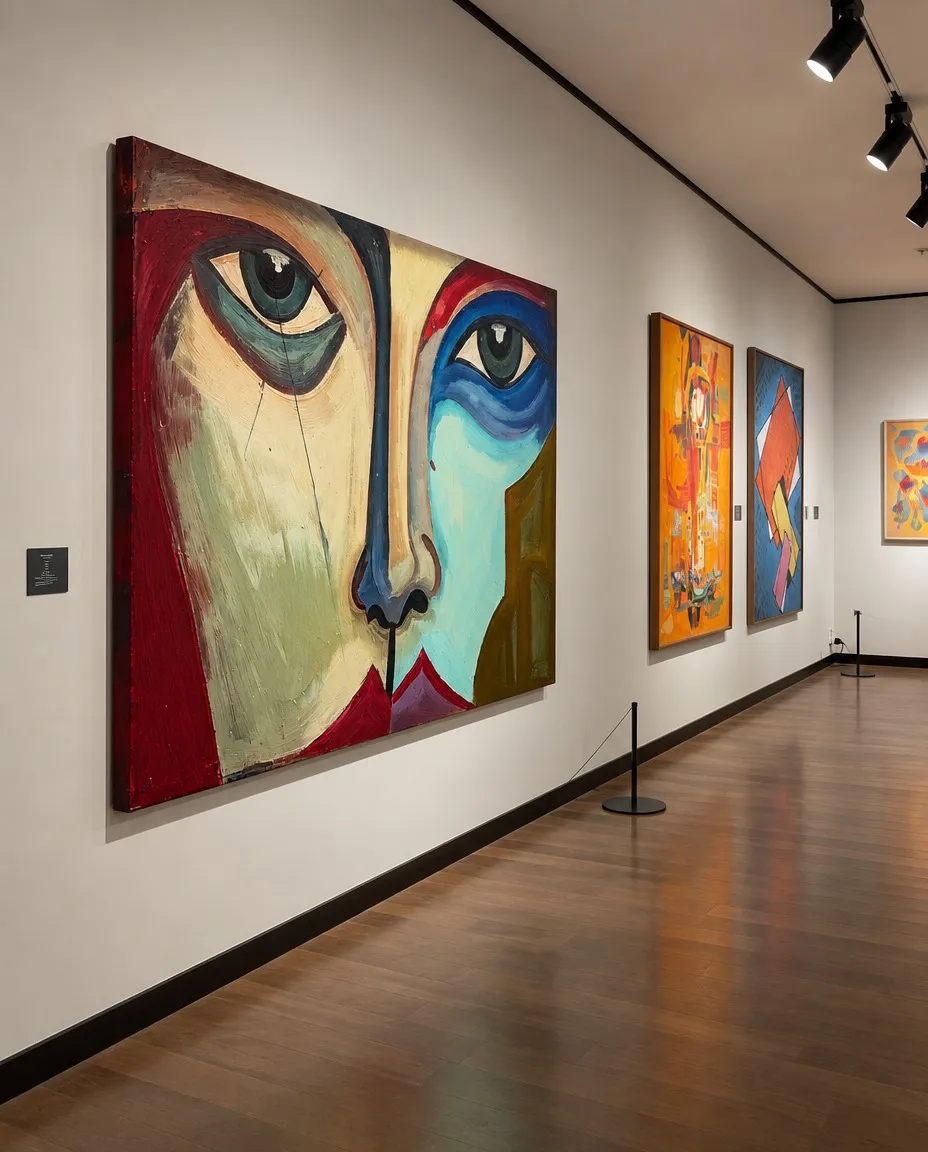
Context study / SIMULACRUM
SIMULACRUM, fragmented face painting by Maurizio Valch
As one approaches the 210-centimetre width of SIMULACRUM, the monumental scale of the painting asserts itself not as an amplification of identity, but as a purely territorial unfolding. Within Maurizio Valch’s abstraction, this divided face eludes the conventions of traditional portraiture to take shape as a geological map in which sedimented oil paint simulates earthly strata under constant tension. Two asymmetrical eyes, stripped of soft orbital contours and fixed in an impassive gaze, look out from a mineral stillness that dispenses with empathy. This absolute exposure conveys a profound sense of helplessness: without a body to support it, a neck or shoulders to anchor it in recognisable anatomy, the face remains suspended and defenceless before the viewer, like an exiled presence. This vulnerability is brutally materialised in the left cheek, where a clean, slender diagonal incision runs across the surface; it is not an ornamental drawn line, but a physical scar that wounds the chromatic paste, a groove made with force that interrupts the flatness of the earth tones and reveals the underlying support.
Entering the studio and confronting such a surface means assuming the role of a surveyor marking out hostile terrain, or of a stonecutter seeking to wrench a monolith from the inertia of matter. As I applied the palette knife loaded with dense oil paint, I conceived the central partition of the nose not as a simple physiognomic line but as a tectonic boundary, a physical limit where two plates of matter collide and come to a halt. My search in SIMULACRUM does not pursue an incorporeal eternity, but the emphatic endurance of the surface: a material resistance achieved through the stubborn accumulation of cream, ochre and crimson layers. I wanted the time of making to remain trapped and sedimented in these compact impastos, each scraping to reveal the persistence of the preceding colour, and the painted mass to refuse erasure by daylight, presenting itself as an eroded yet firm rock that survives its own formation in the studio.
Chromatic and compositional analysis reveals an irreconcilable fracture between the two hemispheres of the face, which obey opposing physical logics. While the left side sinks into earthy density, opaque glazes, and the oppressive enclosure of a dense crimson that seems to contain an ancient heat, the right side opens violently onto a turquoise and cyan plane free of soft transitions. It is precisely in this disruption that wonder emerges, understood here not as complacent amazement but as an unforeseen luminous collision that fractures the heaviness of the earth tones. This block of cold colour destabilises the face’s symmetry and neutralises the composition’s gravity, compelling the eye to experience a physical tension between the leaden descent of crimson and the ascent of blue. The wonder of cyan coexists on the same plane with the helplessness of a gaze stripped of eyelids, assailed by a light that does not warm but exposes the nakedness of its own painterly structure.
When I stand before the stretcher in the half-light of my workspace, I am overcome by the suspicion that I have brought forth an untamed simulacrum that no longer belongs to me. Those oversized eyes stare back with a fixity that nullifies my authorship, posing the irresolvable question of whether I have shaped a face that remembers or simply erected a stone mask that feigns memory through the accidents of scraping and palette-knife work. In the process of dragging the tool and scraping wet pigment, there is a breaking point at which the viscosity of oil paint takes control of the canvas. At that instant, the wonder of glimmering colour and the helplessness of matter exposed to its own gravity merge definitively; painting ceases to be my representation and becomes an autonomous body that breathes through its scars, a simulacrum so physical and self-sufficient that it expels me from its own territorial logic.
Placed within the restrained lines of exhibition architecture, SIMULACRUM becomes a tactile edge where real space and the pictorial plane enter into direct friction. The work does not decorate the silent wall; it interrupts and questions it, establishing a field of physical pressure with the visitor’s body as it moves before it. The violent coexistence of the helplessness of its dismembered gaze, the endurance of its accumulated oil layers like a geological monolith, and the wonder of that suspended blue block that breaks the gravity of the whole prevents the image from being quickly assimilated as an object of visual consumption. By resisting immediate reading, this simulacrum of a face operates as a threshold that arrests the flow of everyday time, compelling us to inhabit the dense, silent materiality of a painting that refuses to dissolve into another’s gaze.
- Original artwork
- SIMULACRUM
- Actual dimensions
- 82.7 × 55.1 in / 210 × 140 cm
- Presentation
- Digital contextual visualization
Context references
SIMULACRUM Maurizio Valch FACIES · contemporary abstract face painting · asymmetrical face painting · fragmented face art · turquoise blue and ochre painting · large-scale gallery artwork · contemporary figurative art · contemporary painting with eyes
About this visualization
This visualization places the artwork within an architectural context to help collectors and viewers imagine its presence in a real space. It is an interpretive reference, not an exact reproduction: the original work remains the sole authority for scale, color, surface and material presence.