Context study / SIMULACRUM
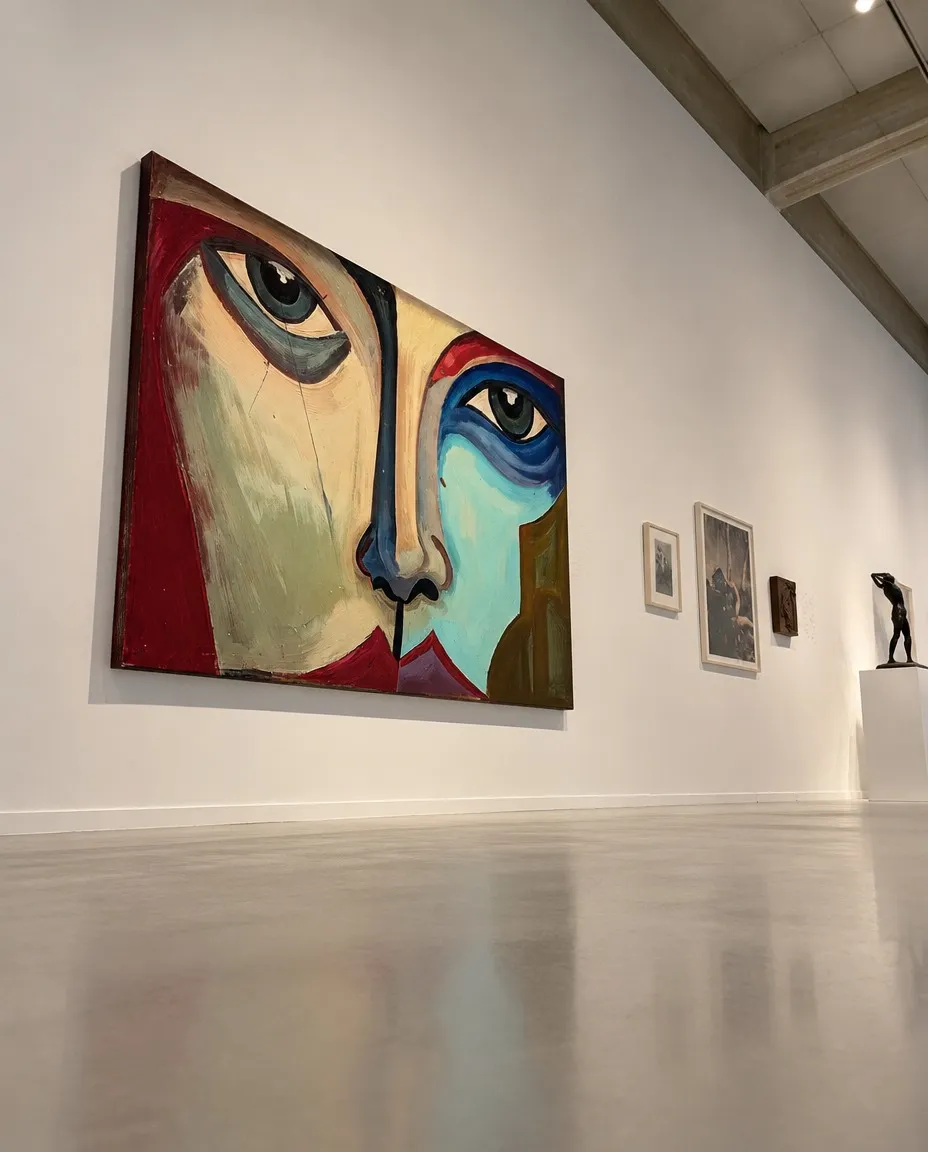
SIMULACRUM, abstract face by Maurizio Valch in a gallery
Hung within the vastness of the gallery, beneath an industrial ceiling that underscores its monumental scale, SIMULACRUM creates an immediate physical confrontation. The dimensions of the canvas require the viewer to stop and recalibrate their distance, but it is the brutal division of the face that arrests their movement. There is no chronicle of events here, no map of dates or names from which a personal chronology might be reconstructed; the artist’s biography has withdrawn into the very structure of the image. The broad dark band descending along the central axis and dividing the composition into two chromatic and temporal hemispheres functions as the silent record of an existence lived on a threshold, in the continual passage where the self fragments in order to survive. Life appears stripped of anecdote, transformed into pure material pressure, into a geography in which painting has had to choose between the resistance of earth and the speed of air.
When I hold a brush before a surface of this size, I know that I am not interested in illustrating the paths I have travelled on foot, the temporary rooms I have occupied, or the precariousness of nights spent outdoors. All that external noise, which thought hastens to arrange into a heroic feat of survival, dissolves in the studio, leaving only its sediment. The vertical cut that divides this face is not an illustrative decision; it is the very fracture I feel each morning when trying to reconcile the desire for stillness with the inertia of travel. I paint because I need to give form to that internal collision, allowing the dense, weathered red on the left to coexist with the haste of turquoise on the right, without the urgency to heal the wound that separates them.
This refusal to narrate is precisely what brings the work close to Paul Klee’s tradition of the living sign, where the line does not delimit a closed contour but mediates the conflict between opposing forces. The brown mass interrupting the right cheek of SIMULACRUM does not symbolise a trauma or a specific religious belief; it is a volumetric, hermetic presence that occupies space, behaving like those rigid convictions we accumulate over the years and that eventually condition our gaze. By relinquishing the representation of a recognisable story, the painting becomes a non-narrative autobiography. The surface, eroded by glazes and scrapings, becomes a skin that remembers somatically: it retains the trace of pressure and time without needing to explain which physical event produced the mark.
I have learned to distrust the ordered theories I devise to explain myself, that almost automatic tendency to turn my existence into a coherent and exemplary story. This face is my most honest self-portrait because it accepts my own dispersion, the impossibility of unifying my systems of thought beneath a single healthy, controlled self. The left eye, with its heavy eyelid and ochre tones, observes from a melancholy stillness that seeks to persuade no one, while the blue of the right eye seems too awake, exposed to the constant friction of its surroundings. No reconciliation is possible between these two ways of attending to the world; my work is simply to sustain the gaze between them, to accept that the beauty of falling requires no intellectual justification.
On the gallery’s polished concrete floor, the colours of the work seem to cast a mental shadow around the viewer. SIMULACRUM offers no intimate diary to decipher, but a spatial structure in which the monumentality of the format and the scale of the split eyes compel the viewer to stand within the void of division. In the end, the work functions like the silence that arrives when the mind understands its own noise: emptied of narrative, it opens a space of pure resonance. The artist’s biography is completed not when we discover the facts of his life, but when we accept that our own identity is made of these same silent strata, of these constructions that sustain and divide us at once, awaiting contemplation without the burden of interpretation.
- Original artwork
- SIMULACRUM
- Actual dimensions
- 82.7 × 55.1 in / 210 × 140 cm
- Presentation
- Digital contextual visualization
Context references
SIMULACRUM Maurizio Valch · contemporary abstract face · fragmented face painting · contemporary art with large eyes · red and turquoise abstract painting · large-scale artwork for gallery · contemporary facial painting · wall art for exhibition space
About this visualization
This visualization places the artwork within an architectural context to help collectors and viewers imagine its presence in a real space. It is an interpretive reference, not an exact reproduction: the original work remains the sole authority for scale, color, surface and material presence.