Context study / SIMULACRUM
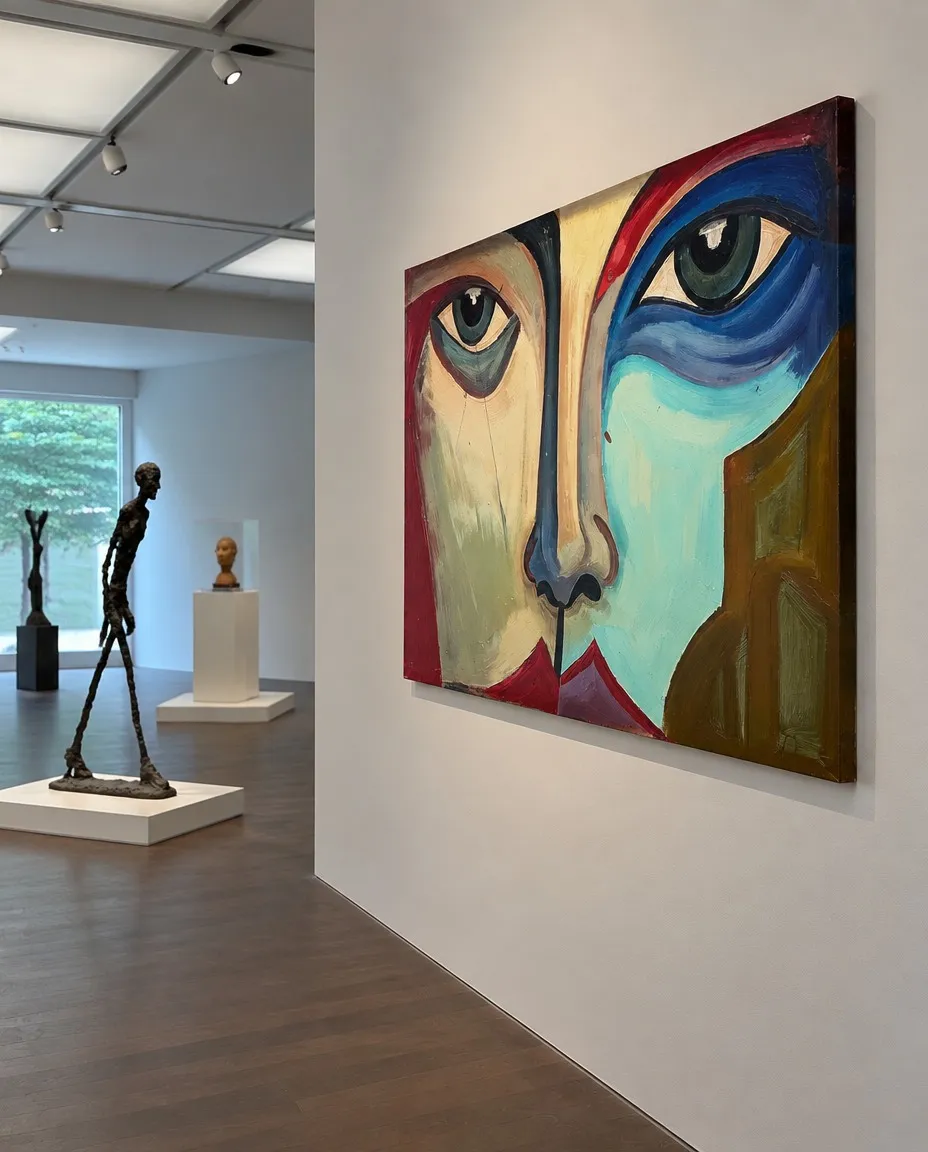
SIMULACRUM in a contemporary exhibition space
To hold one’s gaze before the 210 × 140 centimetres of "SIMULACRUM" is to submit to the gravity of a face-wall that abandons anthropomorphic scale to rise as an almost architectural structure. Maurizio Valch does not offer a portrait, but an impassable threshold where the painted surface is organised through a drastic visual polarity. The canvas is split by a vertical limit descending like a tectonic fault, dividing the composition into two distinct chromatic fields: on the left, an atmosphere of ochres, greenish tones, and warm earth colours; on the right, the violent emergence of Prussian blue and vibrant turquoise, colliding at its base with a volumetric, opaque block of brutalist brown. This extreme asymmetry, crowned by two enormous eyes of hypnotic fixity, evokes the theories of Carl Gustav Jung, the Swiss psychiatrist who mapped the deep structures of the collective unconscious and the constitutive duality of the self. The viewer is compelled to ask whether this monumental façade operates as the Jungian Persona—that socially constructed mask for interacting with the external world—or whether we are before a Simulacrum in which the archetype of the Double has acquired a geological and threatening density.
When I confront the blank support with acrylic and oil, my intention is not to illustrate a psychology or narrate an inner biography, but to treat the face as a physical territory, a cartography consolidated through stratified surfaces of matter. I do not seek the refinement of anatomical detail; I am interested in the resistance of colour on canvas and in how the boundaries between chromatic blocks create their own tectonic tension. The vertical black line dividing the face was not conceived as a descriptive drawn stroke, but as a mineral boundary separating two states of painted matter. Likewise, the diagonal incision wounding the left cheek is a gesture of real penetration into the superimposed layers of paint, a physical groove that interrupts the continuity of the plane to reveal the accumulated substrate beneath. For me, painting is a brutalist process of construction in which every block of colour must sustain itself under its own weight.
The formal fracture of "SIMULACRUM" shifts the debate from pure matter toward a searching existential inquiry into the fragmentation of the modern subject. The disconnection between the two hemispheres of the face resonates with the thought of George Gurdjieff, the mystical teacher who denounced the automatism of human existence and the chaotic multiplicity of disconnected little “I”s inhabiting a single sleeping individual. This tension also enters into dialogue with the provocations of Osho, the Eastern philosopher who urged us to seek the original face that existed before one’s parents were born, shedding external conditioning. The work’s disproportionate, asymmetrical eyes embody this friction: while one seems directed toward the mechanical observation of its surroundings, the other sinks into abyssal introspection. The central crack and the crimson triangular forms of the divided lips do not represent a tragic mutilation, but the necessary fissure through which the simulacrum of automated identity begins to break apart, allowing a glimpse of the possibility of self-recognition.
As I conceive this simulacrum in the space of my studio, I am constantly assailed by the doubt of whether I am recovering an archaic mask that has emerged directly from the ground, or whether I have fixed the effigy of a living being watching us from the future. The origin of my palette is not accidental; it resonates with the latent memory of my earlier Mediterranean landscapes, where the extreme warmth of sun-beaten earth collided directly with the abyssal, unfathomable blue of the sea. In this series, that whole vast experience of horizon and external territory has been concentrated, compressed beneath the pressure of a monumental human presence. I do not intend for the viewer to find a reassuring answer in these chromatic fields, but to experience the same uncertainty I feel when applying the palette knife: the suspicion that identity is not an immutable essence, but a sedimented surface, constantly built and destroyed.
Before the physical immanence of "SIMULACRUM," the experience of holding one’s gaze does not resolve into a harmonious synthesis or a metaphysical healing of the divided subject. Maurizio Valch’s painting rejects categorical closure; the canvas remains a system of forces in continual friction, where the material execution’s minimalist brutalism joins with the indecipherable enigma of subjectivity. In the end, the colossal face-wall operates as an opaque mirror, returning the observer’s own fragmented gaze. Far from offering a conceptual refuge, the work places us on the threshold of suspicion itself, reminding us that behind the mask of colour and the incision in matter there is no final truth waiting for us, but the unsettling certainty of our own multiplicity.
- Original artwork
- SIMULACRUM
- Actual dimensions
- 82.7 × 55.1 in / 210 × 140 cm
- Presentation
- Digital contextual visualization
Context references
large painting in an art gallery · horizontal artwork in an exhibition space · contemporary art on a white wall · abstract face painting in a gallery · large-scale artwork viewed from the side · painting mockup in a contemporary museum
About this visualization
This visualization places the artwork within an architectural context to help collectors and viewers imagine its presence in a real space. It is an interpretive reference, not an exact reproduction: the original work remains the sole authority for scale, color, surface and material presence.