Context study / SIMULACRUM
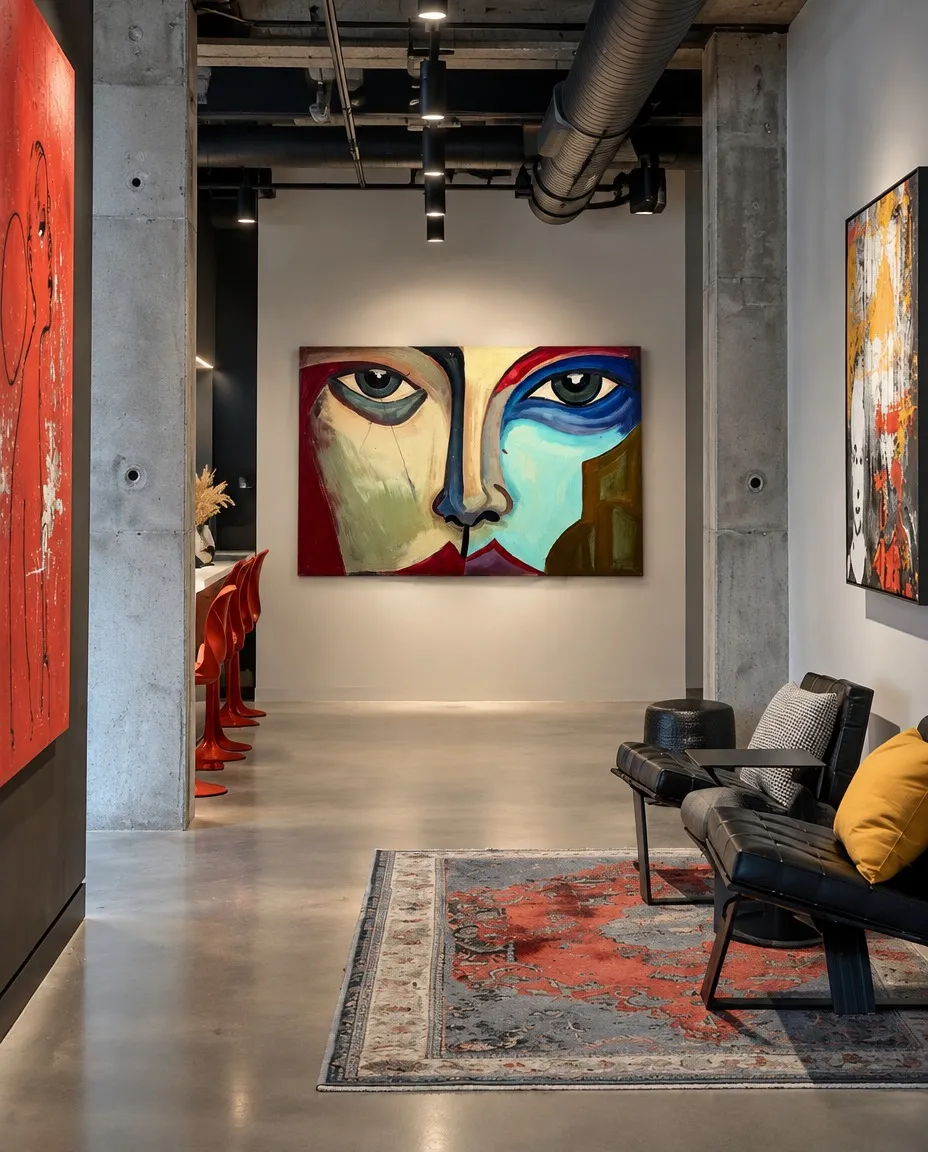
SIMULACRUM in a contemporary industrial interior
A frontal encounter with SIMULACRUM, Maurizio Valch’s imposing 210 × 140 cm work, immediately cancels any attempt at a purely psychological or portrait-based reading, compelling the viewer to stand before a physical and chromatic geography under tension. This is not a face seeking to reveal a soul, but a territory in which features behave like tectonic folds and material accidents. The notion of belonging emerges here with force through an unbridgeable chromatic and structural division: the left side of the canvas, dominated by ochres, earthy yellows, and warm tones, is crossed by a fine vertical incision that tears the surface; the right side, by contrast, sinks into the coolness of deep blues and turquoise, rigidly bounded by a dark block that acts as containment. This extreme duality raises the question of what space, or what shore, this colossal gaze that interrogates us truly belongs to. In this work, belonging is not offered as the refuge of a stable or peaceful identity, but as a permanently cracked boundary, a space of friction in which the warmth of earth and the abyss of cold water are forced to coexist within the limits of one frame.
When I confront the canvas in the solitude of the studio, my purpose has never been to depict an agreeable face, but to construct a presence that resists its own weight through superimposed layers of acrylic and oil, transforming paint into a rough skin that has endured the rigours of the palette knife and the passage of time. For me, protection does not mean raising a sealed, impenetrable shield that conceals what lies behind it, but the honesty of a vulnerability laid fully bare. The vertical incision deliberately cutting through the painting’s left eye is not an act of destructive vandalism, but a necessary fissure demonstrating that behind the vibrant mask of colour there is not an absolute void, but a noble, physical support capable of withstanding the wound. By scraping, building up impasto, and accumulating material again, I seek to reveal that true protection lies in the support’s capacity to bear damage, allowing the exposure of the creative process to be inscribed directly on the painted surface as a record of its own survival.
Despite the formal fragmentation that defines the composition, in which the nose is reduced to a forceful dividing black line and the lips are simplified into geometric wedges of dense crimson, the work finds its centre of gravity in the symmetry and depth of its two dark pupils. These monumental eyes act as perceptual anchors, requiring the viewer to undertake an unavoidable exercise in reciprocal trust: standing before them, we cease to be merely passive observers and become subjects rigorously observed by the painting. The trust proposed by SIMULACRUM does not arise from formal familiarity or representational comfort, but from the conscious acceptance of anomaly. It is precisely that subtle cut, scoring the canvas and interrupting the gaze, that breaks the illusion of perfect symmetry; in accepting this material accident as a constitutive truth of the image, the viewer relinquishes the claim to control and enters into an honest relation with a presence that appears incomplete, yet emphatically real.
For years, in series such as STRATA and PRIMORDIUM, my obsession centred on mapping territory in abstract terms, accumulating horizons, sediments, and incisions that spoke of the earth as an impersonal plane of pure matter. In SIMULACRUM, however, that same territory has decided to stand up, condensing the vastness of landscape into the scale of a body and transmuting the plain into a direct gaze. This formal shift has entirely redefined what I understand by belonging and trust: it is no longer a matter of inhabiting or measuring a geographical distance, but of sustaining a silent pulse before a viewer in real space. Sculpting these colossal eyes through subtraction, removing wet oil paint with the palette knife to recover the light beneath, has been a physically demanding process—a way of compelling the viewer’s body to respond not to a mental idea, but to the imminence of matter that breathes and demands to be recognised in its corporeal dimension.
Ultimately, SIMULACRUM stands as a tactile shore, a critical threshold at which the protective distance between viewer and work definitively collapses. Far from functioning as a simulation or visual falsehood, Valch’s simulacrum asserts itself in the undeniable truth of its weight, in the physical tension of its three-centimetre-deep stretcher, and in the raw contrast between crimson and blue. Here, belonging, protection, and trust leave behind their condition as abstract concepts or moral judgements to operate as purely physical and plastic forces. Through the incised scar tearing through the colossus’s gaze, the painting reminds us that no living territory—whether canvas, body, or shared space—can truly be inhabited or understood without first accepting its own vulnerability and the unavoidable possibility of being wounded.
- Original artwork
- SIMULACRUM
- Actual dimensions
- 82.7 × 55.1 in / 210 × 140 cm
- Presentation
- Digital contextual visualization
Context references
large painting in an industrial living room · wall art for an exposed-concrete interior · horizontal artwork in contemporary decor · abstract painting in an industrial interior · large artwork above a wall · painting mockup in a modern living room
About this visualization
This visualization places the artwork within an architectural context to help collectors and viewers imagine its presence in a real space. It is an interpretive reference, not an exact reproduction: the original work remains the sole authority for scale, color, surface and material presence.