Context study / SIGNUM
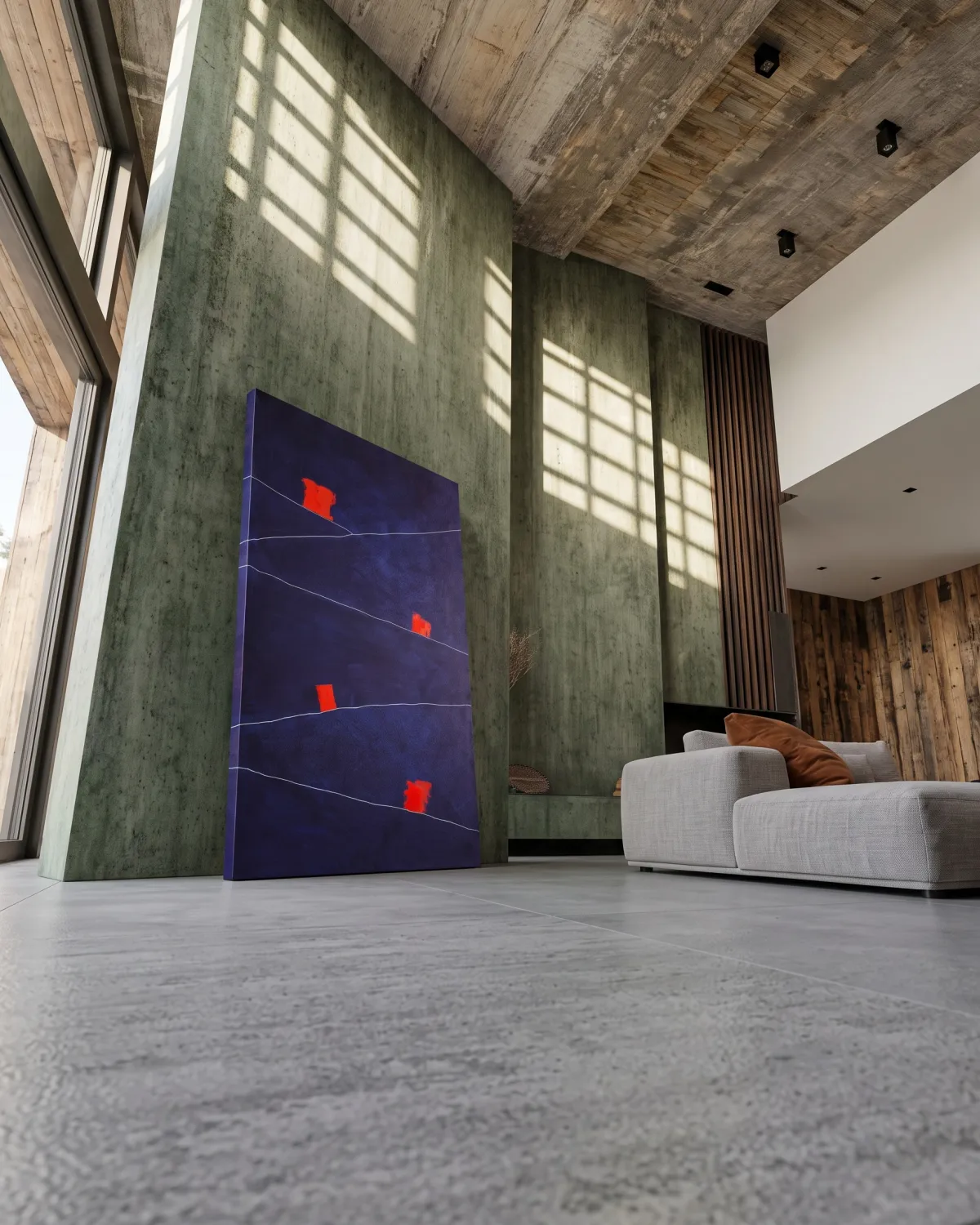
SIGNUM Abstract Painting by Maurizio Valch in Concrete Living Room
An abyss of indigo and ultramarine blue unfolds with the heavy density of a geological night, interrupted by the silent violence of four white incisions that traverse the canvas obliquely. These lines, far from being mere compositional divisions, function as the first boundaries imposed upon an indomitable void; they represent the foundational gesture of a cartography that seeks to measure and tame a chaotic and boundless territory. Upon these precarious chalk ledges rest four blocks of dense and saturated crimson red, arranged like outposts, traffic signals, or the first human settlements clinging to a slope that constantly threatens to crumble. We are not facing a sterile abstraction, but the physical record of a struggle between the formless immensity of space and the obstinate will to leave a vestige, a signum that orders the descent.
When I face the stretcher, I do not seek to represent a landscape, but to embody the raw tension of the geography that inhabits me. The blue is not a flat color, but a mass accumulated by layers of oil and acrylic, a vertical ocean that demands a physical response before its immensity devours me completely. I felt the urgency to mark that space, to scrape the plane to bring forth the white of the canvas that lay buried beneath; that wounded line is not an amiable drawing, but a scar inflicted on the surface to force a direction where only drift existed. By tearing the paint, I force the viewer—and myself—to recognize a boundary, a rudimentary coordinate that stops the inertia of the blue and establishes a minimal possibility of gravity, a ledge where the eye can, at least for an instant, rest from the abyss.
This ordering of chaos arouses tensions that transcend mere plastic formalism and plunge us into a deep dispute over consciousness. From the perspective of Carl Gustav Jung, the pioneer of analytical psychology who explored the tensions between psychic order and unconscious chaos, these dividing lines and their blocks could be interpreted as the emergence of an archetype of Order, a linear mandala designed to save the psyche from dissolving into the abyss of the collective unconscious represented by the blue. However, this apparent will to ascend cracks under the gaze of G. I. Gurdjieff, the mystic who denounced the automatism of human existence, who would see in these white guidelines a closed circuit, an invisible railway track that condemns the red blocks to a purely mechanical and asleep displacement, where the illusion of climbing the slope conceals a systematic paralysis. To this tension is added the warning of the thinker Osho, proponent of a philosophy of vitality and individual liberation, who would point out the fundamental contradiction of this burning red, symbol of blood, fire, and the celebration of life, which has been constrained and domesticated into such rigid quadrangular forms; the vital impulse is forced to balance on the tightrope of the social norm, losing its wild vibration to become a mere boundary marker.
By applying the crimson with the spatula, I seek precisely for that apparent geometric rigidity to fracture up close. I do not aim for the mathematical accuracy of a blueprint; the density of the impasto reveals the trembling pressure of my hand, the frayed edges that bite into the blue and resist the discipline imposed by the white line. Each of these four red blocks is a precarious presence learning to sustain itself on a hostile terrain, a dense body that carries its own imperfections and seems to slide or hold fast depending on the angle from which it is viewed. Working with oil over wet acrylic, I accept the risk of sliding, the possibility of the matter giving way and falling; it is in that vulnerability of the edge, where the crimson subtly blends with the dark background, where the true memory of the physical process resides, the evidence that all order is an unstable equilibrium sustained with difficulty over the void.
Devoid of a frame and resting directly on the grey floor, the canvas relinquishes the illusion of being a window to another dimension to assert itself as a real physical presence sharing our gravity. Resting at the height of our footsteps, the immensity of the blue and the precariedad of the white lines no longer belong to a contemplative plane, but to the very surface we step on, transforming the painting into an object-territory. This physical proximity to the texture of the concrete floor intensifies the tension of the signum: the canvas becomes a mirror of our own march, where we too are those red blocks seeking a foothold on the slope of existence. In this direct confrontation, stripped of adornment, the painting forces us to hold our gaze against the abyss, reminding us that the act of measuring and inhabiting the world is, above all, a silent insistence before the imminence of the fall.
- Original artwork
- SIGNUM
- Actual dimensions
- 31.5 × 47.2 in / 80 × 120 cm
- Presentation
- Digital contextual visualization
Context references
blue and red painting large living room · brutalist abstract painting · modern concrete living room decor · large format abstract art · maurizio valch signum
About this visualization
This visualization places the artwork within an architectural context to help collectors and viewers imagine its presence in a real space. It is an interpretive reference, not an exact reproduction: the original work remains the sole authority for scale, color, surface and material presence.