Context study / QUIES
QUIES — Maurizio Valch | Abstract Painting from STRATA
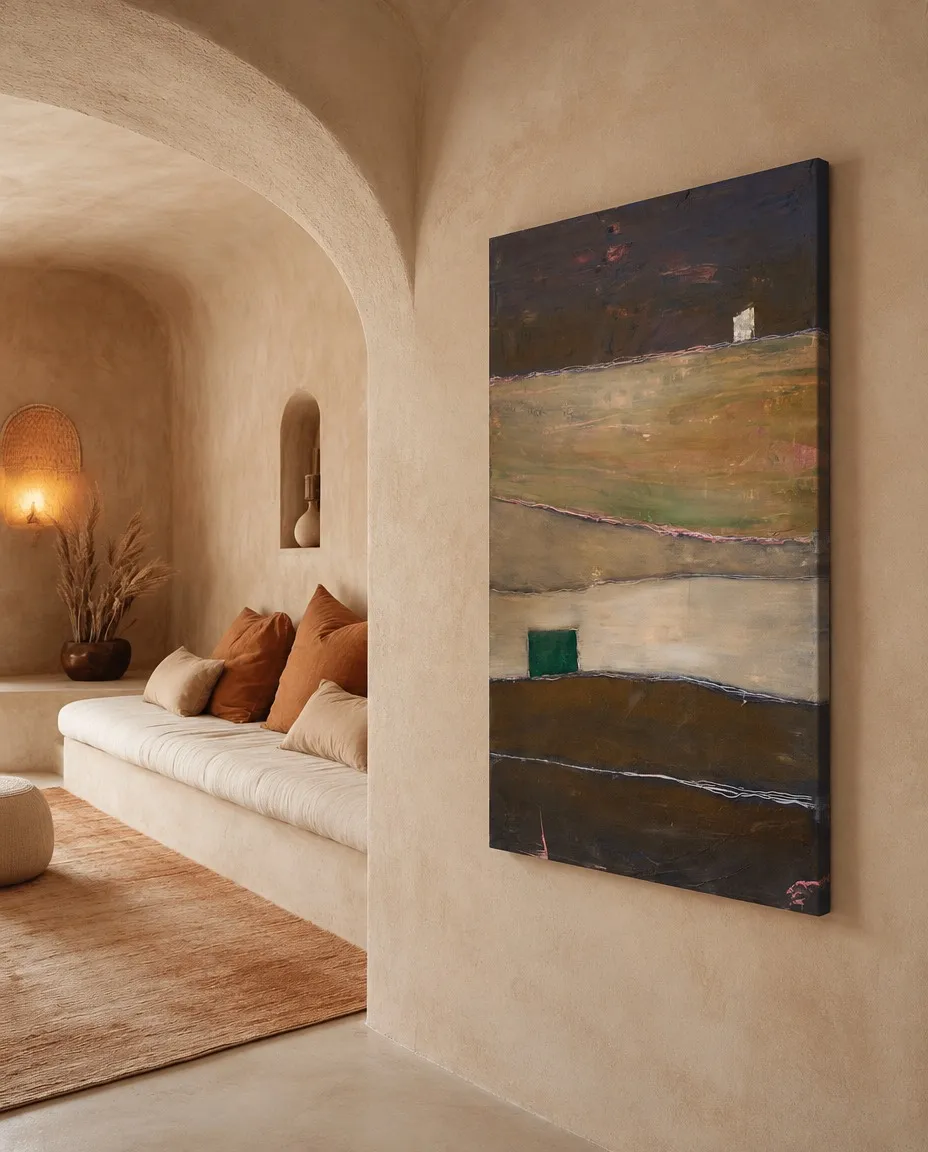
The painting arranges itself before the eye as a stillness crossed by slight shifts. Above, a dark, dense, thick area seems to have absorbed the light, leaving only earthy and reddish reflections beneath its surface; below, fields of muted greens, ochres, veiled pinks, and earth tones extend without fully settling into a single depth. A pale band interrupts this accumulation and opens an uncertain space to breathe, while the lower masses recover darkness with a drier gravity, closer to the ground. Between the bands, open, clear, irregular edges emerge, at times almost nervous: they do not describe the fields, but seem to have wounded or physically separated them, as though the material had been scraped, incised, or left exposed at the precise point of contact. The small white rectangle, suspended to the right in the upper area, and the green form, lower down and to the left, introduce two presences that resist being reduced to a common scale. Here, QUIES does not name a definitive peace, but a suspension: the moment when something has ceased to move without yet coming to rest. Everything seems motionless, yet each layer contains a pressure, a delay, a possibility of sliding over the next.
I work with the bands without seeking to turn them into a recognisable sky, ground, or distance. I am interested in the way a dark band can weigh upon a lighter one without having to explain where that darkness comes from, and in how the greens, muted pinks, and ochres can hold together through friction rather than resemblance. I do not construct a horizon in order to situate a view; I try instead to leave a separation that compels the eye to look again, a zone where the painting does not immediately yield its orientation. I scrape, cover, drag, and veil again until the edges retain something of the action that produced them. The white rectangle appeared as a necessary interruption, but not as a figure that had to be named; lower down, the green block remained in a different relationship to the pale band and the darkness below. I do not need these two bodies to be read in the same way, or to belong to the same place. I prefer them to remain isolated, their difference in size and position keeping open a question the composition does not resolve.
What kind of civilisation might arise in a territory where the horizon does not separate earth from sky, but layers of silence? The question does not lead to an ancient scene or a lost landscape, but to the initial condition of every boundary: a line drawn to divide, protect, remember, orient, or claim something. Before becoming writing, a mark may have been a form of attention; before describing a property, it may have indicated a threshold, a variation in stone, the passage of water, the persistence of a shadow. The pale cuts in QUIES evoke this possibility without illustrating it. Their irregularity retains something of incisions on mineral surfaces, of pigments adhering to an uneven wall in the caves of southern Europe, of a Mediterranean memory older than maps and grids. Yet here the mark does not fix a coordinate: it hesitates, thins out, breaks off, and reappears. Perhaps the problem begins when a sign that helped one find one’s bearings hardens to the point of preventing one from seeing what lies beyond it. The upper and lower darknesses do not simply function as background or threat; the decisive distance lies in the pale band that separates and, at the same time, stitches the layers together. There, the territory seems to have no visible centre, because its centre is separation itself.
I do not think of material as a coating for a prior idea. Each layer retains the actions that alter it: covering to conceal a decision, dragging to redirect a colour, veiling so as not to close off a surface, scraping to return air to an area that has become too sealed, incising so that two masses do not merge into one. I am interested in allowing those actions to remain legible without turning them into a technical narrative. I can arrange a pale expanse and leave a green rectangle within it, but I cannot force that relationship to become a door, a sign, an object, or a stable promise. I can control the weight of the dark area, the placement of the white block, the tension between the central bands and the downward fall, but painting produces relationships that exceed my anticipation. An irregular incision can sustain more tension than a figure because it does not fully say what it has separated or what it holds together. I am not seeking a closed geography, nor a psychology of the surface; I want the painting to retain a resistance, for each edge to seem to belong to a specific action and yet remain incapable of being exhausted by it.
For someone looking from the present, this horizontal organisation offers something closer to an experience than a place: the need to order without fully possessing what is being ordered. The bands seem to have been deposited over different periods, but they do not refer to an identifiable chronology; the darks may advance, the central colours may recede, and the pale band may be both a respite and a difficult separation to cross. The white rectangle remains suspended with a clarity that explains nothing, while the lower green form seems to concentrate a density that silently alters the adjacent expanse. No narrative is established between these presences, but rather an active distance. Perhaps this is where the fragility of the first human boundaries becomes recognisable: not in their ability to fix the world, but in their exposure to everything they do not yet understand. In the end, the eye returns to one of those pale, broken edges between the fields, to that trace which does not quite close the separation it has opened, and remains there as an attention still in motion.
- Original artwork
- QUIES
- Actual dimensions
- 31.5 × 47.2 in / 80 × 120 cm
- Presentation
- Digital contextual visualization
Context references
QUIES Maurizio Valch · QUIES STRATA series · vertical contemporary abstract painting · abstract painting with incised lines · abstract art with layers of colour · material painting in green and earth tones · 80 x 120 cm abstract painting · abstract wall art for a warm interior · minimalist abstract painting with geometric blocks
About this visualization
This visualization places the artwork within an architectural context to help collectors and viewers imagine its presence in a real space. It is an interpretive reference, not an exact reproduction: the original work remains the sole authority for scale, color, surface and material presence.