Context study / QUIES
QUIES by Maurizio Valch | Vertical Abstract Art for a Living Room
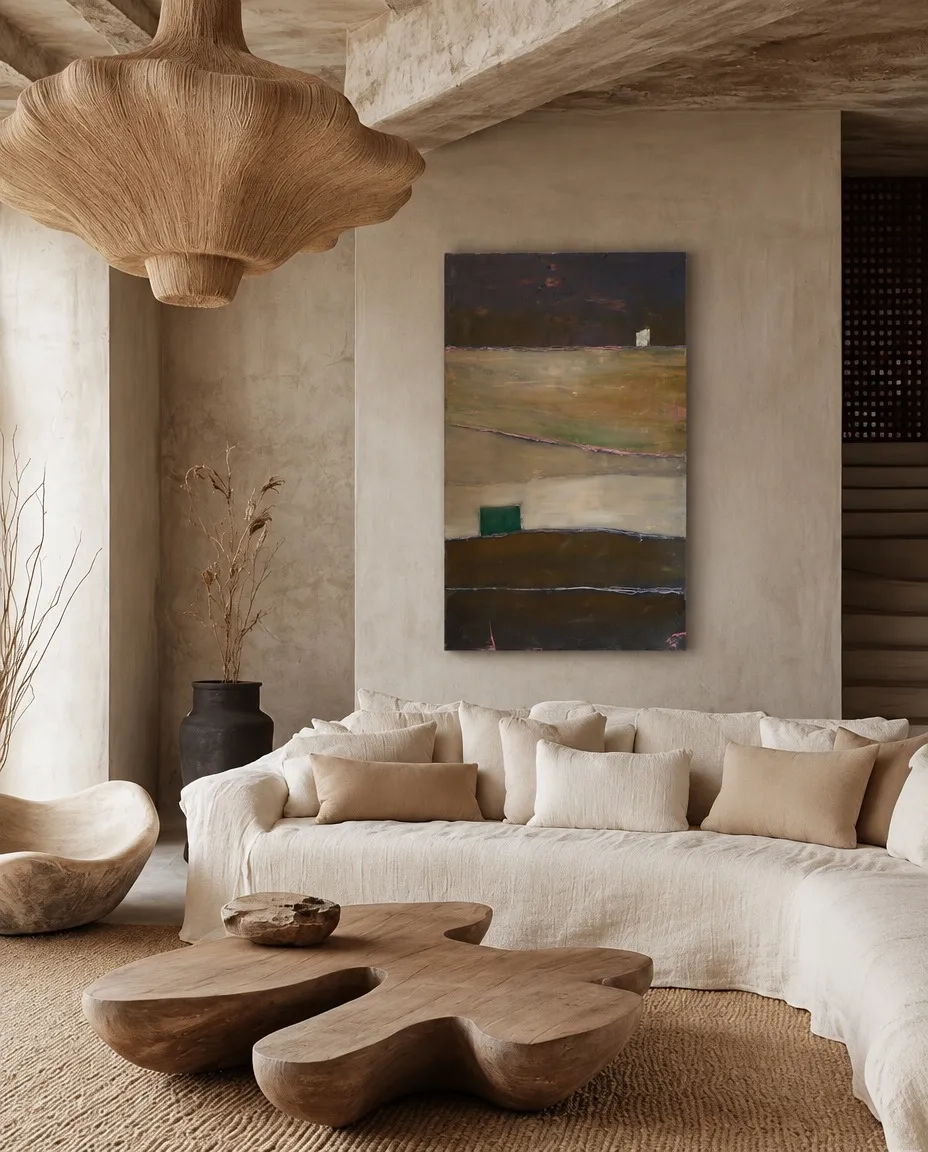
QUIES is organised through the verticality of a field that never quite becomes landscape, though it retains some of landscape’s resources: horizon, ground, coastline, sky, distant construction. In the upper part, a dark, violet-toned and nearly closed expanse bears down, worked through variations of black, muted blue and reds that barely reveal themselves. Below, the material opens into strata of veiled greens, ochres, muted pinks and greyed earth tones; they do not describe a recognisable geography, but establish differences of density, temperature and distance. Several pale, irregular, almost incised lines cross the canvas horizontally: at times they seem to be the edges of layers, at others cuts, scars or paths that never fully settle. In the upper area, towards the right, a small white block emerges with a restrained clarity within the darkness; lower down, towards the left, a dark green rectangle settles more heavily upon a pale band. The shadowed bands at the lower edge push space forward and close it without sealing it off. Depth does not appear here as a background one might reach by passing through the surface, but as a consequence of these delays: glazes that retain what they cover, lines that separate without fully isolating, areas that compel the gaze to measure the distance from one presence to another.
I seek to keep the surface from behaving like a window. I am not interested in leading the eye towards an illusion of ordered distance, but in making thickness remain on the skin of the painting, in its deposits, drags and interruptions. When I darken an area, I do not necessarily think of something behind it; I think of matter that holds back, that does not yield everything at once. That is why an incised line can be deeper than perspective: it touches the layer, cuts it slightly, compels it to acknowledge that another lies beside it. But I do not want that cut to repair anything. I can bring an ochre and a green, a light band and a dark mass close together without making them coincide. For me, the irregular edge has this difficult task: it establishes neighbourliness while preserving resistance. The painting begins to breathe when it does not confuse proximity with agreement, when it lets each stratum sustain its own slowness.
A decisive tension gathers between the small white block and the green block. The first, isolated in the upper dark field, has something of a minimal appearance: it does not dominate the composition, illuminate the whole, or function as a stable centre. Its whiteness seems limited by the vast reserve around it. The second appears differently: lower, more compact, more terrestrial, it seems inserted within a layer whose clarity has already been altered by stains, glazes and lateral strokes. Both blocks might suggest constructions, signs or retained presences, but the painting avoids turning them into figures with a fixed meaning. What matters is that they do not touch and yet are not indifferent to one another. The undulating lines that traverse the intermediate strata may be read as boundaries, coastlines, surface wounds or precarious modes of connection. They do not directly join the two blocks; rather, they keep open the interval separating them. In that interval, communion begins to lose its customary meaning of fusion. It may consist in one form being able to affect another from afar: the white alters the reading of the darkness that contains it, the green densifies the band that receives it, and between them the painting sustains a relationship that need not be resolved through contact.
I do not fill a painting to demonstrate that there is much to say. At times I remove, cover, mute or leave an area not fully occupied because I need the forms to have their own distance around them. This is where I think communion begins: not as a mixing of materials until they can no longer be distinguished, but as the possibility of their remaining together without losing their particular condition. The white may remain alone in the upper part and the green may remain below, heavier, without that separation being a lack. If I grant them space, I also grant them time: time to be seen separately, to change according to the light of adjacent layers, not to answer one another immediately. For me, the generosity of a painting does not lie in adding signs or completing voids; it lies in accepting that a dark area has the right to keep silent and that an edge need not become a bridge. Matter can host distinct presences without requiring them to merge.
From that reserve, QUIES proposes a depth that does not depend on the illusion of a world located beyond the painting. Depth becomes a capacity for coexistence: it can reside in the thickness of a blackened violet, in an earthy glaze that lets what came before show through, in a pale incision that barely divides two masses, in the unresolved distance between the upper white and lower green. Nothing in the work compels a choice between separation and relation. The strata remain differentiated, the dark bands persist in their gravity, the lines do not cease to be unstable; yet it is precisely this lack of final reconciliation that allows the painting to avoid reducing its parts to a single voice. The generosity it suggests is not abundance or a promise of harmony: it is the material decision not to occupy everything, to let darkness retain its opacity and to let the blocks, layers and voids share one field without giving up their distances. In this sense, the painting does not offer a lesson in being together. Rather, it constructs a surface capable of bearing the fact that what is different can remain together, visible and still separate.
- Original artwork
- QUIES
- Actual dimensions
- 31.5 × 47.2 in / 80 × 120 cm
- Presentation
- Digital contextual visualization
Context references
QUIES Maurizio Valch · vertical abstract art for a living room · abstract painting for an organic interior · minimalist abstract painting in earth tones · contemporary painting with layers of colour · abstract art with geometric blocks · material painting for a wall · large 80 x 120 cm abstract artwork
About this visualization
This visualization places the artwork within an architectural context to help collectors and viewers imagine its presence in a real space. It is an interpretive reference, not an exact reproduction: the original work remains the sole authority for scale, color, surface and material presence.