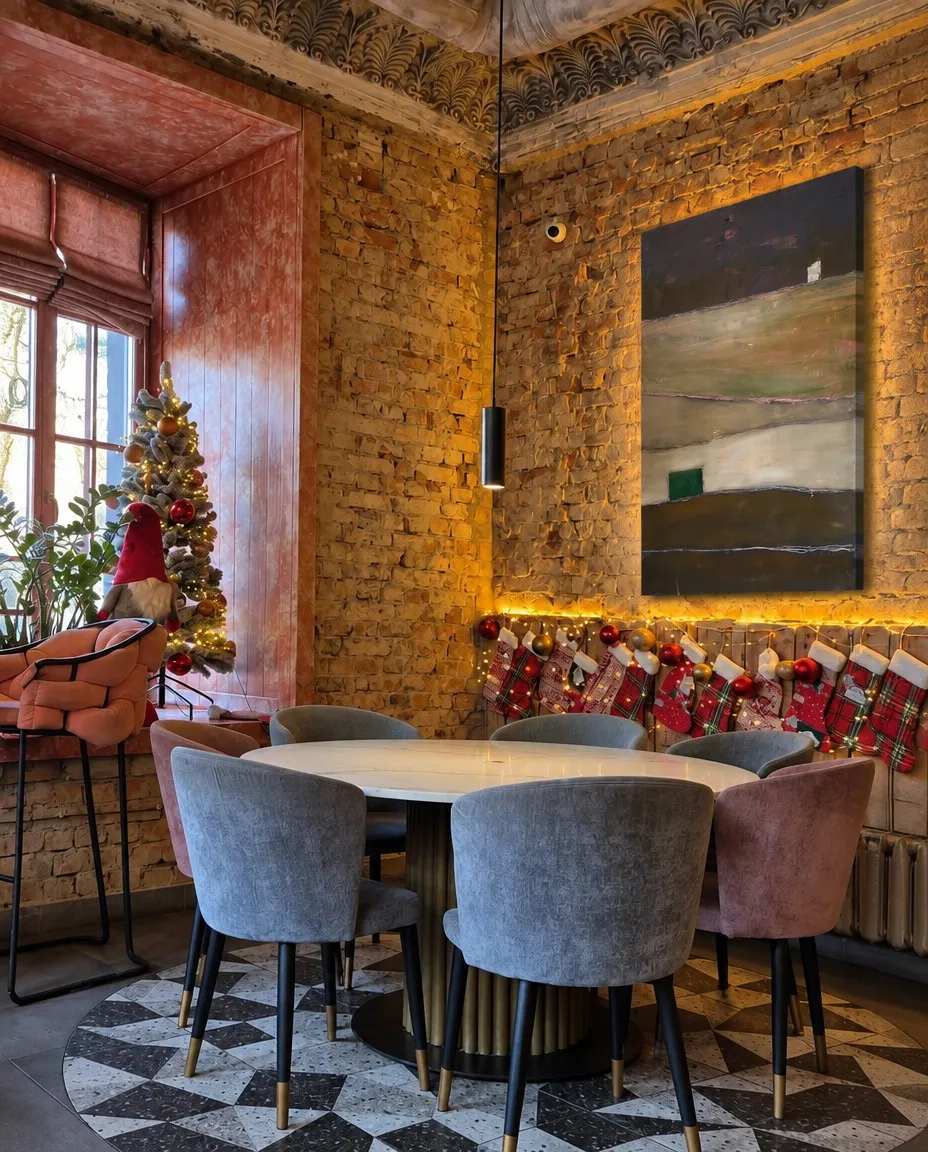
Context study / QUIES
QUIES — Maurizio Valch | STRATA Abstract Painting
Drilling log: 0 cm. The surface offers a strange resistance: it does not seem like a view, but the section of something that was already there before it was seen. Above, a dark zone extends like suspended matter, almost without a horizon, though it contains several. It does not fall. Nor does it entirely cover what lies beneath it. The gaze tries to rest on it and discovers that its support slowly slips to the right, where a small pale rectangle interrupts the darkness without illuminating it.
It is not a secure opening. From a distance it might resemble a minimal house, a sign, a mark set aside for later. Up close—or imaginatively up close—it becomes less available: a pale edge embedded in a band that cannot decide whether it is sky, roof, ash, or distance. First error of the sounding: to call this layer “upper” assumes that it is still above the others. There are signs that it moves sideways, scraping against a clearer memory.
I feel that, when I look at this painting, my intention remains behind it like someone arriving late at a station. I want to arrange the bands, give them a ground and an above, but something on the surface begins to determine its own gravity. Then my body corrects its posture without my asking it to: my eyes lower, rise again, and the painting seems to have changed weight as I look at it.
Drilling log: –12 cm. The central greenish, earthy band receives the measuring instrument like ground that has been disturbed many times yet displays no trace of excavation. It is lighter than the upper mass and yet offers no relief. It has the visual temperature of a wet expanse seen from too far away. Its greys, muted greens, and earthy glazes allow one to think of field, stagnant water, plain, eroded wall; but none of those words manages to remain on its own.
Here Alfred Wegener appears. He was the scientist and explorer who dared to think that continents, seemingly motionless, might have travelled and pulled their edges apart.
His way of looking enters the painting like a ruler that never quite becomes straight. At first, the horizontal bands resemble poorly fitted plates: expanses that have retained the memory of contact for too long. The pink line crossing one of the bands might be a friction edge; the lower pale line, a provisional suture; the shifts in tone, scattered evidence that one matter has moved in relation to another. No single piece of evidence is enough. A crack alone does not prove a broken continent; a coincidence of edges may be accidental; a band that seems to slide may be the result of a tired eye.
Yet the painting does not allow the pieces to be assembled. Wegener would look for a corresponding coast, an earlier continuity, an original form that might explain the separations. But the white rectangle, high on the right, disrupts the method. It fits nothing. It does not extend a vein. It does not answer to the logic of the masses. It is too small to correct the geography and too firm to ignore. The pink line, moreover, does not behave like a boundary: at times it seems to separate; at times to stitch; at times it simply floats, almost joyfully, over the pressure of the layers.
The drilling question begins to shift its pressure: what if these horizontal lines did not separate landscapes, but were the scars of several worlds trying to slide over one another without managing to leave each other behind? Wegener receives no answer. He receives a misalignment.
Drilling log: –27 cm. Interrupted by a low voice. The thin lines do not have the monumental appearance one expects of a fault. They are too fine. One of them is barely enough to divide two expanses of very different weight. Even so, the eye returns to it as a fingertip returns to a scar one does not quite want to touch. There is a precise disproportion: the line occupies little space, yet it holds the painting’s breath.
At this point Anna Akhmatova enters. She was the poet who turned waiting, wounded memory, and what could not be fully said into a form of verbal presence.
She does not arrive to turn the bands into comfortable metaphors. Rather, she detects a withheld sentence between them. The dark zone above is not an absence: it holds something that does not yet accept being spoken. The greenish band resembles a sentence crossed out without disappearing; the lower mass, the part that remains once the sentence has been erased. And the pink line, so fine that it almost seems embarrassing to assign it any weight, persists as a sentence that does not conclude because to conclude it would falsify the waiting.
Akhmatova mistrusts the need to reconstruct an original continent. Perhaps no fragment wishes to join again. Perhaps some separations are not the ruins of a unity, but ways of persisting without being absorbed. Wegener returns the suspicion from the edge of his maps: that silence need not be stillness. It may be accumulated pressure, a force held back not through resignation but because it has not yet found a direction.
At this point, the sounding should have gone down, but the instrument records lateral displacement. The central band seems to have shifted a few millimetres to the left; or perhaps the lower black mass has moved forward. For a moment, the room around the painting loses its level. The viewer may feel their knees asking for a firm reference point, while none of the bands grants one.
It is worth making a small, almost domestic test. Mentally cover the white rectangle in the upper part. Do not replace it with black or sky: simply remove it. The painting’s gravity sinks slightly downward; the dark zone becomes heavier and more expansive, as though it no longer had an escape route. Now restore that rectangle. The weight changes without becoming lighter: a deviation appears, a kind of vent that releases not air but orientation. Then locate the green rectangle, low on the left, within the lighter band before the darkness compacts. It does not illustrate a story. It is neither a door nor a mineral sample nor a landscape flag. Yet when one sees it, the whole space seems to tilt towards it and away from it at the same time.
Drilling log: –46 cm. Question found in a cavity. A child might ask: “Why does the green rectangle stay stuck to the pale earth if the black band below is pulling everything down?” It is best not to answer too quickly. The question remains beside the fine lines and changes their function. If something pulls downward, why do the seams not break? If the layers shift, who taught them to wait one above the other? The green square resolves nothing, but makes visible that gravity here does not only descend: it also drags, accumulates, and makes mistakes.
The question accompanies the descent through the large lower zone, where browns and blacks occupy the field like sedimentation without a date. There is no uniform blackness. There are variations: dense earths, opaque surfaces, edges that seem to hold dust or shadow, zones where a minimal brightness has almost been absorbed. The body wants to read this stretch as a base, but the base does not rest either. A pale line crosses the lower area and, in doing so, prevents the background from being merely background. It divides it without splitting it. It keeps it in a state of imminence.
Here Wegener’s method and Akhmatova’s truly interfere with one another. For one, the bands demand attention to slow pressures, to edges that never quite coincide. For the other, those same bands safeguard a sentence that need not return to its origin in order to carry weight. The third way of looking that emerges from this disagreement does not choose between geology and silence: it sees faults that are precarious seams, seams that behave like verses, verses that refuse to end because something is still happening beneath them.
Now I see that one part of the painting does not move even though everything around it seems to shift. I do not know whether it is the green rectangle or the band that holds it; the more I try to fix it in place, the less I recognise the decision that left it there. There is an immobility that does not reassure: it is not rest, but a way of not yielding. My gaze returns to that edge and discovers that I, too, have changed position before it.
Drilling log: –61 cm. Depth error. The ground has returned an observation to the surface. The initial dark zone no longer seems like sky or a covering: perhaps it was the compressed pressure of everything below, raised to the top without quite emerging. The small white rectangle, first read as a suspended anomaly, might be the point at which that pressure thins. But it should not be conquered by that hypothesis either. It remains a form that alters orientation without yielding its name.
Only now, late, does the title QUIES brush against the drilling notebook. Not as rest, nor as an effective command. Rather, as an apparent stillness given to matter that is still negotiating its movement. The painting offers successive horizons, but none permits the eye to rest for long. Each asks to be crossed; each returns the previous one with a minimal alteration.
On leaving, the child’s question has not disappeared. The green rectangle continues not to fall, yet it does not float either. The pink line still crosses the middle band with disproportionate delicacy, and at its edge—barely pale, barely tense—the layers once again slide against one another without making a sound.
- Original artwork
- QUIES
- Actual dimensions
- 31.5 × 47.2 in / 80 × 120 cm
- Presentation
- Digital contextual visualization
Context references
QUIES Maurizio Valch · Maurizio Valch STRATA abstract painting · vertical abstract painting with strata · abstract art with incised lines · material painting in earth and green tones · vertical abstract painting for dining room · abstract wall art for rustic interior · large contemporary abstract painting
About this visualization
This visualization places the artwork within an architectural context to help collectors and viewers imagine its presence in a real space. It is an interpretive reference, not an exact reproduction: the original work remains the sole authority for scale, color, surface and material presence.