Context study / QUIES
QUIES — Maurizio Valch | Abstract Work from the STRATA Series
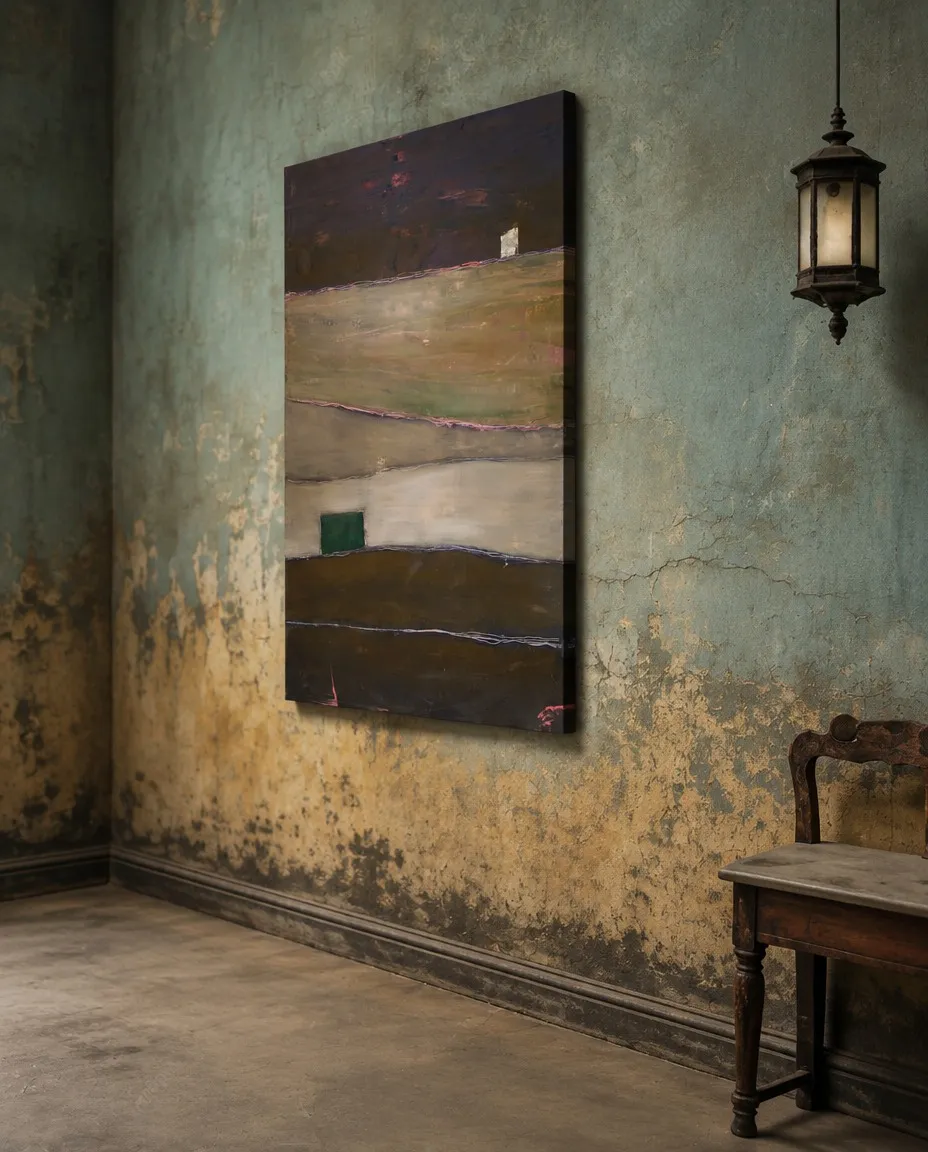
Biography enters QUIES without bringing with it a scene that can be told. There is no road, city, farewell or figure that would identify an episode; yet the painting is organised as though it had retained the atmosphere of an experience. The strata rise in an irregular vertical arrangement, accumulating darkness, reddish glazes, murky earth tones and grey areas that never fully settle. In the weathered room of this presentation, the canvas does not seem to illustrate a past: it seems to have absorbed it. The eroded wall extends, without replacing it, the condition of a surface that has borne friction, time and layers of revision.
I do not paint a life in order to make it recognisable. I am more interested in what remains when an event has lost its names: a pressure, a distance, the need to hold two adjoining things together without forcing them to coincide. At times a pale line appears between two fields and may seem like an edge; as I work, I discover that it is also a precarious form of contact. I do not know whether it protects or leaves the separation more exposed. Perhaps it does both. Painting preserves that uncertainty better than an explanation, because it does not need to resolve which part of the territory belongs to either side.
The small white block, suspended in the upper band, and the green rectangle resting much farther below introduce a relationship of scale and isolation. They do not form characters or make up a hidden narrative. Their distance, however, causes the composition to behave like a memory without a plot: something remote remains active in another area of the pictorial body. Between them, undulating lines stitch and unmake the fields, as though every division retained the memory of having been crossed. This condition brings QUIES close to an autobiography without anecdotes: not life turned into a story, but a sensibility shaped by displacement, partial supports and territories that never fully become one’s own.
I have known travel as an experience also made of fatigue, temporary rooms, conversations that leave no clear lesson, and hours in which apparently nothing happens. I do not need to transfer those images to the canvas for them to continue working within it. They can survive transformed into an unevenness, a layer that does not fully cover the one beneath it, a point of light that cannot master the darkness around it. QUIES does not return an ordered story to me; it compels me to accept that a life is also written in its interruptions, in what could not be stabilised, and in that which, despite everything, did not entirely come apart.
The stillness of the title takes on a particular density here. Against the aged wall, beneath the lateral light and beside an architecture that seems to retain its own history of wear, the painting does not claim prominence through shine or a conclusive image. It remains. And that permanence does not amount to security: the dark bands remain open to alteration, the incisions do not seal the matter, and the two blocks continue to be exposed to a distance that will not be resolved. Perhaps this is where its most intimate form of autobiography lies: not in declaring who the artist has been, but in allowing painting to hold the interval between what protects, what limits and what still seeks a way to remain close.
- Original artwork
- QUIES
- Actual dimensions
- 31.5 × 47.2 in / 80 × 120 cm
- Presentation
- Digital contextual visualization
Context references
QUIES Maurizio Valch · QUIES STRATA series · contemporary abstract art with layers of colour · vertical abstract painting in dark and earthy tones · abstract art with undulating lines and geometric blocks · territorial abstraction with horizontal divisions · material painting with colour fields · vertical abstract wall art
About this visualization
This visualization places the artwork within an architectural context to help collectors and viewers imagine its presence in a real space. It is an interpretive reference, not an exact reproduction: the original work remains the sole authority for scale, color, surface and material presence.