Context study / QUIES
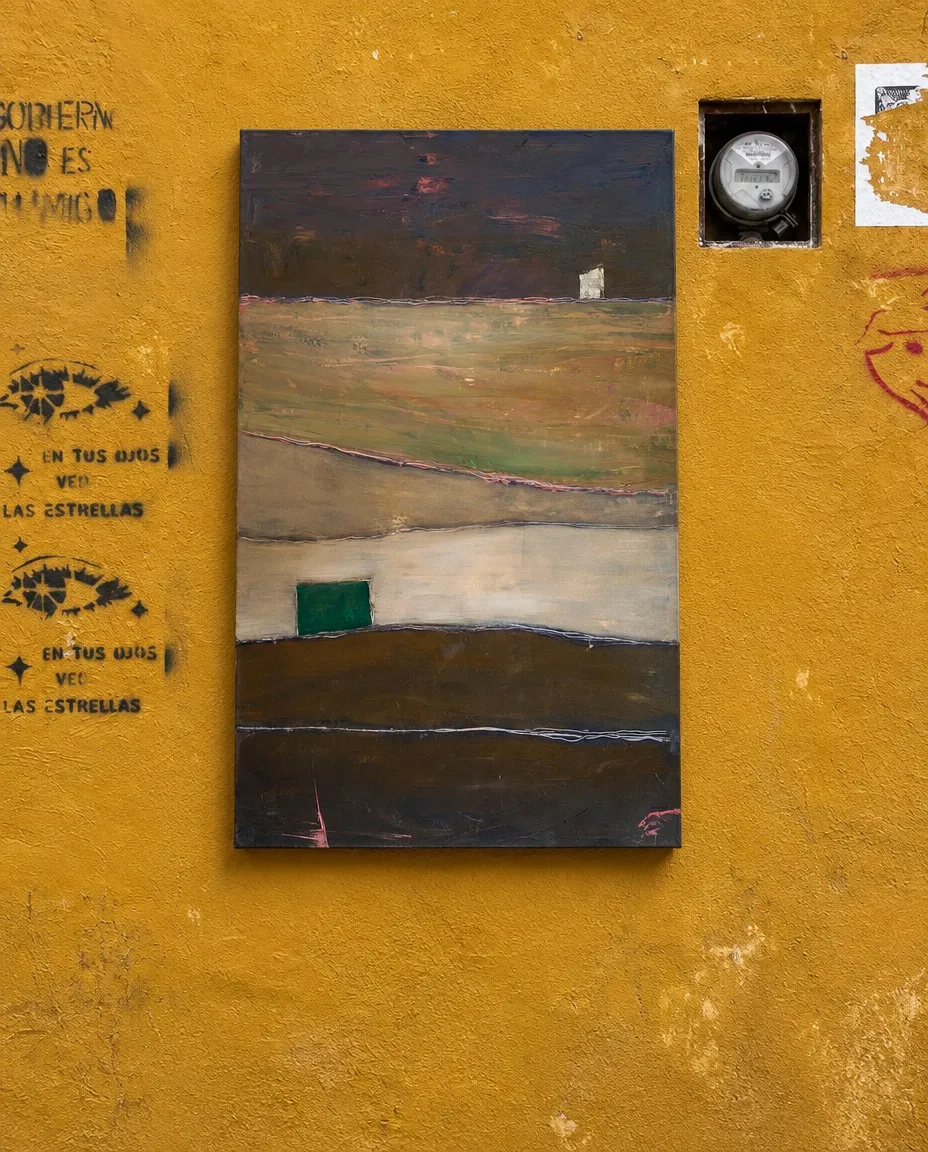
QUIES by Maurizio Valch on an ochre exterior wall
The surface of QUIES is arranged in broad horizontal bands that never settle into regular strata. At the top, a dark, violet and earthy mass thickens with reddish abrasions; below it, a field of muted greens, ochres and greys seems to extend without ever fully coming to rest. Its limits are not straight: light, undulating edges, at times almost filament-like, travel across the painting as though several decisions had been layered onto a single boundary. Toward the middle, a brighter, greyish band opens up, its clarity not resolving orientation but making it more uncertain: it does not establish a definitive above or below, but a suspension between two densities. Further down, the dark, compact tones return, and within them a green rectangle appears, shifted toward the left and carrying an isolated presence. Above, near the right edge, a minimal white form remains set apart from the other masses. Nothing establishes a secure perspective; everything seems to extend, be cut through and begin again on a plane that retains its own misalignments. What kind of civilisation might emerge in a territory where almost everything happens horizontally and yet two small vertical presences completely alter the distribution of silence? And if these lines were the first marks of a community, what might they be trying to contain or remember: a measure, a separation, a custom of looking without crossing over?
I do not think of horizons as distant views, but as places where painting resists being resolved. I work in layers, cover and drag, allowing a more opaque material to remain beneath another that seems lighter. The lines in this work were not drawn onto an already finished surface: they emerged by intervening in what had been deposited—by scraping, pressing, shifting wet or dry paint, by insisting on an edge until it ceased to be a clean edge. I was seeking stillness, yes, but never motionless stillness. For me, what is still retains earlier movements: one layer that settled, another that was interrupted, a gesture that was covered without entirely disappearing. I do not need the green rectangle to be a sign of something outside the painting, nor the small white form to receive a function that explains it. I am more interested in their being there as separate matter, as concentrations that oblige the rest of the field to reorganise itself without abandoning its silence.
G. I. Gurdjieff, a thinker attentive to the mechanical nature of ordinary life and to the possibility of conscious self-remembering, enters here not to offer a key to interpretation, but because his questions touch on the insistence of these bands. Are the bands of QUIES the image of a dormant repetition, of a surface that continues because it does not know how to do otherwise, or do they function instead as a device capable of interrupting that continuity? The paradox remains in the material: perhaps a culture begins when it learns to draw limits, when it distinguishes one zone from another, when it repeats a mark until it becomes recognisable; but perhaps it also begins to fall asleep when it forgets that it was the one that drew the mark and takes it for a natural condition. Here, the undulating edges seem to carry both possibilities. They are limits, yet they do not behave with the firmness of a rule; they are accumulations of paint, but they also seem to insist upon a separation. Attention might remain fixed on their horizontal rhythm and glide over them almost automatically. Yet the appearance of the small green block or the light form, positioned outside the dominant continuity, introduces a delay. They do not explain the field: they make it less available to a gaze that would seek to recognise it too quickly.
I now look at these two isolated forms and do not recognise them as figures or buildings. The light one above and the green one below arrived as presences that altered the weight of the bands without imposing themselves on them. It matters to me that they are separated, that each occupies a distance difficult to measure in relation to the edges around it. Something can be alone without becoming an emblem; it can remain in a place without declaring what it is for. The white form is small, but it shifts the scale of the dark zone containing it; the green rectangle seems closer and yet never quite belongs to the light band on which it rests. I am not sure that every repetition is sleep. There are material repetitions—returning to a layer, following an edge, allowing a stroke to reappear beneath another—that make it possible to perceive something that might otherwise go unnoticed. Sometimes I need to persist for a presence to become visible, not because repetition turns it into a sign, but because it gives it time to separate from the noise of the surface.
What remains, then, is a kind of excavation that does not seek a ground beneath, but a slower attention to what is already in view: earth tones spread in opaque glazes, pigments brushing against one another without fully mixing, light incisions that seem to have found their place while simultaneously destabilising it. A remote memory may arise of hands spreading matter over stone or of surfaces worn down by a persistent sun, but the painting cannot be reduced to that memory. Rather, it asks whether the first human line was made to divide the world or to discover that the world was already divided before it was marked. In QUIES, each line seems to answer differently: one contains, another opens, another barely vibrates over a denser layer, another approaches a wound without settling upon it. The green rectangle and the small white form remain as minimal interruptions, two decisions of attention within a stratified surface. Between the lower dark band and the light field at the centre, the green persists without advancing; above, beside the undulating edge, the white patch remains suspended in its small separation.
- Original artwork
- QUIES
- Actual dimensions
- 31.5 × 47.2 in / 80 × 120 cm
- Presentation
- Digital contextual visualization
Context references
abstract painting on exterior wall · vertical painting on ochre wall · contemporary art on urban façade · textured wall painting mockup · outdoor wall decor with abstract art
About this visualization
This visualization places the artwork within an architectural context to help collectors and viewers imagine its presence in a real space. It is an interpretive reference, not an exact reproduction: the original work remains the sole authority for scale, color, surface and material presence.