Context study / NEXUS
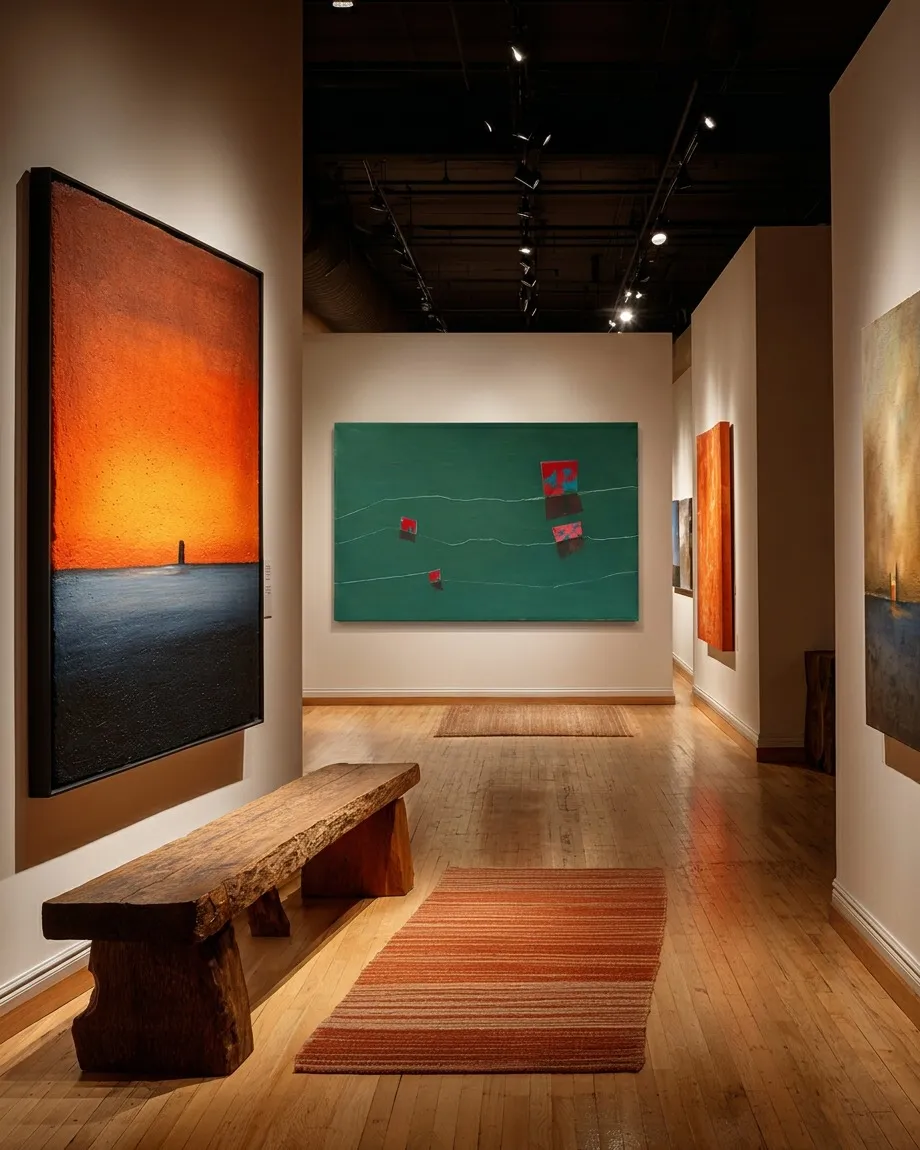
NEXUS Abstract Painting by Maurizio Valch in Gallery | STRATA
The gaze moving through this gallery corridor experiences a shift in visual temperature before confronting the emerald plane of NEXUS. Maurizio Valch does not construct a window for evasion here, but rather a dense and delimited territory that halts the step by means of three horizontal levels of white incisions trembling on the canvas. These incised marks, characteristic of his STRATA series, do not act as linear adornments, but as physical wounds in the chromatic matter that support the drift of small crimson and blue blocks. The gravity of these compact forms, which cast downward shadows, anchors the composition against the surrounding luminous vibration, transforming the painting into a wall that arrests the wandering eye and forces it to measure its own physical scale against the format of the work.
This point of arrival in the exhibition space dialogues intimately with the need to halt the relentless search—that tendency to convert existence into an endless quest laden with expectations of recognition. In Valch's experience of travel, personified in his silent walks and territorial displacements, value does not reside in the conquest of a distant goal, but in the voluntary surrender of the character who needs to justify their path through effort. The static immensity of the emerald green thus functions as a reflection of that silence which ensues when the mind understands its own noise and desists from constructing theoretical explanations for every everyday action. The chromatic plane offers itself as that fresh ground stripped of psychological urgencies, a space of quietude where the colored blocks represent the minimal certainties that thought has needed to fix in order not to lose direction in the midst of the plain.
By analyzing the evolution of his series, one understands that this halt is not a gratuitous isolation, but the logical consequence of a transition leading from the suspended landscape of dreams to the materiality of skin. In his essays, the artist describes how territory progressively abandons its condition of contemplative distance to approach the body and acquire thickness, a process where the primal ground of PRIMORDIUM gives way to the wounded surface of STRATA. NEXUS operates as the dry dock where the shipwrecked person's red keel has definitively run aground, freeing itself from the tyranny of a destination to discover its sovereignty in the immobility of the shore. The incisions crossing the painting are no longer promises of transit or ladders for an idealized ascent; they are fragmented maps of a movement that has ceased its agitation, traces of a memory that no longer needs to defend itself with conceptual trenches.
In this setting, flanked by the glowing horizons of the side walls, the work establishes a revealing affinity with the magnetism of Mark Rothko’s color fields, but distances itself from his vocation of purely mystical transcendence to claim an almost tectonic physical presence. While color in the American painter seeks to envelop the viewer in a suspended atmosphere, Valch prefers the somatic friction provided by the rustic wooden bench and the textured rugs—elements that guide the body and impose a contemplative deceleration. The contrast between the saturated ochres in the foreground and the cold stillness of the emerald green background intensifies this silence, turning the perspective into a clearing where the pictorial matter recovers its condition of an exposed body. It is in this physical standstill that the separation between subject and space dissolves, allowing the gaze to rest in the honesty of the surface without the weight of interpretation.
- Original artwork
- NEXUS
- Actual dimensions
- 47.2 × 31.5 in / 120 × 80 cm
- Presentation
- Digital contextual visualization
Context references
emerald green abstract painting · large format painting for living room · Maurizio Valch artist · abstract art from STRATA series · contemporary art home decor · abstract paintings exhibition · incised lines in painting
About this visualization
This visualization places the artwork within an architectural context to help collectors and viewers imagine its presence in a real space. It is an interpretive reference, not an exact reproduction: the original work remains the sole authority for scale, color, surface and material presence.