Context study / NEXUS
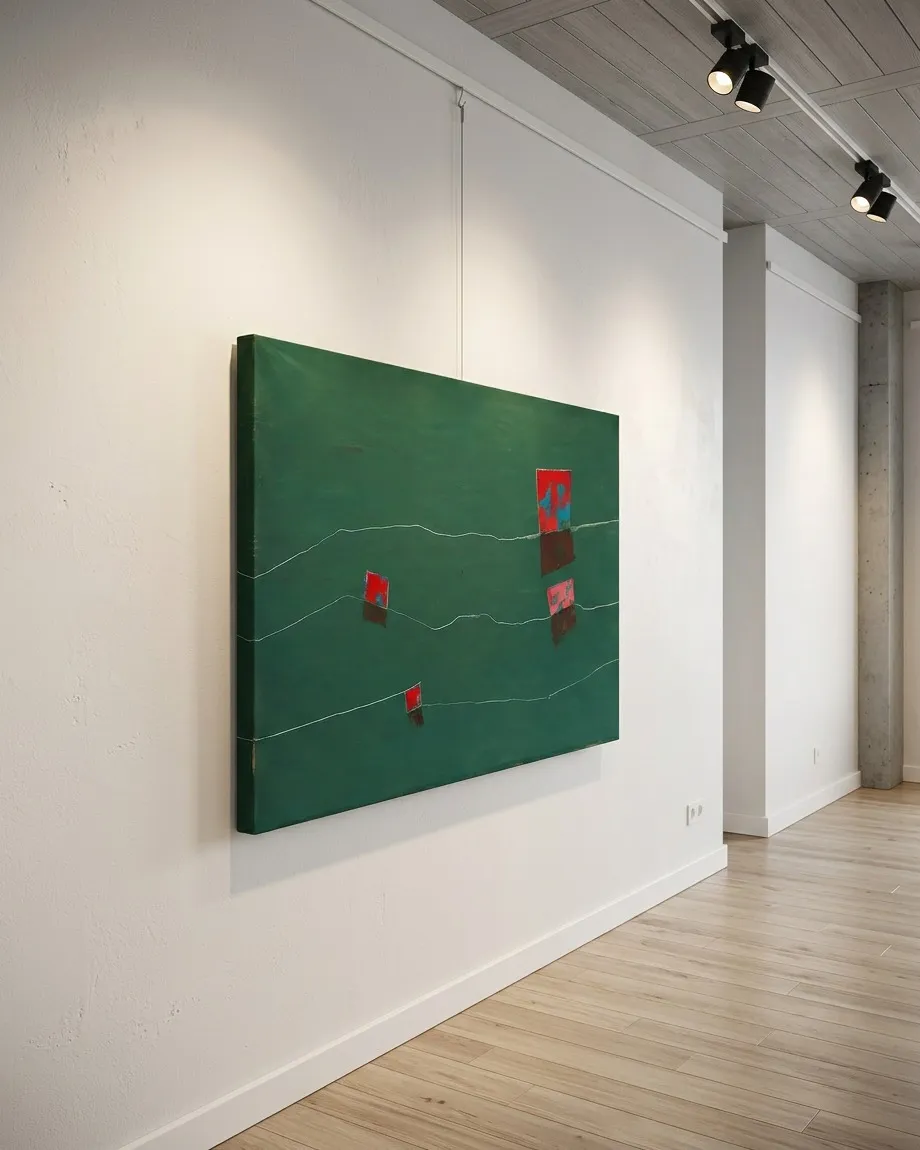
NEXUS Painting Suspended on White Wall | Maurizio Valch
Hanging a dense, material canvas by steel cables in front of an immaculate wall is not merely a display decision, but a dissection that exposes its physical fragility. In NEXUS, the greenish chromatic fields and the incisions that tremble with the imperfection of the hand are forced to dialogue with the cold precision of technical ironwork. Floating free from the complicity of direct support, the three-centimeter-thick stretcher behaves like an unprotected body, where the subtle curvature of the fabric and the vibration of the painted edges reveal their organic nature against the asepsis of the exhibition environment.
This staging makes visible a radical detachment, a transition where painting abandons the protective environment of the studio to assume its own exposure. The disconnection from traditional support resonates with the human need to let go of familiar structures, transitioning through a void where there are no longer certainties to cling to. Suspended in the air, the emerald matter does not seek to impose itself as a declaration of strength or a heroic gesture; on the contrary, it embodies the honesty of one who accepts existing under the constant tension of their own contradictions, assuming the weight of their decisions without the aid of a justification to explain their fall.
The dialogue between the rigidity of the tensioners and the sinuosity of Valch’s strokes deepens what his essays describe as a tactile shore, that sensitive limit where the conceptual map dissolves to meet the physical reality of the body. As examined in La insumisión del declive, the fine white incisions that fall and yield over the green field represent a frontal disobedience to the orthogonal precision of the surrounding space. Scraped directly onto the surface to reveal what pulses beneath, these lines do not act as rigid coordinates of control, but as the record of a passage, a clinamen that transforms the canvas into a living membrane pulsing before the physical proximity of the viewer.
In this condition of exposed skin, Valch’s painting shares with the eroded matter of Antoni Tàpies the urgency of treating the surface as a wall marked by the passage of time and physical wear. However, where the Catalan master grounded his compositions in telluric gravity and the solidity of the wall, Valch chooses to separate the work from the partition, forcing it to float by means of a technical system that exalts its spatial lightness. By stripping the canvas of its earthly support, the artist not only preserves the tactile nature of the surface but relocates abstraction to a plane of aerial suspension, where the painting ceases to behave as a static absolute to become an unprotected boundary vibrating in real space.
- Original artwork
- NEXUS
- Actual dimensions
- 47.2 × 31.5 in / 120 × 80 cm
- Presentation
- Digital contextual visualization
Context references
painting hung with steel cables floating · abstract artwork suspended minimalist wall · contemporary art display design · NEXUS floating green painting · Maurizio Valch gallery installation
About this visualization
This visualization places the artwork within an architectural context to help collectors and viewers imagine its presence in a real space. It is an interpretive reference, not an exact reproduction: the original work remains the sole authority for scale, color, surface and material presence.