Context study / NEXUS
NEXUS by Maurizio Valch: Presence and Perspective in Corridor
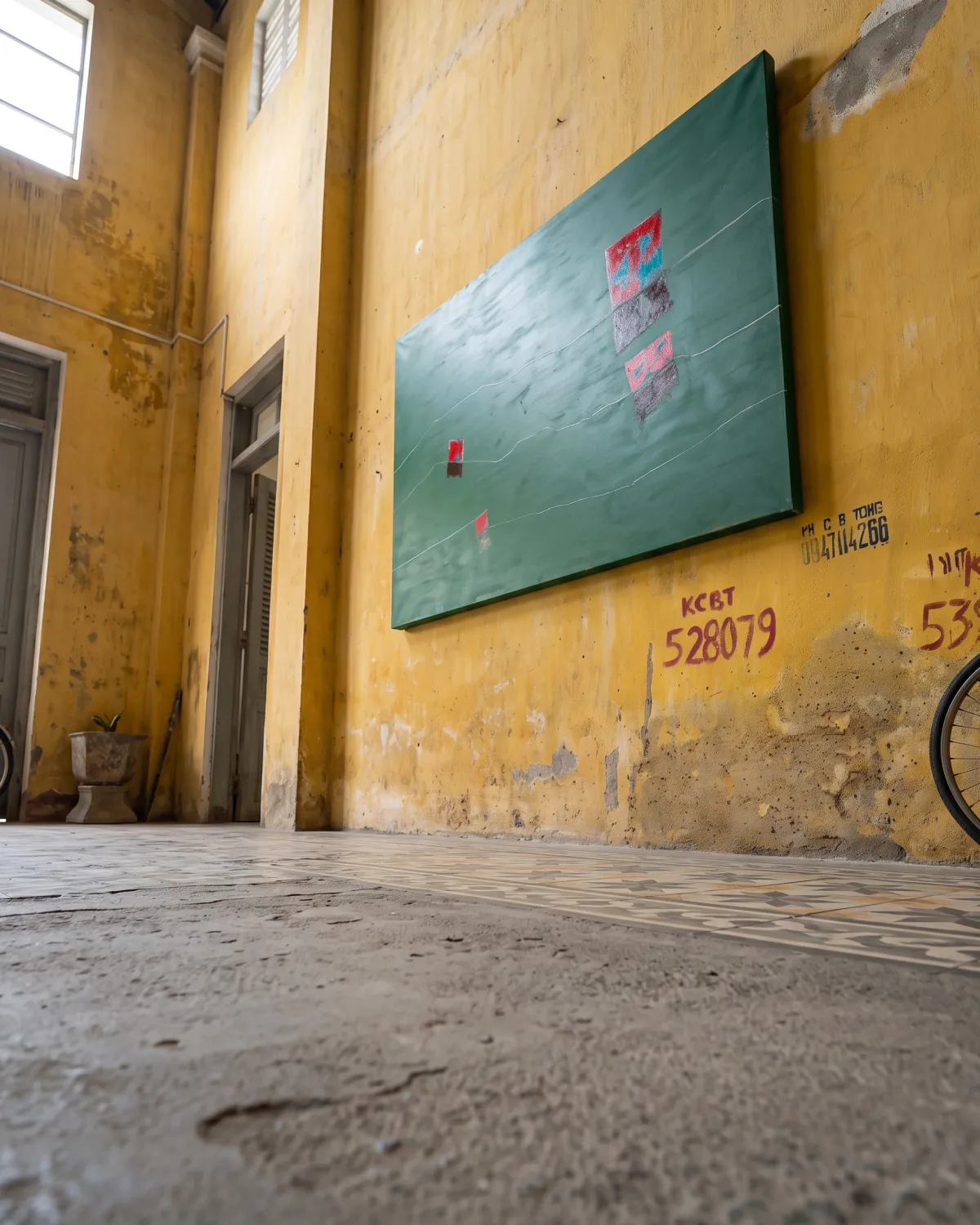
Looking obliquely upward in this yellow corridor of dense patinas forces the painting to abandon its two-dimensional placidity and break in as a volume obstructing the gaze. From this forced low angle, the thickness of NEXUS's stretcher ceases to be an invisible dimension, acting instead as a three-dimensional friction plane that alters the proportions of the hallway. The dense emerald green field does not behave here as a contemplative window, but as a suspended material plate, an objectual border whose white incisions assume a diagonal vanishing trajectory that disobeys the rigid orthogonality of the surrounding colonial frames, doors, and windows.
This insertion blocking transit through the colonial corridor reverberates with Maurizio Valch's reflections on travel as a state where fixity dissolves and spatial uncertainty gains weight. Placing the work in this thoroughfare, forcing the body to stop before it to bypass it, shifts the pictorial territory to the plane of tactile experience and interrupted movement. The red marks floating over the incisions act as those halting points or anchors of memory that, far from being decorative, recall the necessity of registering passage through a place, confronting the observer's inertia in a space usually traversed in haste.
That physical resistance of the canvas precisely embodies the notion of painting as a trench or a tactile shore, concepts the artist has developed when questioning the limits imposed by Cartesian thought. By forcing the visual decline of the incised lines through the oblique angle, the composition renounces symmetry and submits to the physics of deviation, transforming the surface into an active field of forces where the observer no longer passively contemplates but physically collides with the work. The painting ceases to protect a predictable identity, behaving instead as a membrane exposed to the friction of the gaze and the real environment—a conceptual barricade dissolving analytical distance.
In this dialogue with matter and architectural erosion, the piece reveals a close affinity with the sensibility of Antoni Tàpies, for whom the pictorial surface operated as a wall or a skin weathered by time. Much like the textures of the Catalan creator, Valch's canvas integrates uninhibitedly with the painted numbers and peeling plaster of the colonial wall, yet distances itself by maintaining an internal geometric structure and a territorial order that prevents the chaos of pure matter. NEXUS thus stands in its singularity: a visual barricade that, by intercepting the colonial perspective of the hallway, forces the body to reorganize its pace and the mind to depose its automatic interpretations before the absolute presence of the physical fact.
- Original artwork
- NEXUS
- Actual dimensions
- 47.2 × 31.5 in / 120 × 80 cm
- Presentation
- Digital contextual visualization
Context references
perspective view of abstract painting · contemporary art in old hallway · abstract art installation · NEXUS Maurizio Valch STRATA · painting as spatial object
About this visualization
This visualization places the artwork within an architectural context to help collectors and viewers imagine its presence in a real space. It is an interpretive reference, not an exact reproduction: the original work remains the sole authority for scale, color, surface and material presence.