Context study / NEXUS
NEXUS by Maurizio Valch on an Eroded Colonial Wall
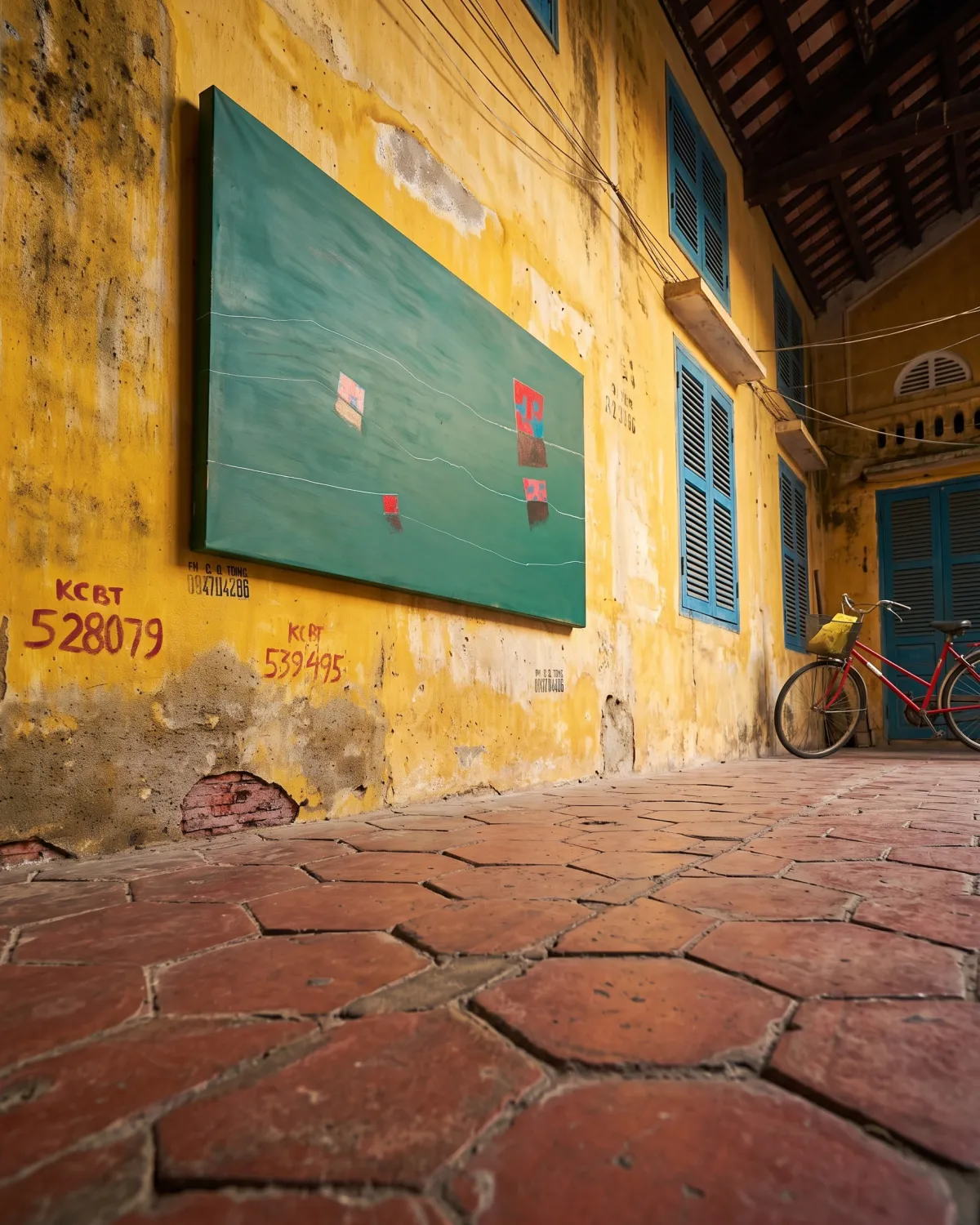
Confronting the crimson blocks and the emerald vastness of NEXUS with the peeling ochre yellow of a colonial wall activates a dialogue where physical time and artistic matter intertwine. Maurizio Valch does not hide the construction process of his painting; on the contrary, the large three-centimeter-thick surface functions as a support of accumulation and wear that assumes the imperfections of its own tactile geography. The incised marks that furrow the composition horizontally from end to end tremble with the vulnerability of the human pulse, acting as physical scars on the layers of pigment. The real light bathing the outdoor corridor accentuates these irregularities in the oil paint, while outlining the cracks, exposed bricks, and inscriptions of the supporting wall, integrating the canvas into a visual archeology of urban neglect.
This material collision echoes the understanding of the pictorial plane not as a static image, but as a skin that accumulates time and resists its pressure. In the artist's path, constant displacement and the provisional nature of inhabited places inform a gaze suspicious of definitive orders or closed explanations. The blocks of color floating or anchoring on the work's incisions behave as mental structures that have acquired weight and inertia; representations of ideas that sometimes protect and sometimes constrain. By placing the painting on a wall that has lost its colonial luster and displays the sediments of its own history, Valch's forms lose any temptation of conceptual purity to reveal themselves as fragments of an existential experience subjected to weathering and erosion.
The subtle incisions of the STRATA series, traversing the chromatic fields like incomplete cartographies, find their meaning away from any representative illustration. In his studio essays, the artist reflects on how the surface of the painted territory operates as an archive of what has been lived, refusing to offer clear maps or directions to the viewer. Like the silence that ensues when the mind understands its own noise, these subtractive lines do not add decorative information, but open a discontinuity, a fissure in the dense color. Confronting these incisions with the real cracks of the wall, the work ceases to function as a window of aesthetic escape, standing instead as a three-dimensional object sharing the same condition of an exposed wound and physical memory with its surroundings.
This dialogue with the support and the wear of the surface connects visually with the material legacy of Antoni Tàpies, where the wall presents itself as a body and a canvas marked by the passage of time. However, Valch distances himself from Tàpies' informalist abstraction by sustaining a much more rigorous and contained territorial organization, structured by precise horizons and defined chromatic blocks. In this colonial corridor, the painting does not pretend to blend into the decorative design of the space, but claims its physical sovereignty on the decaying wall, forcing the gaze to transition from the roughness of the peeling lime to the silent thickness of the canvas. The work is then perceived not as an isolated object of contemplation, but as a tactile edge where the sediments of the historical past and the marks of the inner territory coincide under the same raking light.
- Original artwork
- NEXUS
- Actual dimensions
- 47.2 × 31.5 in / 120 × 80 cm
- Presentation
- Digital contextual visualization
Context references
abstract painting outdoors · yellow colonial wall with art · emerald green and red painting · abstract art weathered textures · Maurizio Valch STRATA series
About this visualization
This visualization places the artwork within an architectural context to help collectors and viewers imagine its presence in a real space. It is an interpretive reference, not an exact reproduction: the original work remains the sole authority for scale, color, surface and material presence.