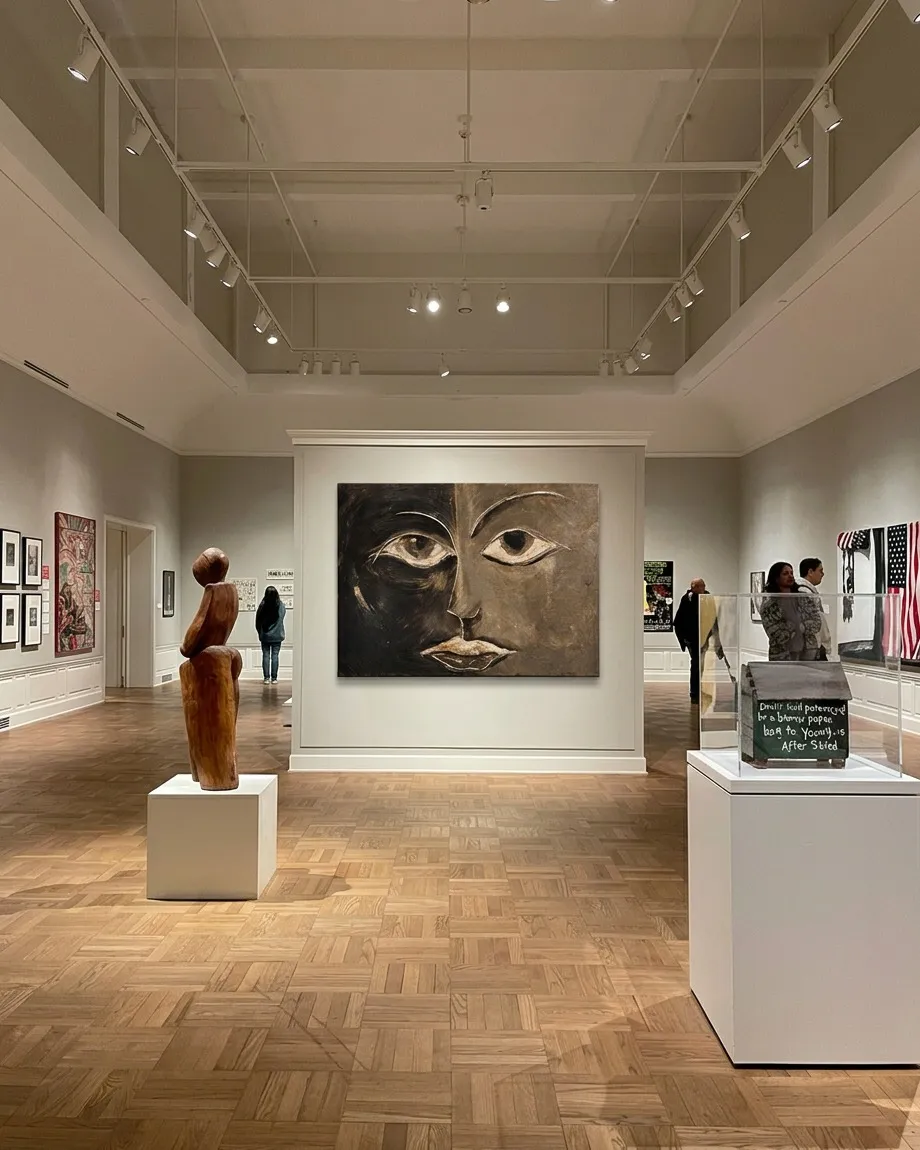
Context study / La mitad de la mirada
La mitad de la mirada, FACIES Series - Maurizio Valch
The monumental frontality of La mitad de la mirada by Maurizio Valch imposes itself on the viewer with the severity of a menhir or a wall of psychological containment. The pictorial surface, structured in a 90 by 110 centimeter format, is split vertically into two hemispheres of opposing chromatic and textured natures: on the left, a dense night built through concentric black brushstrokes that trap light in an opaque whirlpool; on the right, a plane of ochre and earthy tones, with a material aspect that emulates dry clay or weathered limestone. This binary division immediately evokes the notions of the Shadow and the Double developed by Carl Gustav Jung, the Swiss psychiatrist who analyzed the primordial images inhabiting the collective unconscious, whose perspective is key here to unraveling how this fragmented face does not depict a concrete subject, but rather maps the archetypal forces in permanent struggle within the self. The frontal gaze, anchored in symmetrical, almond-shaped eyes outlined with a clean cut, interrogates the observer from a liminal space where self-awareness emerges precisely from that original fracture of the self. By dividing the face into light and darkness, the work does not seek to resolve the contradiction of the human psyche, but rather to freeze the precise instant of its division before the inexorable mirror of matter.
When facing this canvas of ninety by one hundred and ten centimeters, I did not seek the subtlety of academic representation, but rather the physical resistance of matter. I worked by layering dense coats of acrylic and oil, allowing the palette knife to build up the black on one side and drag the ochre pigment on the other, aiming for the surface itself to acquire the roughness of the ground I walk upon. The white lines that define the eyes, the eyelids, and the curve of the eyebrows are not strokes layered with a docile brush; they are direct physical incisions, deep scrapings executed on the still-fresh paint that wound the pictorial layers to reveal, in an almost violent manner, the luminous background of the canvas. In this physical process of subtraction, my own Mediterranean experience resonates—the echo of those archaic masks unearthed from buried civilizations that I contemplated in my youth; ritual objects that did not seek to capture the psychology or likeness of a specific individual, but rather to fix a stark presence, an imperishable human sign carved into the crust of the earth.
This formal tension between the incised volume and the flat background confronts us directly with the duality of human behavior and its tendency toward alienation. Contemplating the unperturbed symmetry of these empty pupils inevitably summons the thought of George Gurdjieff, the mystic who proposed that the ordinary human being spends existence in a state of hypnotic sleep and mechanical automatism—an idea that gains prominence in this work by prompting us to ask which of the two halves of the face is truly awake, or if both participate in a mineral lethargy. The ochre half, with its texture reminiscent of socialized skin, of molded clay exposed to the public gaze, functions as the protective mask that conceals the abyss; meanwhile, the dark side, governed by the circular black brushstroke, suggests an indomitable essence that refuses to be domesticated by the conventions of modern visual language. This silent struggle is visually related to the hieratic heritage of prehistoric Mediterranean stone idols, figures that did not need to gesticulate to impose their cosmic validity over the viewer's contingency.
I seek silence through a gaze that neither blinks nor avoids confrontation with those who pause before it. By painting these oversized eyes, which occupy almost the entire width of the composition, I do not intend to establish a conventional psychological dialogue, but rather to erect a physical threshold: in my series FACIES, the face ceases to be physiognomy and becomes a territory, a border where material abstraction suddenly condenses into a recognizable yet unreachable human sign. This is why the mouth lacks detailed anatomical features; I barely sketched it with a few thick, horizontal brushstrokes, leaving a small glint of light in the center to suggest a lip that remains silent. By annulling the word, I allow the pure texture of the eroded pigment, the roughness of the ochre plane, and the tactile depth of the black to speak for themselves, transforming the canvas into a relief where silence becomes a physical property accumulated at the edges of the incision.
Ultimately, the work operates as a surface of friction where social domestication and the wild, nameless freedom of the self collide. This dichotomy finds a precise interpretive framework in the philosophy of Osho, the Indian thinker who defended radical authenticity and the systematic demolition of moral masks imposed by civilizational structures—a theory that allows us to reframe the dark half of this face not as a space of threat or loss, but as the creative, free matrix of which we have been stripped by social conventions. By refusing any kind of harmonic resolution between the ochre and the black, the painting places us at an uncomfortable existential crossroads. The canvas is thus reduced to its material truth: a set of rough incised lines carved into a two-dimensional background, a brutal contrast of chromatic masses that refuses to dissolve into a comforting synthesis, forcing the viewer to remain suspended on the threshold of their own internal division, forever captured by that stone gaze that demands an answer only the spectator can formulate.
- Original artwork
- La mitad de la mirada
- Actual dimensions
- 35.4 × 43.3 in / 90 × 110 cm
- Presentation
- Digital contextual visualization
Context references
Maurizio Valch La mitad de la mirada · contemporary abstract face painting · modern abstract face art · abstract art with ochre and black textures · brutalist painting with incisions and spatula · large format artwork for living room gallery
About this visualization
This visualization places the artwork within an architectural context to help collectors and viewers imagine its presence in a real space. It is an interpretive reference, not an exact reproduction: the original work remains the sole authority for scale, color, surface and material presence.