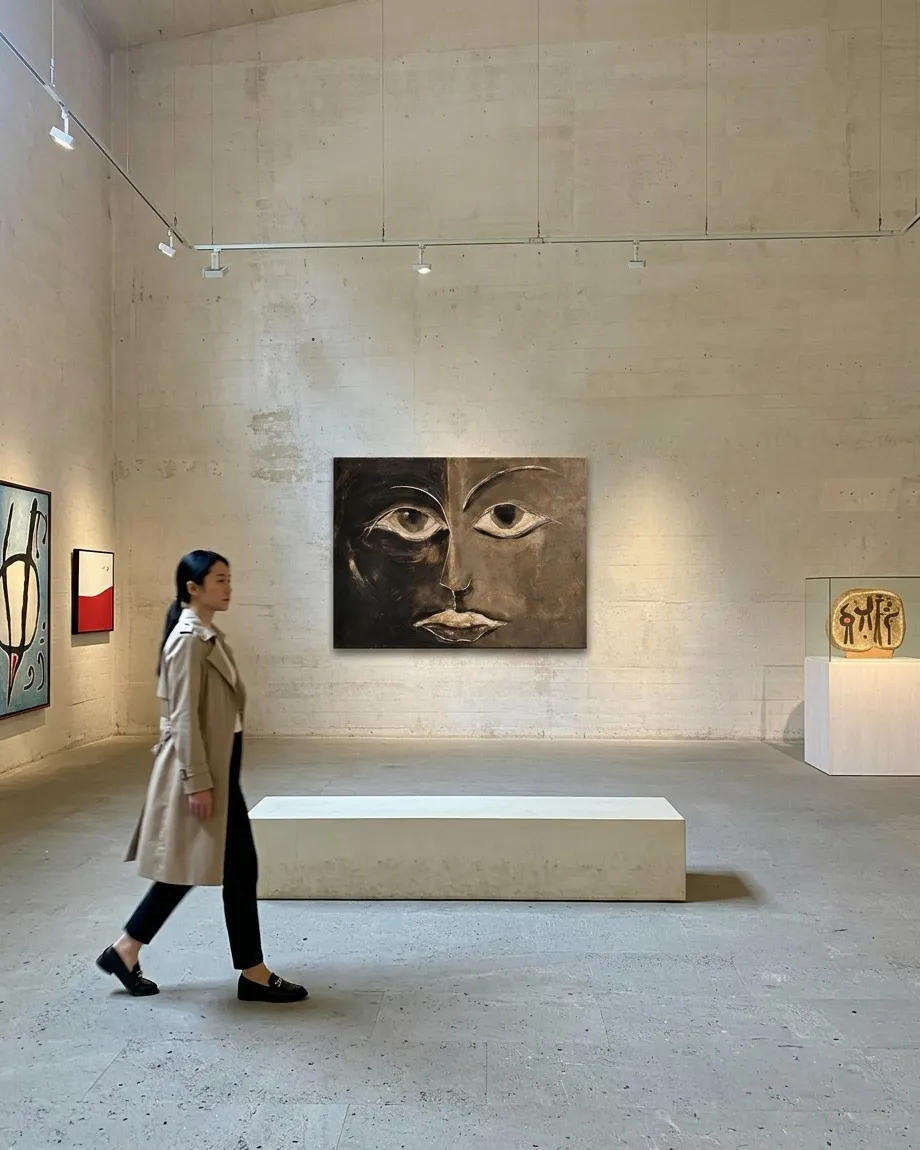
Context study / La mitad de la mirada
Abandonment, Warmth, and Listening in La mitad de la mirada - Maurizio Valch
"La mitad de la mirada" stands before the viewer like a boundary architecture, structured by an imposing vertical division that organizes and fractures the canvas into two chromatic and conceptual realities as distant as they are complementary. On the left side, the surface sinks into an abyssal gloom, a dense, rough black that evokes the absolute abandonment of light—a space where form seems to renounce the tyranny of definition to surrender to the pure latency of the void. Conversely, the right half emerges constructed on an ochre and clayey material that radiates a primordial, silent warmth of an almost geological character, as if the earth itself had been summoned to model that feature of the face. In the midst of this polarity, two monumental eyes, outlined with the primitive urgency of direct physical incisions on the pigment, challenge classical bidimensionality; their open sockets do not merely observe the observer, but seem submerged in a state of profound active listening, tuning in to the vibrations of the empty space surrounding them and the imperceptible breathing of the exhibition room.
Faced with the blank canvas, my work always begins as a tactile struggle against the plane; in this piece, the act of scraping and scratching the material became a visceral need to bring forth a hidden presence. What in my previous processes manifested as a purely abstract territory, a faceless geological stratum, began to strongly demand a physiognomy, a human outline to anchor the dispersion of the pigment. Working with the palette knives, I felt how the warmth of the thick oil, its pasty density, and its physical resistance were transformed under my hands into a rough skin, a mask of clay breathing its own material temperature. Tracing the lines of those oversized eyes, wounding the wet paint to seek the base of the support, was not an exercise in descriptive drawing, but a way of placing myself physically on the exact threshold where the outer landscape and the inner body merge, opening a window where matter is finally humanized.
It is precisely in the whitish incised marks defining the eyebrows, eyelids, and the contour of the mouth that the work acquires its greatest tragic and expressive dimension. These linear marks do not operate as ornamental additions or superficial lighting strokes, but as genuine wounds inflicted on the accumulated pigment, revealing rifts that exhume the lower chromatic layers of the support. The apparent abandonment of the conventions of realism and academic proportion strips the face of any social mask, allowing the physiognomy to function as a purely tactile and exposed shore. In this way, the monumental gaze is detached from its traditional function of judging or classifying the environment; the eyes no longer look to dominate, but empty themselves of speculative intent to transform into receptive antennas, into pure listening to the dense silence that inhabits the room, inviting viewers to lower their own defenses before the canvas.
For me, the creative process is meaningless without a true exercise of abandoning the will for absolute control; I must detach myself from my certainties and my own identity to let the painting speak for itself through accident and material error. Contemplating this divided mirror now hanging on the studio wall, I am struck by the doubt of whether this imposing face looking back at me is a disfigured self-portrait of my own memory or, on the contrary, an archaic and latent presence that already inhabited the darkness of the black and the warmth of the ochre long before I approached the canvas. My work as a painter was reduced to being the channeler of that repressed energy, the operator who with patience and violence scraped the surface to open the necessary air channels for that entity, trapped in the layers of pictorial time, to finally breathe and confront the present.
The work culminates its dramatic tension in the subtle resolution of the half-open mouth, whose material relief seems to retain a last breath suspended in the gallery space. At this point of confluence, the ancestral friction between shadow and light is not presented as a violent conflict or a theatrical chiaroscuro, but as a pact of permanence where both realms coexist in a sacred balance. The geological warmth of the earth painted in ochre, the serene abandonment of waking life proposed by the dark zone, and the reverent listening to the void emanating from the eye sockets integrate harmoniously in this half of the gaze. By fragmenting the face and renouncing perfect symmetry, the perception of the subject is not weakened; instead, we are returned a far more honest, intimate, and complete vision of our own fragmented condition, reminding us that the human mystery is only revealed when we accept inhabiting our own shadows.
- Original artwork
- La mitad de la mirada
- Actual dimensions
- 35.4 × 43.3 in / 90 × 110 cm
- Presentation
- Digital contextual visualization
Context references
large abstract ochre face painting · contemporary big eyes face art · abstract mask and face painting · modern brutalist living room wall art · painter Maurizio Valch FACIES
About this visualization
This visualization places the artwork within an architectural context to help collectors and viewers imagine its presence in a real space. It is an interpretive reference, not an exact reproduction: the original work remains the sole authority for scale, color, surface and material presence.