Context study / La mitad de la mirada
Archaic Stillness and Relief in La mitad de la mirada | Maurizio Valch
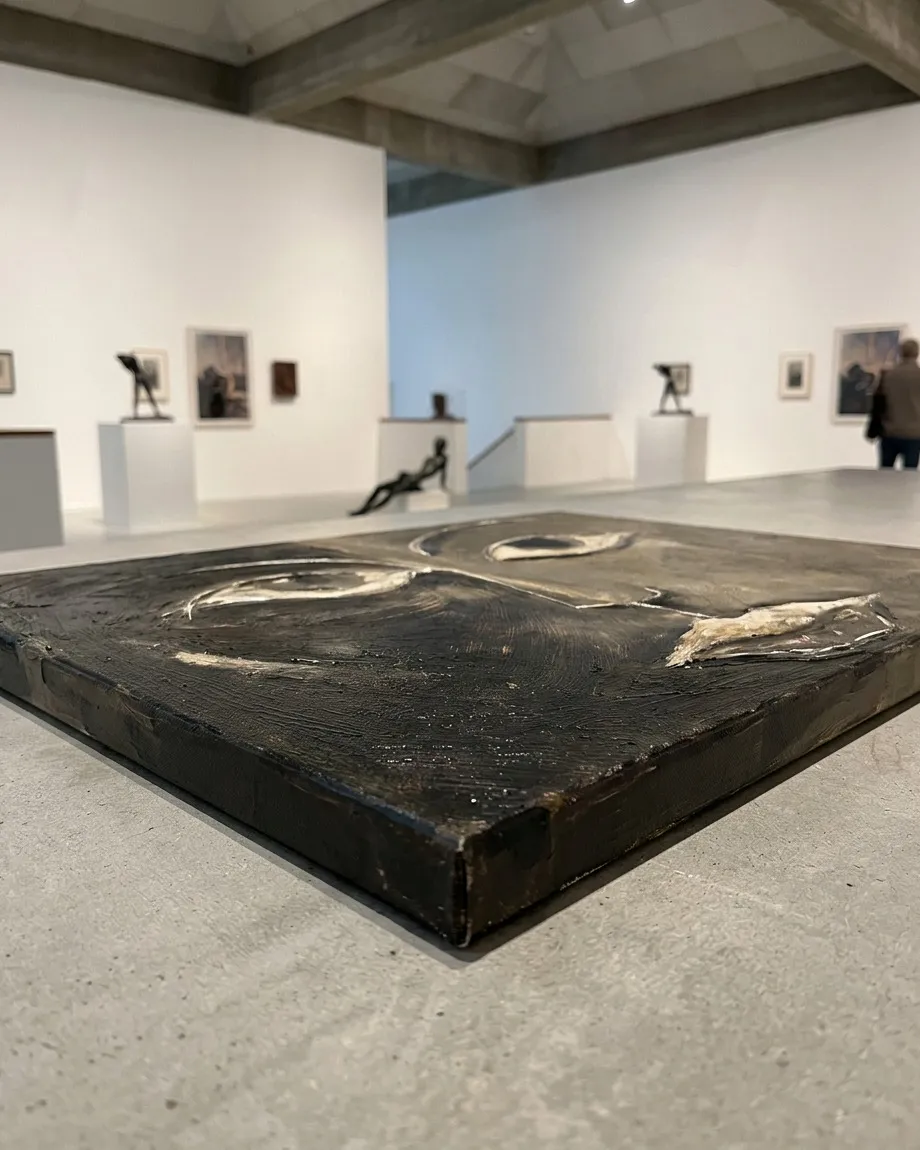
The almost horizontal layout of the work on the floor of the exhibition room radically alters the conventional axis of contemplation, forcing the viewer's body to lean forward like someone peering into a well or an ancient slab. From this low, raking angle, the relief of the black paint and dry ochre no longer function as a flat portrait, but as an uneven topography emerging from the concrete. The atmosphere of the room, with its contained lighting and the dull echo of the empty walls in the background, turns this approach into something far removed from a mere aesthetic visit; stripped of any ornament or symbol of worship, the frontality of the divided face imposes a silence that suspends the flow of ordinary time, demanding an attention bordering on reverent contemplation.
Cleaving the crust of fresh oil paint with the metal stylus, I was not thinking of building a recognizable physiognomy, but of opening a vent in the density of the matter. Scraping those empty sockets to find the light base of the canvas was a pursuit of subtraction, an attempt to find a space where the gaze is not directed at an external object, but folds back toward its own origin. I felt that by dividing the face in this severe, almost unbearable symmetry, I stripped the painting of its psychological anecdote; what remained in the studio was no longer the reflection of a man, but a silent threshold, a presence that demands silence in order to be heard.
This archaic stillness connects the piece with the oldest manifestations of human representation—those where the image did not illustrate a doctrine, but embodied a boundary before the invisible. By dispensing with halos, aureoles, or mystical attributes, Maurizio Valch's painting achieves a liturgical dimension through the pure honesty of its materials: clay, oil, ash, and rustic light. The mask does not speak to us of an individual with a history, but of the very condition of the gaze before being colonized by words. It is the formal tension between the dark half that absorbs everything and the ochre half that resists weathering that places the observer at a point of absolute questioning, where beauty no longer depends on pleasing, but on the gravity of a presence that sustains itself.
Sometimes I wonder if this insistence of mine on dividing the canvas into two perfect halves is not a way of keeping a part of myself safe from the gaze of others, a hermetic box guarding its own secret in the shadows. As I burnish the bridge of the nose and define the rigidity of the chin, I perceive that the paralysis of this mask is the same paralysis I experience when I attempt to rationally explain my existence. The painting became a physical fact that hit back; by forcing me to work with the weight of the earth and the opacity of the black, the painting stripped me of all prior theory and left me alone with the simple event of being there, holding my breath before a gaze that seems to know more about me than my own thoughts.
In the end, the true strength of this presentation lies in its renunciation of spectacular elevation. Presented so close to the ground, almost within reach of foot and hand, the work does not promise an easy ascent or distant illumination; it offers itself as a portion of marked earth that must be approached with respect. In that physical proximity to the bare concrete, the mask from the FACIES series reveals that access to what surpasses us is not found in the abstraction of the heights, but in the immediacy of wounded matter. It is in the wound of the incised mark and the density of the pigment where the viewer, pausing, discovers that the painting's gaze does not judge them, but welcomes them into its own silent mystery.
- Original artwork
- La mitad de la mirada
- Actual dimensions
- 35.4 × 43.3 in / 90 × 110 cm
- Presentation
- Digital contextual visualization
Context references
textured pictorial relief face painting · prehistoric face carved in oil · ochre and black divided face painting · contemporary art inspired by Etruscan masks · abstract face art exhibition
About this visualization
This visualization places the artwork within an architectural context to help collectors and viewers imagine its presence in a real space. It is an interpretive reference, not an exact reproduction: the original work remains the sole authority for scale, color, surface and material presence.