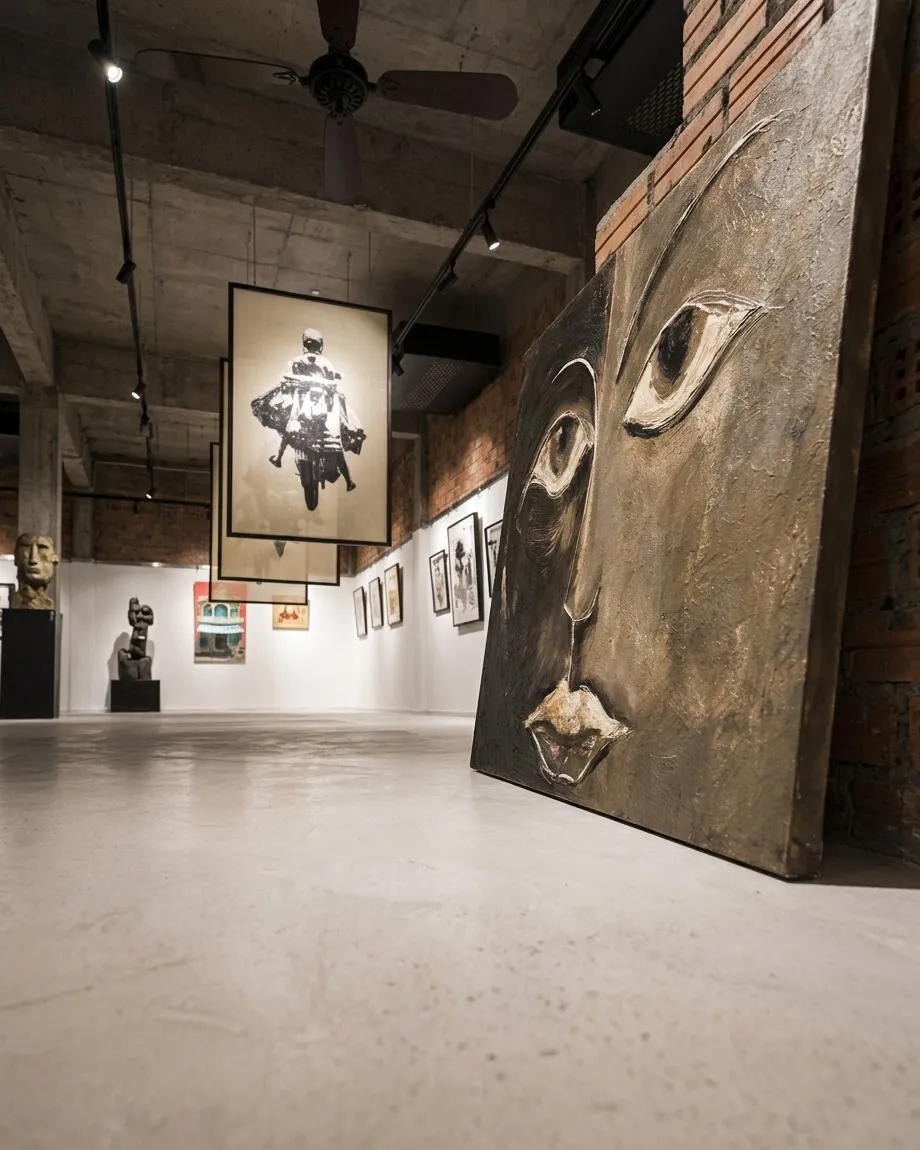
Context study / La mitad de la mirada
La mitad de la mirada: Shadow, Earth, and Suture | Maurizio Valch
Movement I: The Shadow Side
To immerse oneself in the left hemisphere of this work is to experience a thermal drop. Here, the gaze plunges into a dense matter, a damp and heavy void where light has not been invited. This is not a darkness that symbolizes fear, but a shadow that functions as a physical substrate; a mineral silence where the thick strokes seem to accumulate by sheer gravity. The left eye, outlined with a coarse and enveloping brushstroke, does not seek the outside; it seems folded back into its own latency, contemplating what has not yet taken shape. There is an asymmetrical weight pressing from this side, a dark inertia pushing the composition downward, forcing us to breathe with the slowness of someone walking underwater. Is this penumbra the origin of the face or its inevitable destiny? The surface here feels cold to the visual touch, smooth in its apparent abyss, like a wet rock waiting in the depths of a cave.
When I faced the canvas to trace the scar running through the center, I felt the dense resistance of the pigment, a material that seemed to oppose being divided. Dragging the brush to erect that wall between the darkness and the clay, my hands experienced the physical weight of a border. Does this vertical line unite the two sides of a single existence, or is it the insurmountable wall that condemns each half to an eternal solitude? The lip and the nose remained suspended there, like hostages of a tectonic tension that hesitates to erupt.
Movement II: The Central Suture (The Boundary)
The dividing line is not a simple dead border; it is a vibrant seam where two continental pressures collide. At this point of friction, the nose and the lips become the hinge preventing the face from collapsing. If this central line were suddenly erased, would the entire structure collapse into a chaos of matter, or would we finally see the fusion of two worlds that need each other to exist? Are we before a single being fragmenting before our eyes, or are we witnessing two distinct entities striving to be born from the same earthly matrix?
To understand this delicate architecture of tension, it is revealing to summon Zaha Hadid, the great architect whose fluid structures challenged gravity to teach us that space is not inhabited from rigidity, but from continuous movement and vector forces. Hadid would observe this vertical boundary not as a static wall, but as an active fault, a dynamic fold where darkness curves and stretches to transform into light. For her, the lip and the nose do not divide the face, but channel the energetic currents of the canvas, suspending the collapse through a symmetry suspended in the air.
The physicist and philosopher David Bohm joins this conversation, having proposed that reality is not fragmented, but woven into an invisible, holistic flow where the part contains the whole. From Bohm's perspective, the apparent separation between the dark half and the earthy half is an illusion of our analytical perception. The "enfolded order" of the painting pulses in that central suture: light and shadow are not opposing forces in conflict, but projections of a single underlying totality unfolding before the viewer. Thus, while Hadid makes us feel the physical tension of the boundary supporting the physiognomy, Bohm invites us to dissolve the border, revealing that each eye, though looking in opposite directions and under different lights, shares the same invisible breath.
Movement III: The Earth Side
Crossing the border into the right hemisphere, the temperature of the work changes drastically. We enter a clarity of clay and dry earth, a rough surface that retains the heat of the desert. Here, there are no promises of transcendence or celestial luminosities; what emerges is the pure presence of terrestrial matter, an ochre sediment that has captured light to turn it into texture. The eye on this side is wide open, but its gaze is not peaceful: it is exposed to the elements, furrowed by ridges and reliefs that evoke the cracked skin of the earth. This eye does not look in the same direction as its shadowy counterpart; while that one retracts in introspection, this one projects outward, measuring the distance to the viewer through the roughness of its relief. The breath here is drier, almost dusty.
Today, stepping back to observe the finished work in the stillness of the space, I perceive that the painting possesses an autonomous wisdom about the dualism of the gaze that I myself do not yet fully comprehend. "La mitad de la mirada" no longer belongs to me; it has learned to sustain the contradiction of being broken and complete at the same time. It reveals to me, in its muteness of earth and shadow, that looking is not an act of absolute clarity, but the eternal oscillation between what we decide to hide in the gloom and what we dare to expose to the harshness of the day.
- Original artwork
- La mitad de la mirada
- Actual dimensions
- 35.4 × 43.3 in / 90 × 110 cm
- Presentation
- Digital contextual visualization
Context references
textured abstract face paintings · shadow and earth duality artwork · incised face painting · brutalist clay face art · expressive abstract art decor
About this visualization
This visualization places the artwork within an architectural context to help collectors and viewers imagine its presence in a real space. It is an interpretive reference, not an exact reproduction: the original work remains the sole authority for scale, color, surface and material presence.