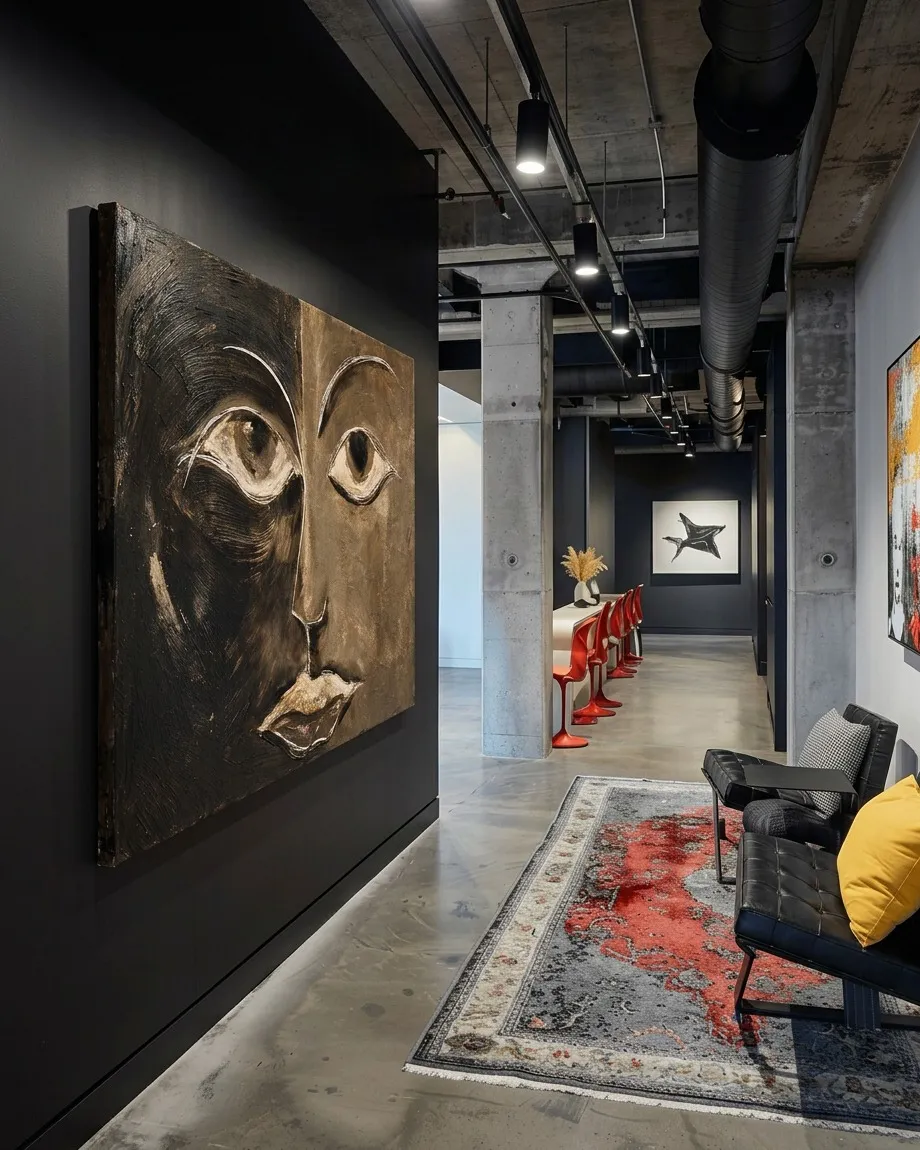
Context study / La mitad de la mirada
La mitad de la mirada in Industrial Design Living Room
I. The Left Side: The Wet Penumbra
Standing in front of the one-hundred-and-ten-centimeter height of this canvas, before the brain attempts to decipher the features, a purely thermal collision occurs. The viewer's left side cools; an imperceptible draft of damp air seems to emanate from that dense black, a mud of oil paint that retains the shine of stagnant water. The matter here has weight, almost a nocturnal viscosity that oppresses the chest and forces one to blink to clear the eyes of that physical darkness. The left eye of the painting, huge and liquid, floats in this swamp without sinking, looking at us with a stillness that does not seek to confront, but to absorb.
It is here, under the gravity of this wet penumbra, that the shadow of Baruch Spinoza emerges—the philosopher who conceived the universe as a single infinite substance where body and mind, light and shadow, are not opposites but different attributes of the same divine reality. Before this dark half, Spinoza would see not a negation of light, but light folded back on itself, expressing its power in a mode of maximum concentration. Is this left side a separate entity, or is it simply the same substance of the face folded into its own silence? For the philosopher of unity, the black and ochre of this canvas are not enemies in conflict, but the vibration of a single matter breathing in two different ways in the same sacred space of the canvas.
II. The Vertical Scar: The Threshold
The center of the canvas is not a clean line; it is a geological meridian where two tectonic plates of matter collide. The nose rises like a dividing mountain range, a partition of resistance where the wet black is stopped cold by the rough ochre. The lips, joined in a horizontal seam, act as a suture that barely manages to contain the internal pressure of both sides. On this border, the paint becomes rough, almost painful to look at closely, revealing the agitation of the brush that attempted to reconcile the irreconcilable.
> I remember perfectly the pull of the brush loaded with thick oil paint as I drew the dividing line that crosses this face vertically. I felt the physical resistance of the wet matter opposing my hand, as if the canvas itself wanted to reject the border I was imposing on it. I dragged the palette knife with an almost violent force, struggling in the absolute doubt of not knowing whether with that definitive gesture I was joining two wandering faces in a painful copulation, or whether I was splitting in half a single soul that until that second lived in peace in the whiteness of the empty canvas.
III. The Right Side: The Dry Earth
Crossing the scar of the threshold, the painting changes season and temperature. Ochre is not a color, it is a climate: it is a land scorched by the sun, a desert where the oil has been worked with such dryness that the light seems to scrape the surface like dust accumulated on an old mirror. Here the right eye, outlined with a line reminiscent of the incisions of primitive clays, lacks the aquatic moisture of its twin. It is a mineral gaze, made of lime and dry wind.
Contemplating this arid half, a child would approach the painting and, free of aesthetic theories, ask the only truly crucial question: “Which of the two eyes blinks first?”, or perhaps, looking at the tension of that divided mouth, “why does the dark side look like it is going to cry and the earth side looks like it is going to bite?”. The child immediately detects the temporal asymmetry of the face, the fact that one half lives a second before or a second after the other.
This suspension of time connects us with the sensitivity of Yasujirō Ozu, the filmmaker who revolutionized the gaze by placing his camera at ground level, capturing the quiet melancholy of the passage of time in the stillness of domestic spaces. Ozu would understand this face not as a mythological monster, but as the portrait of a daily loss. Its frontal, low gaze dialogues with the cinematic stillness of the Japanese director: in the empty space that separates these two eyes, the same thing happens as in the famous empty shots of his films. There is a domestic silence, a poetic resignation before the imperfection of life that gently clashes with the Spinozian longing for totality. The canvas is not resolved; it remains suspended in that tension between the desire to be one and the humble acceptance of being broken.
> Today, years after having finished the work, I stand in front of it and no longer recognize myself in its strokes. I feel a strange discomfort, as if the one-hundred-and-ten by ninety-centimeter canvas had independent life from my memory and my hands. I find myself observed and, in some way, judged by this two-pronged gaze that I myself provoked but no longer control. There is an area in the transition of the ochre cheek, a small knot of dry, dirty oil, that feels completely foreign to me, as if another hand had slipped into the studio during the night to paint what I did not dare to see.
- Original artwork
- La mitad de la mirada
- Actual dimensions
- 35.4 × 43.3 in / 90 × 110 cm
- Presentation
- Digital contextual visualization
Context references
paintings for modern offices · decorating industrial loft with art · face painting on black wall · brutalist and minimalist artworks · decorating ideas with large paintings
About this visualization
This visualization places the artwork within an architectural context to help collectors and viewers imagine its presence in a real space. It is an interpretive reference, not an exact reproduction: the original work remains the sole authority for scale, color, surface and material presence.