Context study / La mitad de la mirada
La mitad de la mirada — Context Study
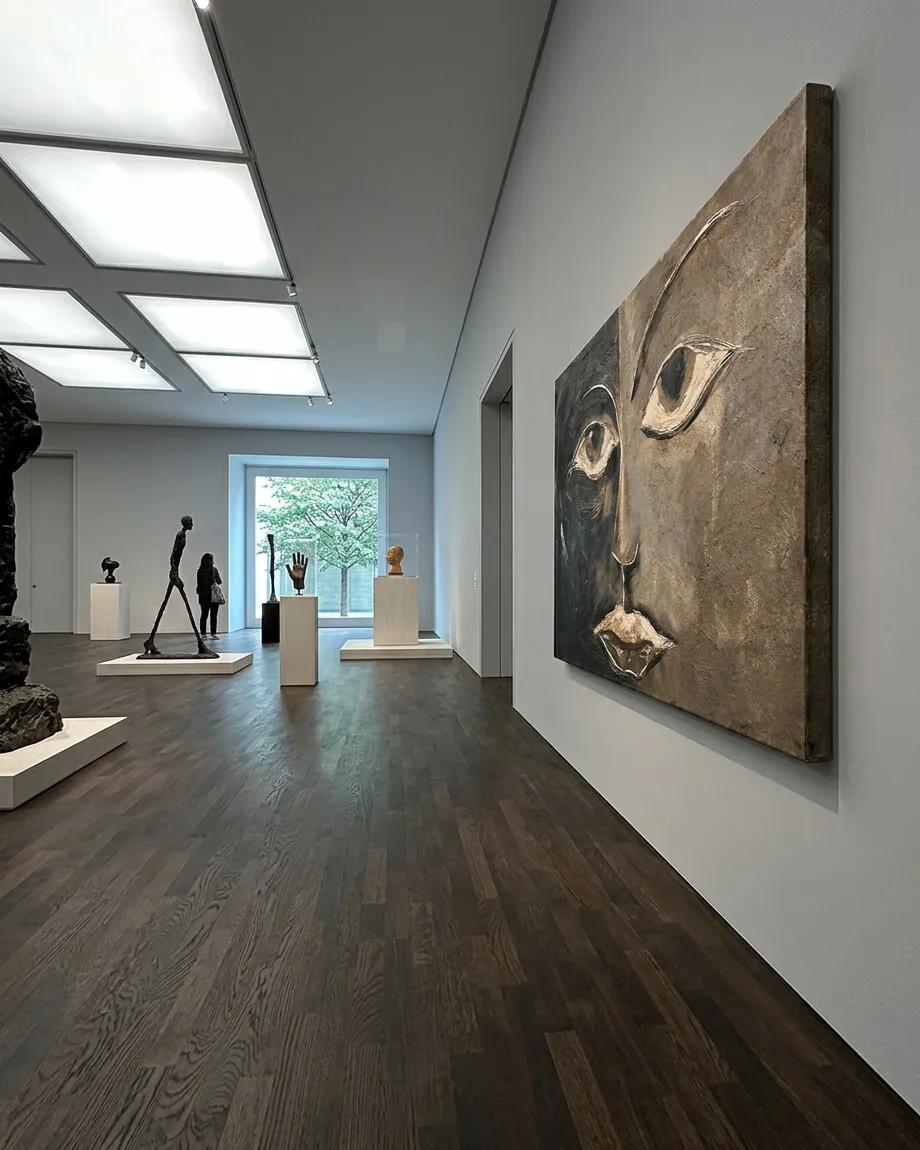
The gaze stops on the museum wall not before a narrative of fracture, but before the fracture itself turned into a motionless presence. In this room of austere proportions, where slender-limbed bronze sculptures seem to measure the solitude of the space, "La mitad de la mirada" imposes a radically different vibration: a compact weight that does not explain its origin. The vertical division of the face, separating the mass of dense black from the ochre mud resisting on the right, does not function as the illustration of a moral dilemma or the staging of a personal drama. It is the instantaneous condensation of an emotional atmosphere that dispenses with anecdote; a state of suspension and gravity that does not need to justify its reasons to take over the room with the force of an ancient unearthed monument.
When I plunge the metal tip into the fresh oil paint to open the contour of those disproportionate eyes, I am not thinking of a story that must be told. There is no before or after in this partitioned face; there is only a physical urgency, a muscular pulse seeking to stabilize an inner tension on the canvas before thought begins to manufacture its explanatory theories. Black is not a metaphor for sadness, nor does ochre represent the resignation of the earth; they are densities, temperatures that clash in my studio until they find a point of equilibrium as tense as it is insurmountable. By scraping the layers and removing the excess pigment, what I pursue is precisely to strip the fact of its literature, letting the paint act as a clean channel where discomfort or quietness hold themselves up by their own material weight, without the interference of language.
This renunciation of narrative brings the work closer to the contemplative sobriety of Mark Rothko's color fields, where color ceases to describe the world to transform into a space of pure emotional immersion. In the oblique perspective offered by this gallery, the painting reveals its true three-dimensional nature: a relief that projects from the wall and dialogues with the dark wood of the floor and the silence of the rooms. The incised eyes, reminiscent of the rough cuts of archaic Mediterranean masks, look straight ahead but do not communicate a specific message. By avoiding any anecdotal or contemporary physiognomic detail, the canvas empties itself of individual psychology and offers itself to the viewer as a container of silence, a structure that does not allow itself to be deciphered but returns with unsettling clarity the echo of one's own inner noise.
Sometimes, contemplating the work exhibited in such a stripped environment, I wonder if it is not precisely the stillness of this silent gaze that generates the vertigo of whoever observes it. In the studio, the painting is a somatic battlefield where I fight against symmetry and the drying of the oil; here, suspended on the white wall, it seems to have reached a mineral paralysis that has frozen psychological time. The viewer instinctively looks for a "why" in that barely carved mouth, an explanation to relieve the tension of being addressed by a divided presence that offers no comfort. However, I have no theory to give them to calm that suspicion: the work is that instant in which the mind discovers itself divided, a simple and naked fact that can only be observed if we renounce the haste of wanting to diagnose everything.
The journey through the room thus ends in front of a precarious border that does not seek to be resolved. The illuminated and nocturnal halves of the face coexist in "La mitad de la mirada" without either attempting to dominate the other, proposing a model of order that does not depend on harmonic reconciliation, but on the capacity to sustain friction. By laying down the weapons of analysis and symbolic translation, the viewer who stops in this concrete and stone loft does not find a psychology lesson, but a material mirror. The painting, turned into a tactile shore where the limits of the self dissolve in the density of the pigment, demonstrates that an emotion is not explained: it is inhabited with the same dignity with which the crust of oil supports the changing light of the afternoon.
- Original artwork
- La mitad de la mirada
- Actual dimensions
- 35.4 × 43.3 in / 90 × 110 cm
- Presentation
- Digital contextual visualization
Context references
museum level art · visually powerful abstract painting · minimalist decor with dark paintings · abstract expressionist face · collector paintings
About this visualization
This visualization places the artwork within an architectural context to help collectors and viewers imagine its presence in a real space. It is an interpretive reference, not an exact reproduction: the original work remains the sole authority for scale, color, surface and material presence.