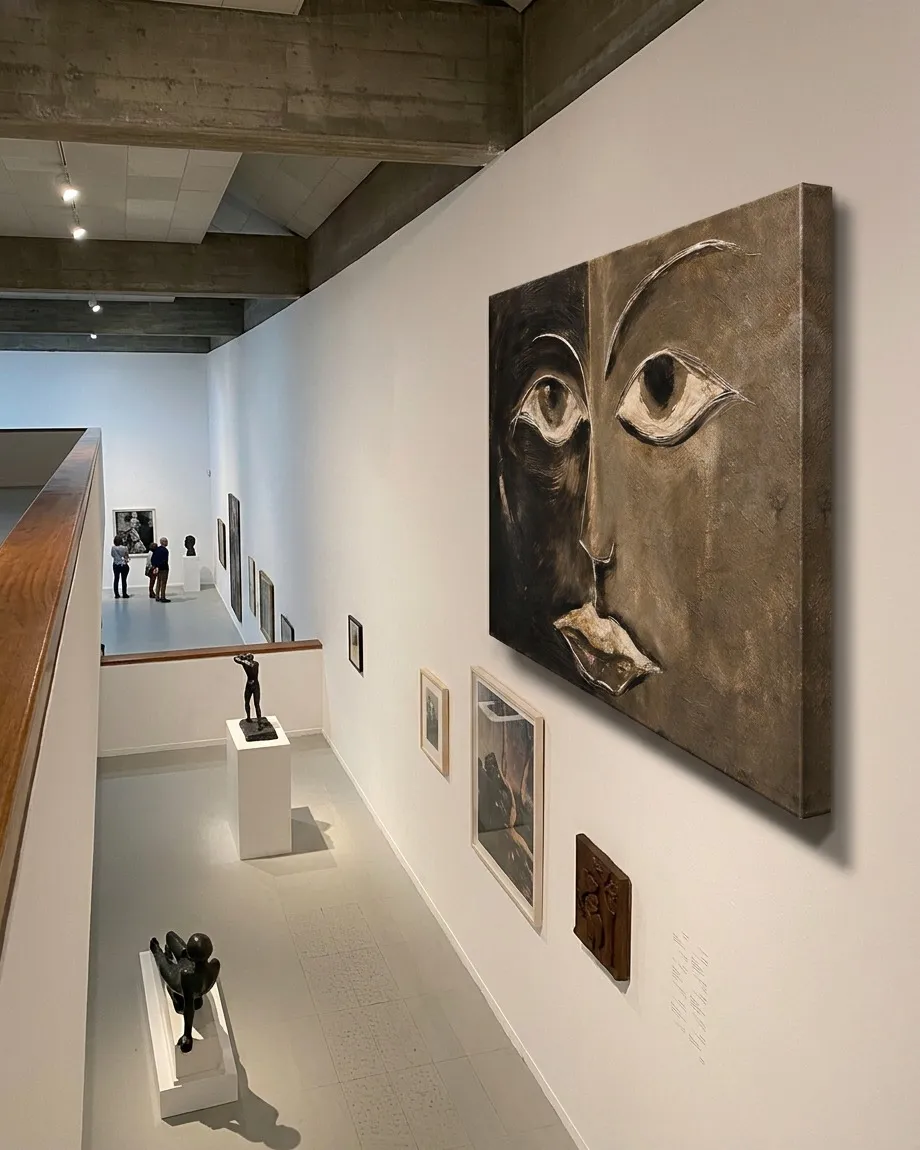
Context study / La mitad de la mirada
La mitad de la mirada in Contemporary Art Gallery
The surface of "La mitad de la mirada" (90 x 110 cm) offers itself to the viewer not as a two-dimensional pictorial surface, but as a biseeted geography where matter becomes the topography of conflict. On the left half, a dense black, applied with an opaque and bound gesture, absorbs light and buries it in a bottomless hollow; on the right half, an earthy brown, loaded with sediments and roughness, evokes the mineral consistency of eroded soil. This face does not aim to be a psychological representation or a conventional portrait, but a geological stratum emerging from the accumulation of oil and acrylic. It is in this vertical slash, dividing the face along its symmetrical axis, that vulnerability is inscribed—a physical and identity exposure that leaves the figure exposed to the elements of the canvas, devoid of shelter and torn at its very origin. The whitish lines outlining the eyebrow, nasal contour, and lips do not function as superficial ornamental strokes, but as physical incisions, direct gashes into the impasto that reveal the structural wound of the matter and act as the visible scars of that foundational vulnerability.
Plunging metal into the fresh paste of the painting is an act of excavation, an attempt to find the reverse of my own painting through the violence of scraping. While working on this canvas, I understood that permanence does not reside in the immutable rigidity of a marble block or the eternal fixation of a line, but in the record of wear, in the physical memory of aggression that the support is capable of resisting. In carving the eye sockets and opening the corner of the mouth directly onto the superimposed layers of pigment, I did not seek to define a physiognomy, but to leave a record of time and loss. The face does not remain because it is protected from the outside, but precisely because it has been wounded, because the incision has removed the excess matter to reveal a bone of hidden light; the line that survives the scraping is the tactile trace that refuses to dissolve under the density of black and earth.
The formal tension of the work is concentrated in the irreconcilable asymmetry of its eyeballs, two sockets operating under opposing optical laws. The left eye, plunged into the dense, tarry patch of the dark plane, directs its orbit toward an inaccessible interior abyss, a self-absorbed gaze that seems to close off any communication with the outside. On the contrary, the right eye, defined by a firm incision on the brown crust, dilates toward the viewer, claiming a common space of visual confrontation. In this mismatch lies the true wonder: an experience devoid of aesthetic complacency that arrives as an unsettling astonishment before the radically strange. The wonder manifests when, in the center of this face split by vulnerability and broken matter, a gaze suddenly emerges that recognizes and appeals to us; it is the precise instant when the physical crack of the painting ceases to be a destructive void and becomes an eloquent presence that returns our contemplation.
For years I walked through arid territories, chasing the horizon line, the weight of stone monoliths, and the vibration of color blocks on barren land; however, this face ended up imposing itself in my studio as an absolute limit, as the only desert from which I could no longer escape. Painting this telluric portrait meant transferring the silence of the plain to the scale of a human head, discovering that wonder also dwells in absolute stripping, in the miracle of removing layers of paint until only the elemental structure of bone and gaze remains. Observing the finished piece against the gray concrete of the wall, I am struck by the doubt of whether this divided face is the mirror of my own accumulated fatigue after the long walks or if it is an alien presence, a silent observer that has taken possession of the matter to interrogate me from its stillness.
In its final resolution, "La mitad de la mirada" establishes itself as a tactile shore, a physical membrane where seemingly incompatible forces coexist and where the concepts of vulnerability, permanence, and wonder ultimately merge into a single sensory experience. The mineral heaviness of fired clay is measured against the cutting lightness of incised light, while the absolute muteness of the closed lips, which seem ready to crack under the weight of the pigment, retains a contained vibration. The painting renounces offering narrative solutions or explanations about the fragmentation of the contemporary subject; instead, it limits itself to holding an open question materialized in the thickness of the canvas. Approaching this textured surface, the viewer finds themselves exposed to the same fragility of the painted face, confronting the persistence of their own gaze against the inexorable passage of time.
- Original artwork
- La mitad de la mirada
- Actual dimensions
- 35.4 × 43.3 in / 90 × 110 cm
- Presentation
- Digital contextual visualization
Context references
minimalist painting for living room · textured relief painting · contemporary artworks for decor · abstract oil faces · artistic interior design
About this visualization
This visualization places the artwork within an architectural context to help collectors and viewers imagine its presence in a real space. It is an interpretive reference, not an exact reproduction: the original work remains the sole authority for scale, color, surface and material presence.