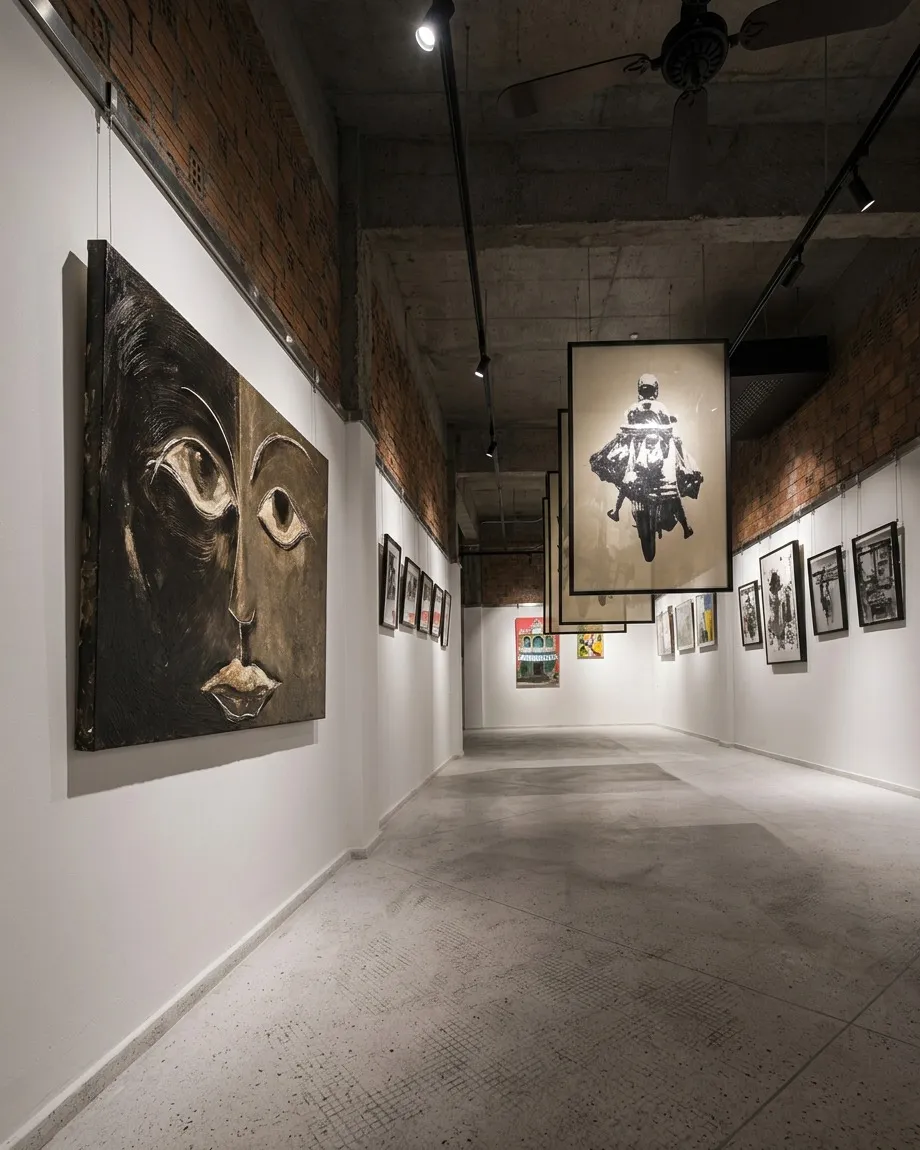
Context study / La mitad de la mirada
La mitad de la mirada - Maurizio Valch | FACIES Series
Hung on the severity of a wall bordering the rawness of exposed brick and industrial concrete, La mitad de la mirada asserts itself not as the portrait of an unfamiliar face, but as the material testimony of a time folded back on itself. This imposing double-faced mask, split with the precision of a geographical wound, eludes chronological narrative; there is no date here, no mapped journey on paper, nor any event to decipher. The thick, scraped oil behaves like a silent logbook, where the accumulation of earth and the absolute opacity of black record the density of an existence stripped of anecdote. In this exhibition environment, where the work coexists with images of transits suspended in mid-air, the ninety-by-one-hundred-and-ten-centimeter face presents itself as a somatic border inviting us to pause before the pure presence of sediment.
When I plunge the palette knife into the wet paint to trace that vertical divide, I know I am not illustrating a psychological conflict, nor am I recalling the moves and abandonments that have marked my personal geography. Each violent scraping over the ochre, each accumulation of dark pigment resisting being shaped, is simply the body's way of remembering the weight of paths walked, the fatigue of temporary rooms, and the exposure of beginnings. I do not need to paint the tent in which I lived with my dogs, nor the map of the five Caminos de Santiago I exhausted on foot; the wound I open by removing the crust of paint to carve the eye socket is already the physical record of that vibration. Painting thus becomes my true autobiography: an accumulated ground where the daytime self and the nocturnal shadow dispute the space without either half having any obligation to explain itself.
Maurizio Valch's painting finds in this archaic mask a subterranean affinity with the concept of wall or skin that Antoni Tàpies explored through matter scarred by time. By dispensing with illustrative anecdote, the canvas is transformed into a tactile archive where life appears decanted, stripped of the linearity of a biographical narrative. This "half of the look" that interrogates the viewer from the roughness of limestone and the abyss of soot embodies Gurdjieff's theory of the multiple "selves" that alternately govern our mind; there is no homogeneous protagonist in this story, but rather systems of thought coexisting under an uneasy symmetry. The non-narrative autobiography is fulfilled here: the external event is completely evacuated to make room for the pure topography of mental resistance.
For a long time, I fell into the trap of wanting to turn my existence and my painting into a grand heroic quest, a journey of self-improvement to justify each of my scars before an invisible court. Today, observing the mineral stillness of this chin and the paralysis of this mouth carved out of the matter, I understand that peace does not come from summiting any peak or accumulating comforting interpretations of who I am. The act of painting this split face is an act of detachment from that epic narrative; I do not seek to impress with a dramatic display, but to register the simple fact of a gaze that finds itself divided. In the end, there is no theory to sustain: the dry brush drags the final shadow, and what remains on the stretcher is only the silence of a mind that has understood its own noise.
At the end of the long gallery corridor, under the overhead light that defines the canvas's relief, the mask stands like a monolith that has survived its own shipwrecks. The viewer approaching this tactile shore finds no mirror in which to seek comfort or decipher someone else's drama, but rather a surface that reflects their own internal division. The work does not narrate the artist's life—it embodies it in its geological density, demonstrating that the deepest experience can appear without recognizable events, diluted in the temperature of clay and the vibration of black. Facing this gaze born of incision and void, questions about past and future lose their psychological urgency, inviting us to rest in the immensity of a present that, like cold ash, no longer needs to defend any theory about itself.
- Original artwork
- La mitad de la mirada
- Actual dimensions
- 35.4 × 43.3 in / 90 × 110 cm
- Presentation
- Digital contextual visualization
Context references
industrial wall art · rustic contemporary art · split face painting · brutalist art decor · large format gallery paintings
About this visualization
This visualization places the artwork within an architectural context to help collectors and viewers imagine its presence in a real space. It is an interpretive reference, not an exact reproduction: the original work remains the sole authority for scale, color, surface and material presence.