Context study / La mitad de la mirada
La mitad de la mirada in Modern Museography
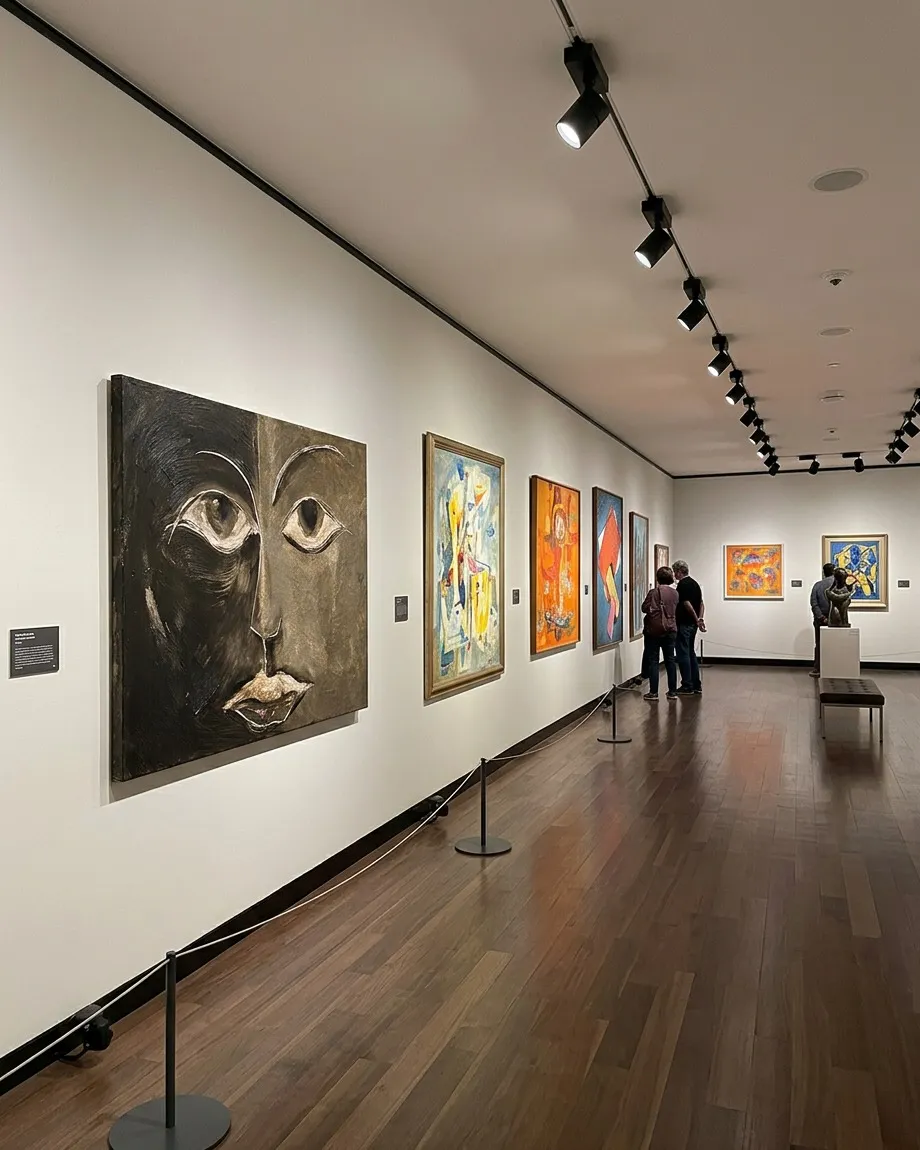
In La mitad de la mirada, the geography of the monumental face presented by Maurizio Valch unfolds as a territory in constant material friction. Vertically divided by a sharp border, the surface of the canvas struggles between a left half submerged in a dense, textured black and a right half worked in an earthy, weathered, grey-ochre tone. This severe division of the composition immediately questions the concept of belonging: the face refuses to affiliate itself with a single space, inhabiting instead the vague boundary between absolute concealment and mineral exposure. Far from functioning as a mere descriptive drawing, the thick incisions of a rustic white outlining the almond eyes and eyebrows operate as an architecture of protection. These subtractive grooves, which bite into the layers of paint, act as a material bastion that shields the gaze from external wear—a parapet preserving inner attention from the dissolution of the background.
In the solitude of the studio, when confronting the density of the oil and acrylic built up on the support, the act of incising the surface ceases to be a purely formal decision and becomes a physical struggle. Scraping the material with force, cutting through the superimposed layers to outline those monumental eyes, implies a real physical exertion where my hands must negotiate with the resistance of the paint mass. It is in that deliberate wound where I place my trust. I do not understand this term as an abstract optimism, but as a somatic risk I assume when holding the palette knife: the bodily certainty that, by subtracting material and opening a raw white slit in the dark plane, a living presence will appear—a gaze that challenges us, rather than an inert and silent void.
The gaze that emerges from this process features an imperfect symmetry, mirrored below by full lips that have also been defined through the subtraction of material. Here, a fundamental paradox is revealed, linking protection with vulnerability. Although the white lines outlining the features seem to function as protective shields or scars designed to isolate the face, they actually operate as tactile cracks—rough passages through which the surface breaks and allows the viewer entry. At this point of the visual journey, belonging ceases to be an affiliation with a social environment or a secure external refuge, becoming instead the acceptance of one's own internal division: the recognition that we are, simultaneously, the density of the shadow and the erosion of the earth.
By walking long distances through barren geographies, observing how time and the elements wear away the crust of the land, I have learned that the human body and the landscape share the same stratified skin. This face-landscape is the result of that observational experience—a map of dispossession where rough textures and scrapings emulate the textures of soil and abandoned walls. For me, true trust only arises when I decide to drop the character's mask and accept the raw exposure of the canvas. By scraping away the impasto and revealing the rustic skeleton of the painting, I expose the vulnerability of the medium, transforming the painting into a testimony of silent resistance that does not seek to please, but to endure.
The final encounter with La mitad de la mirada collapses the analytical distance between viewer and representation to establish a tactile shore. The formal opposites of the work—light and shadow, the interior protected by the incisions, and the exposed exterior of the canvas—unify under the raw vibration of the reliefs and grooves. In the end, trust, protection, and belonging do not appear as concepts foreign to the fracture of the monumental face, but are revealed in the radical honesty of its fall. It is in the silent vibration of its wounded matter, where the white grooves expose the inner layers of the support, that we discover that the only possible integrity lies in embracing our own cracks.
- Original artwork
- La mitad de la mirada
- Actual dimensions
- 35.4 × 43.3 in / 90 × 110 cm
- Presentation
- Digital contextual visualization
Context references
hallway decoration with large abstract paintings · lighting paintings in modern museums · how to hang large format canvases in hallways · art galleries with wooden floors and track lighting
About this visualization
This visualization places the artwork within an architectural context to help collectors and viewers imagine its presence in a real space. It is an interpretive reference, not an exact reproduction: the original work remains the sole authority for scale, color, surface and material presence.