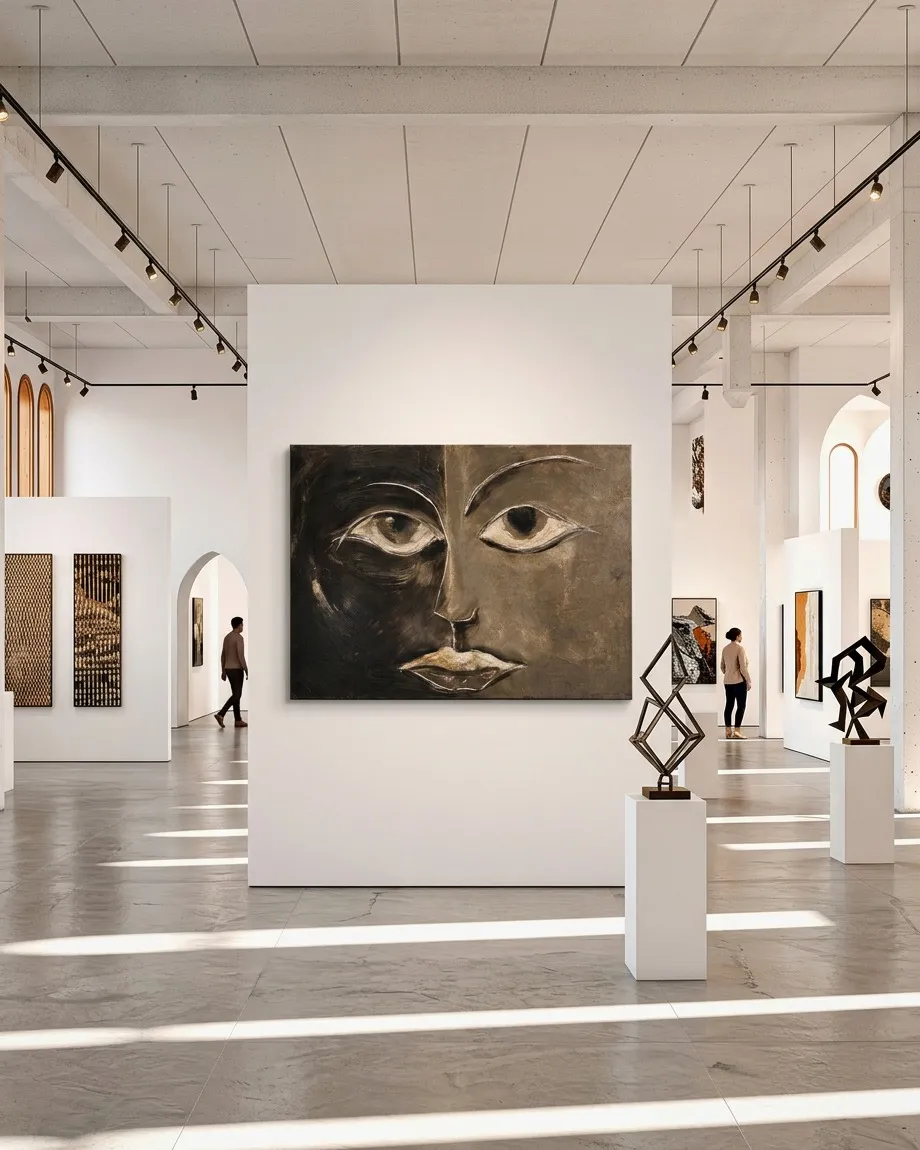
Context study / La mitad de la mirada
La mitad de la mirada in a Contemporary Art Gallery
First Movement: The Left Side (The Shadow of the Brain)
When resting our eyes on the left half of La mitad de la mirada, we enter a territory where light has been defeated or, perhaps, has not yet been born. Here, Maurizio Valch’s brushstroke is dense, almost tactile in its darkness; a penumbra of charcoal and bitumen tones that seems to absorb the energy of the room. From this blackness emerges an oversized eye, suspended in a vigil that does not belong to the outside world. It is not a gaze that seeks an object, but one that retreats into the interior of the skull itself, a mirror-eye turned toward the mystery of the subject. What sound does silence make on the left half compared to the textured murmur of the right half? It is a dull silence, a fertile yet hermetic void, like that of a mind contemplating itself in absolute isolation.
Faced with this half in shadow, the sensitivity of Oliver Sacks, a pioneer in narrating with deep compassion the detours of the mind and the strange adaptations of our neurological perception, is revealing. Sacks would not see in this asymmetry a mere aesthetic decision, but a plastic representation of hemispheric tension. We might wonder if this face suffers from a sort of visual "hemineglect", that clinical condition where the brain actively ignores one half of space or of itself. However, in Valch's work, the left side is not absent through forgetting, but hyper-present through the accumulation of shadow. It is the hemisphere of intuition and the non-verbal, reclaiming its existence through an eye that watches from the night of the unconscious.
When I placed the brush loaded with black on the canvas, I immediately felt the physical resistance of the material, as if the shadow itself refused to be contained by the limits of a line. My hand did not seek to illustrate a division, but to experience the tension of a boundary: tracing a meridian on the canvas where dark and light pigment had to negotiate their right to exist. I was obsessed with the idea of dividing an identity, of fragmenting this face into two opposing worlds, without completely destroying it in the process. Each stroke in the dark abyss was an attempt to rescue a form from oblivion, while the opposite side demanded a different surrender, an opening toward the rough and the evident.
Second Movement: The Right Side (The Exposed Matter)
Crossing the threshold of the nasal septum, the painting takes an absolute turn toward the outdoors. The right half of the canvas unfolds in a symphony of ochre, earth, and textured gray tones that evoke the skin of clay or the bark of a tree exposed to the erosion of time. Here, light is not an external agent illuminating the face, but a quality emanating from the very materiality of the pigment. The eye on this side is wide open, completely surrendered to the sensory experience of the outside. If the left eye retreated into introspection, this right eye holds the weight of the real, assuming the vulnerability of being seen, of registering the dust, the air, and the passage of observers in the gallery.
It is in this bare exposure where the presence of Ramana Maharshi, a master of spiritual inquiry who dismantled the illusions of duality to return us to the source of pure being, becomes indispensable. While neurological analysis stops at the obvious partitioning of the face's functions, Maharshi invites us to ask the question that deactivates the conflict: “Who is the subject observing both halves?”. Looking at this right eye, so deeply rooted in matter and the world of forms, the sage would remind us that the light revealing the texture of the earth and the darkness flooding the left side are, ultimately, projections on the same conscious screen. It forces us to look at the painting not as two competing halves, but as the fluctuation of a single mind that awakens and falls asleep at the same time. Contemplating this transition, one must wonder: is the dark half invading the light, or is light eroding the night of this face? And which of the two eyes will blink first under the weight of its own reality?
Third Movement: The Seam of the Meridian
The true drama of La mitad de la mirada does not occur in the stillness of its extremes, but in the vertical scar that joins and separates them. The line of the nose functions as a meridian, a vibrant seam where dense shadow and textured earth touch, repel, and fertilize each other. At this boundary, the figure's mouth becomes the territory of a precarious truce: the upper and lower lips undergo the same chromatic division, suggesting that any word this face attempts to utter will be born blessed by the light of reason and, at the same time, tinged by the enigma of the abyss. Is this a face dividing in two, or two souls attempting to merge into a single mirror?
Now that I observe the work hanging in the quiet of the room, under the overhead light that bathes the exhibition space, I realize that it knows something I was completely unaware of while painting it. There is an inescapable strangeness in feeling watched by the creatures of one's own creation; I notice how those two eyes, so dissimilar in their execution and destiny, converge on a point in space situated just behind my shoulders, as if looking for someone else. I admit that the true secret of that divided gaze escapes even me; I was only the bridge for that crack to manifest, the transcriber of a border that now questions me in silence from the wall.
As we physically step back from Maurizio Valch’s canvas, the formal division begins to dissolve in our retina, but the wound of its duality remains open in our perception. There is no harmonious resolution or final verdict to reconcile the night and day of this face. We leave the room with the suspicion that we, too, harbor that invisible meridian, that seam where our analytical mind and our deepest intuition look at each other face to face, waiting, in an eternal suspense, to see which of the two eyes will decide to blink first.
- Original artwork
- La mitad de la mirada
- Actual dimensions
- 35.4 × 43.3 in / 90 × 110 cm
- Presentation
- Digital contextual visualization
Context references
abstract painting exhibited in gallery · art layout ideas for modern rooms · contemporary art mounting · abstract oil painting on canvas exhibition
About this visualization
This visualization places the artwork within an architectural context to help collectors and viewers imagine its presence in a real space. It is an interpretive reference, not an exact reproduction: the original work remains the sole authority for scale, color, surface and material presence.