Context study / Il confine del fuoco segreto
Il confine del fuoco segreto Artwork in Art Gallery | Maurizio Valch
Movement I: The Upper Void (The stillness of the air)
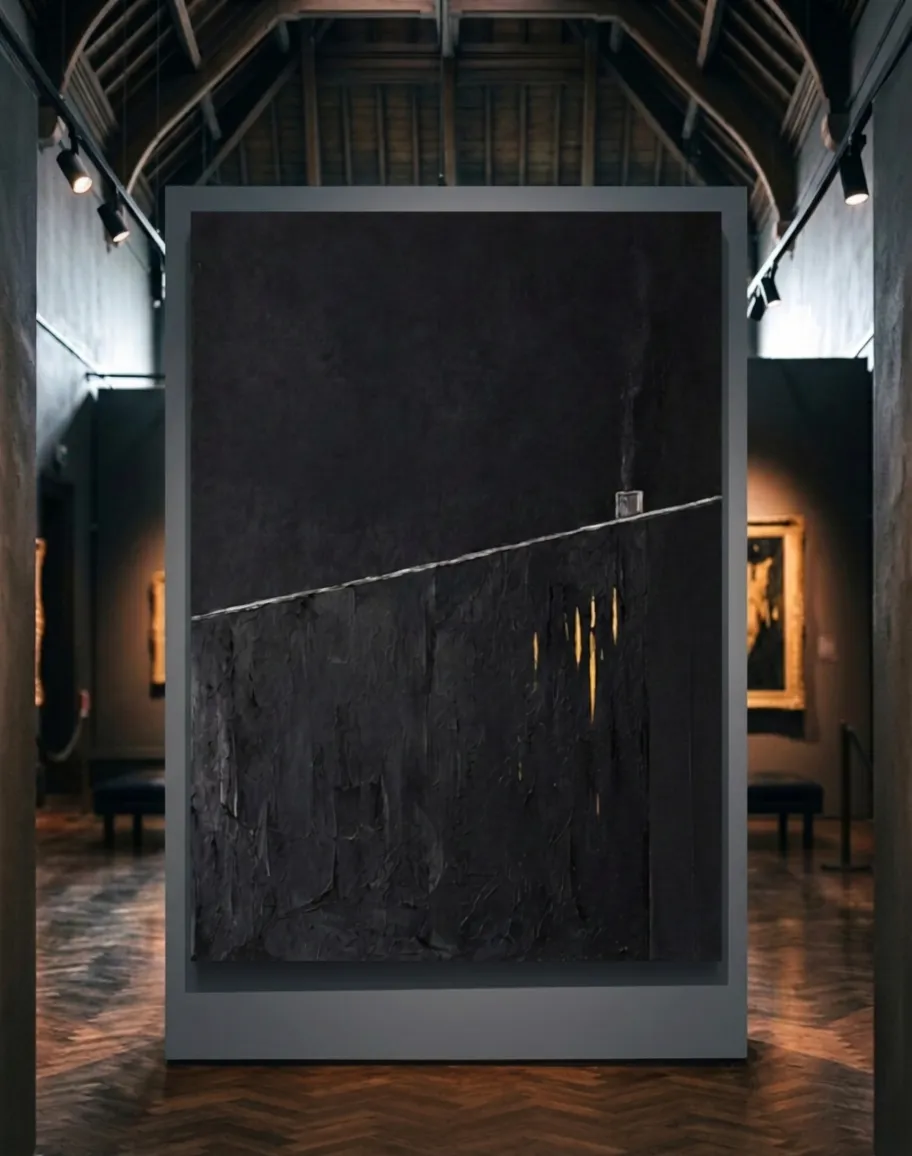
In the upper half of the canvas, black is not an absence, but a suspended density. It is an atmospheric plain, a velvety sky that seems to absorb any acoustic vibration. Upon this plane of absolute geometric calm, a thin column of smoke rises improbably from a mysterious silver cube crowning the slope.
Before this suspended enigma, we summon the gaze of Hypatia of Alexandria, an astronomer and mathematician who seeks to decipher the geometric order of the cosmos, the mathematical tilt of the slope, and the physics of light attempting to escape the abyss. Hypatia observes the subtle grayish exhalation and calculates its vector trajectory: to her, the smoke is an indicator of invisible forces, a perfect vertical line defying the gravity of the void. However, her rigorous measurement is interrupted by the perspective of Astrid Lindgren, a weaver of childhoods and rebellions who does not seek physical laws, but rather the tiny being inhabiting the chimney and the secret play occurring beneath the heavy black carpet. Astrid tilts her head and wonders: Who cleans the soot from that impossible chimney in the middle of nowhere? For her, that thread of smoke is not a physical vector, but the sigh of a tiny castaway sending signals of life from their cubic refuge, or perhaps the secret code of a game that we adults have forgotten how to play.
While Hypatia attempts to measure the refraction of starlight in the upper void, Astrid insists that the smooth sky has the texture of a blanket to protect the chimney from the cold of space. We stand here before the body's first major question to the image: if the silver line dividing the painting were an eyelid, which part is asleep and which part is dreaming?
Movement II: The Boundary Line
The silver diagonal cuts through the space with the precision of a surgical wound. It is the point of maximum tension, the filament where two incompatible realities collide. It is on this threshold where the vibration of the suspended metal becomes matter and vibration.
"When I drew that silver diagonal, my pulse trembled before the immensity of the cut. I physically felt the need to establish a limit, a boundary that would prevent the gravity of the lower abyss from devouring the subtle lightness of the upper air; it was the urgency of separating the silence from the scream, knowing that a single millimeter of deviation in the tilt of the slope would collapse all the tension accumulated on the canvas."
How does the friction between the smooth black of the sky and the wounded black of the ground sound? For Hypatia, this line is a perfect geodesic boundary, a limit of zero friction where two thermodynamic forces contain one another. For Astrid, instead, the line is a dangerous slide down which a silver marble could roll eternally, a limit where the play of the sky stops just before falling into the thick, mysterious forest below.
Movement III: The Labyrinth Below (The crust and the fire)
Beneath the silver boundary, the painting becomes geology, wound, and touch. The black is no longer smooth; it is a rough, sculpted crust, full of vertical striations and impastos that retain the weight of the earth. From the depths of this dense mass, splinters of a bright, burning gold emerge, as if the pressure of the subsoil were oozing liquid fire.
Hypatia analyzes these golden incisions, seeking the refraction angle of the light attempting to escape the abyss, calculating the pressure required for energy to pass through the dense dark matter. Astrid, fascinated by the shine, interrupts her mathematical logic: for her, those vertical lights are not physical energy, but the claws of a pocket dragon sleeping peacefully beneath the heavy black pavement, stretching its fingers of fire in the dark. With childhood curiosity, she invites us to ask: how much does the black crust crushing the golden fire weigh, for it to only show itself in vertical splinters?
The temperature of the painting changes drastically in this section; the cosmic cold of the upper space is transformed into a volcanic heat, a tactile vibration pressing from the bottom of the canvas.
"I hear these two minds debating light, geometry, and play, and I must confess there is truth in both, but also a force that surpasses me. In carving that textured black and injecting gold into its crevices, I felt I was releasing an autonomous force; I admit there is a part of that golden matter beating below whose temperature I myself cannot fully control or understand, a heat that challenges my own stroke and continues to beat with its own life in the dark."
In the end, the painting offers neither answers nor reconciliations. The boundary remains intact: above, the geometric silence of the solitary chimney; below, the secret fire pushing against the earth's crust. It is up to the viewer to decide whether they wish to inhabit the stillness of the air or descend into the burning pulse of the abyss.
- Original artwork
- Il confine del fuoco segreto
- Actual dimensions
- 31.5 × 47.2 in / 80 × 120 cm
- Presentation
- Digital contextual visualization
Context references
maurizio valch collector paintings · contemporary abstract art exhibition · large format painting art gallery · il confine del fuoco segreto by maurizio valch · museum black paintings
About this visualization
This visualization places the artwork within an architectural context to help collectors and viewers imagine its presence in a real space. It is an interpretive reference, not an exact reproduction: the original work remains the sole authority for scale, color, surface and material presence.