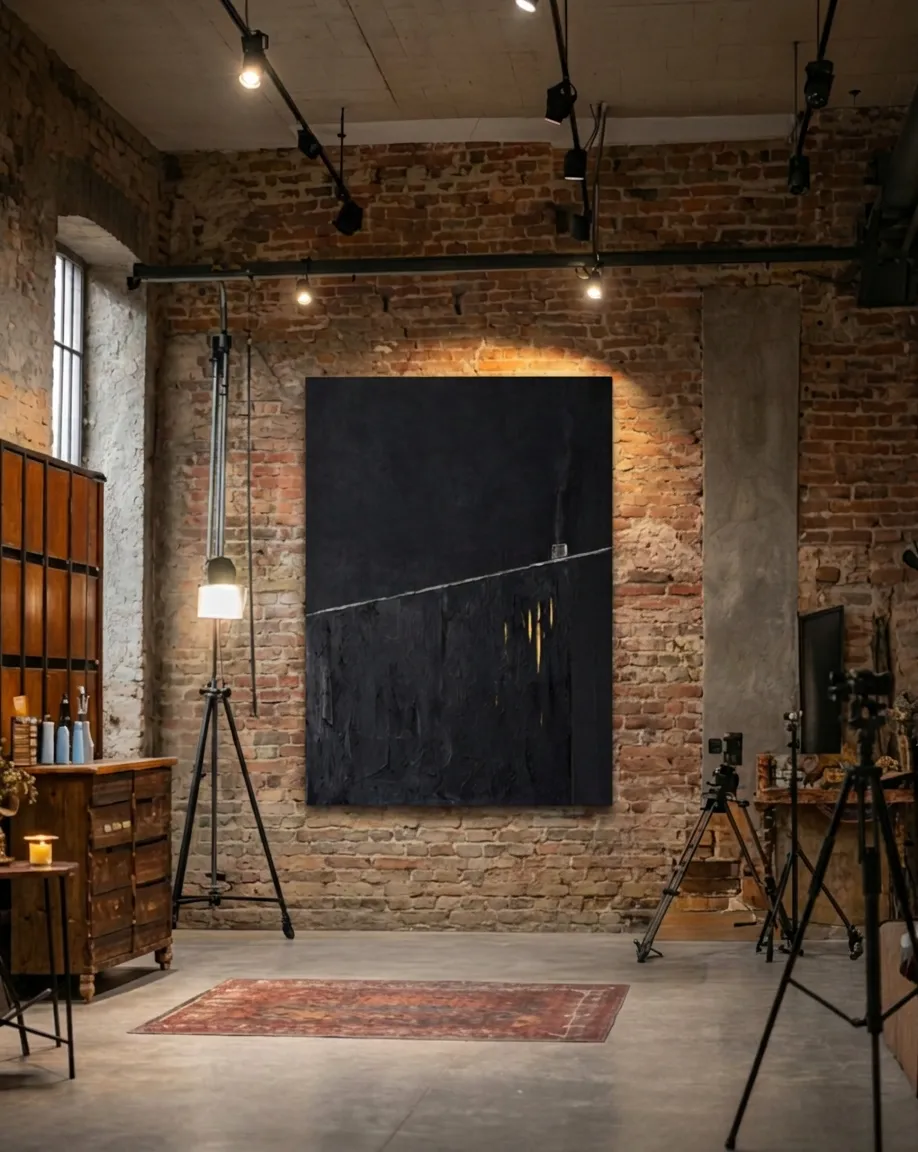
Context study / Il confine del fuoco segreto
Maurizio Valch - Il confine del fuoco segreto | Painting in industrial studio
An oblique line tears through absolute space. It is not a distant horizon, but a tactile border imposing an asymmetrical gravity on the canvas. In the upper half, black behaves like a mute atmosphere, a void absorbing the gaze without returning any echo. Below, on the other hand, the paint folds back upon itself, accumulating a dense, rough, and opaque crust, as if the canvas had become compacted earth or the exterior wall of a closed refuge.
To enter this geography of matter, we have the gaze of Ray Eames, whose innate sensitivity for design, the scale of the human body in living space, and the tactile tension of materials helps us understand how a simple line can transform a void into a habitable limit. From her perspective, that diagonal is not an abstract stroke, but a sloped roof, a plane of shelter dividing the cold exterior from a protected intimacy. The inclination of the line generates a physical tension: it is not a static limit, but a vector sliding our perception to the right, forcing us to seek a point of balance in the density of the lower plane, where the weight of the black matter seems to contain something more than simple pigment.
“When faced with the density of this plane, I felt the almost geological resistance of the black matter under my hands. As I drew that dividing diagonal, an inescapable contradiction assailed me: I did not know if I was building a wall to protect what beats below or if, on the contrary, I was closing off the sky forever. That line was not a calculation, but a physical hesitation in which the paint decided its own gravity before I could stop it.”
Beneath that border, the absolute black fractures. Golden, burning vertical incisions pierce the dark crust, like filaments of energy trapped under a tectonic surface.
Here enters the mind of Alan Turing, whose obsession with deciphering hidden codes, phase transitions, and the mathematical patterns emerging from chaos allows us to read these yellow marks as a coded signal system. For Turing, these lines are not mere decoration; they are a thermal pulse, a binary code of light and shadow where gold acts as pure information trying to filter through the noise of the black background. They are discharges of heat obeying a pattern of material resistance: the accumulated energy seeks the weakest points of the dark mass to manifest itself.
Ray Eames, on the other hand, reads these cracks from the warmth of the home. For her, those golden traces are not equations, but the light of a domestic fire filtering through the slats of a shutter or the cracks of an adobe wall. It is the warmth of the interior revealing itself to the exterior, a reminder that beneath the most impenetrable armor there always beats a habitable, glowing core.
At the far right of the diagonal, just where the boundary seems to fade, sits a tiny cubic structure, a solitary chimney from which a very light thread of smoke ascends, dissolving into the upper nothingness. This detail completely alters the scale of the work: what seemed an abstract plane is suddenly revealed as a minimal architecture, a vanishing point for thought.
What if that tiny chimney is actually the toy of a giant who forgot his house under the black asphalt, and the smoke is only his sleeping breath?
This doubt disarms Turing's analytical logic and Eames's domestic scale. The smoke becomes an unstable flow, a phase transition that cannot be codified or retained. It is the last trace of an invisible combustion, a gray sigh traveling from the interior of the black earth to the upper void, connecting the dense with the ethereal.
“Listening to your voices, I realize that the canvas has taken a path that no longer belongs to me. You look for structures and codes in the gold and the smoke, but I can only contemplate that small exhalation with the strangeness of one who has lit someone else's bonfire; I know there is a secret fire beating in that darkness, but its true temperature and final destination remain a mystery that not even my own brushes have managed to decipher.”
- Original artwork
- Il confine del fuoco segreto
- Actual dimensions
- 31.5 × 47.2 in / 80 × 120 cm
- Presentation
- Digital contextual visualization
Context references
black and gold abstract painting · rustic industrial studio decor · maurizio valch contemporary textured art · large brick wall paintings · textured black painting · industrial loft interior design
About this visualization
This visualization places the artwork within an architectural context to help collectors and viewers imagine its presence in a real space. It is an interpretive reference, not an exact reproduction: the original work remains the sole authority for scale, color, surface and material presence.