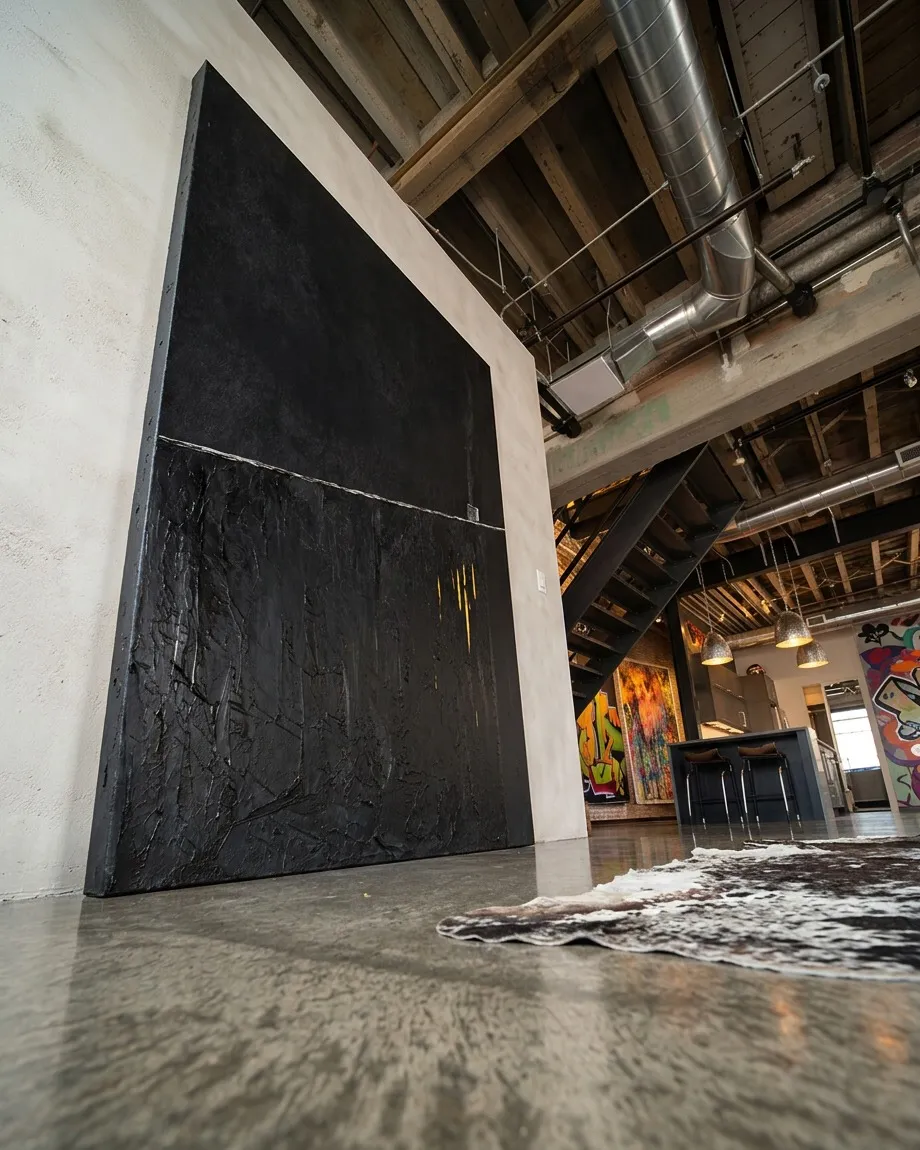
Context study / Il confine del fuoco segreto
Il confine del fuoco segreto by Maurizio Valch | Loft
Before the imposing scale of this vertical canvas, the eye does not act as a judge, but as an inhabitant. The surface, divided by an implacable diagonal line, forces us to renegotiate our relationship with weight and emptiness.
In the upper half of the work, black unfolds with absolute flatness, a two-dimensional abyss that seems to have absorbed all the noise of the surrounding space. It is here that Le Corbusier —a creator obsessed with the purity of lines, the rational geometry that organizes the chaos of life, and the design of the fireplace as a vital organ connecting the domestic interior with the open sky— would look up with a mixture of fascination and strangeness. For the architect, this diagonal is not a simple physical partition; it is the slope of a definitive roof, the radical simplification of a machine for living that floats in nothingness. At the top of that slope, a minimal silver room holds a silent fireplace from which an invisible thread of smoke seems to emanate. Why delimit this refuge in the middle of such a pure void? Le Corbusier would find in this limit a perfect tension: architecture reduced to its minimal expression of survival, a lighthouse of rational order erected on the edge of an abyss threatening to devour everything.
“At first, there was only the physical need to divide the gravity of my own thought. I felt the canvas as a real wall in the studio, a presence that demanded I decide where stability ends and emptiness begins. By drawing that diagonal line, I was not seeking to illustrate a structure or delimit a house; I wanted to experience the weight of one plane upon the other. When that small silver square appeared at the summit, almost like a tactile accident, I understood that the work demanded an escape route, a small vanishing point through which the accumulated pressure could breathe into the silence of the upper half. It is a constant suspicion: the feeling that a part of me lives in that smooth, motionless plain, while the rest remains trapped below, looking for a crack to breathe through.”
If the gaze descends and crosses the diagonal border, the plane collapses into a completely different materiality. The lower half is no longer air or mental space; it is a geological crust, a scarified skin, dense and wounded by time. It is in this dark wound that Elena Garro —who navigated a reality where time does not run in a straight line but overlaps in layers, and where the oldest secrets pulse behind the cracks of everyday life— would halt her suspended walk. Where the architect sees the foundations or the base of a structure, the writer would decipher a closed temporal dimension struggling to overflow. Those vertical golden-yellow incisions, falling like tears of fire or incandescent sap, are not mere chromatic accents to her. They are seepages of a latent past, a fire that the black asphalt of reason attempted to bury, but which continues to beat with the insistence of a memory that refuses to be forgotten. While the architect's diagonal attempts to separate and order, Garro’s gaze discovers that the subsoil is alive and that the rough always ends up cracking the surface of the apparent.
“The yellow was not invited to be a mystical revelation, but a physical resistance of the material itself. As I accumulated the dark layers, feeling the rough density under my hands, the paint itself seemed to demand a wound. Those golden tears falling vertically arose from an impulse of disobedience: the need to show that beneath the blackest, coldest crust there is always something that burns, an accumulated warmth that we cannot fully extinguish. Looking at the finished painting, I feel a strange physical contradiction; the untouchable coldness of the upper void thrills me, but it is in the rough, warm violence of the lower part that I find a refuge where I can truly breathe.”
Moving away from the canvas, we regain a clean, almost childlike gaze, stripped of discourse. The body perceives a real temperature difference between the two halves: the upper part feels cold like a winter night in the mountains, while the lower part seems to radiate the residual heat of a bonfire that has just been covered with earth. There is no definitive answer explaining what this boundary is or where the secret fire hides. We are left only with the physical echo of that border cutting through the air. When we close our eyes in front of the work, the question that accompanies us is not what this painting means, but a more intimate, bodily one: on which side of the diagonal are we breathing at this very moment?
- Original artwork
- Il confine del fuoco segreto
- Actual dimensions
- 31.5 × 47.2 in / 80 × 120 cm
- Presentation
- Digital contextual visualization
Context references
abstract painting for industrial living room · modern loft decor with black art · contemporary textured and gold painting · maurizio valch abstract painter · large format original artworks
About this visualization
This visualization places the artwork within an architectural context to help collectors and viewers imagine its presence in a real space. It is an interpretive reference, not an exact reproduction: the original work remains the sole authority for scale, color, surface and material presence.