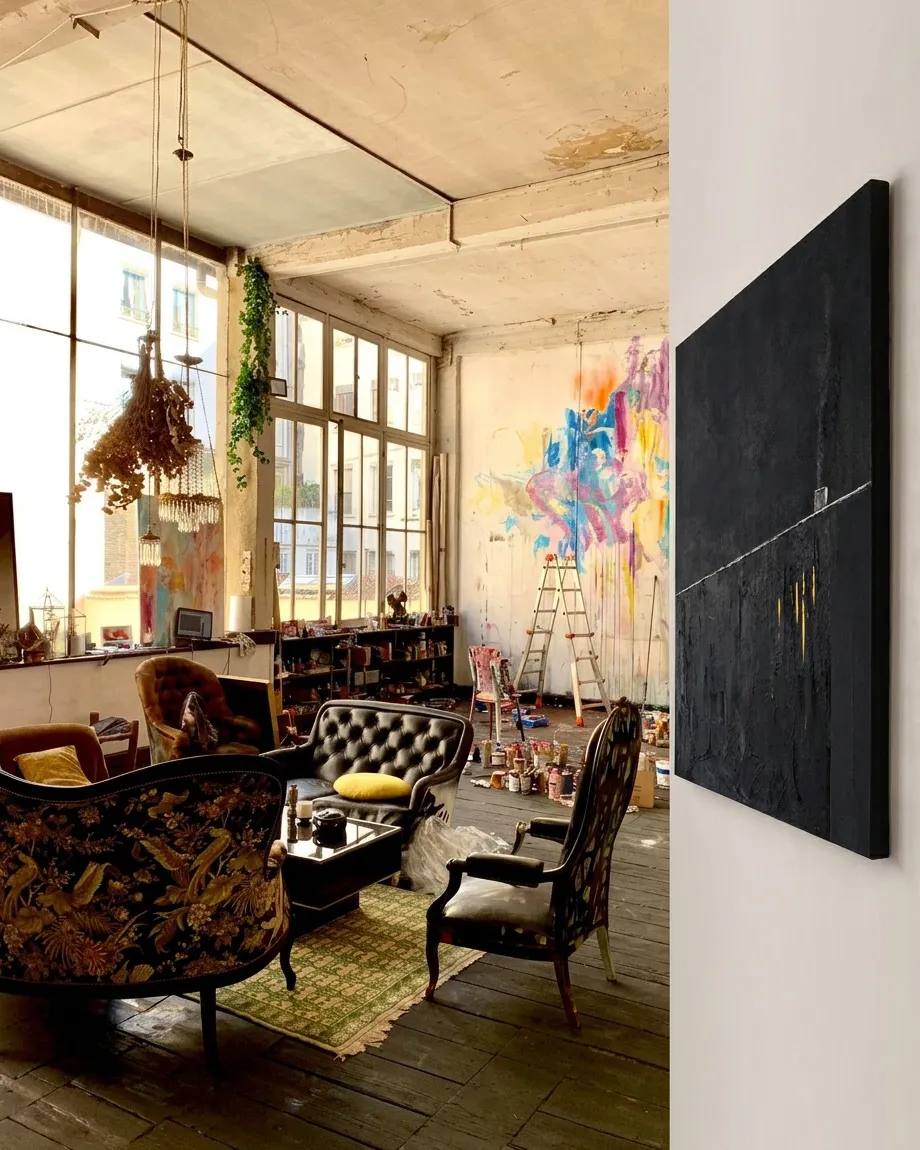
Context study / Il confine del fuoco segreto
Il confine del fuoco segreto - Studio Presentation
Phase 1: Below the Line (The Murmur of the Earth)
Placing one's gaze on the lower half of Il confine del fuoco segreto, the viewer does not stand before a two-dimensional surface, but before a ground that crackles. To descend into this thick, imperfect, black crust, it is necessary to invoke the complicity of Juan Rulfo, the Mexican writer who knew how to listen to the silence of desolate plains and the hot pulse that survives beneath the ash, whose gaze is essential to understanding the mineral heaviness and buried memories of this canvas.
The lower area of the painting breathes with the same mineral stillness of Comala; it is a land of accumulated dust, a territory where time has ceased to pass to become sediment. The matter here is dense, rough, almost geological. It is not a flat black, but an accumulation of accidents, a relief that seems to have been subjected to subterranean pressures for centuries. And suddenly, in the midst of that darkness of coal and rock, thin golden crevices burst forth. They do not behave like flashes of external light, but like wounds of an internal fire seeking air. They are vertical lines that drip, fissures through which a dull, latent heat filters, a murmur of trapped voices resisting the extinction of oblivion.
Maurizio Valch's First Voice
«There was a moment when the matter stopped obeying the movement of my hands and began to dictate its own gravity on the canvas. As I accumulated that dark, dense crust, I felt I was not covering a space, but burying something alive, a sediment demanding its own physical weight. There was a tremor underneath, a dull heat pushing from the back of the canvas, and every time I brought the palette knife close, I doubted my own pulse; I feared breaking that thin seam of oil and letting escape a mineral secret that was not yet ready to reveal itself to my own eyes.»
Phase 2: The Limit and the Antenna (The Geometry of the Absurd)
Just above that wounded territory, a diagonal line crosses the composition from side to side with the precision of an implacable horizon. To decipher the mystery of this border, we must summon Jacques Tati, the French filmmaker and mime who transformed the rigidity of modern spaces into a choreography of subtle misalignments and minimal gestures, teaching us to find human tenderness and solitude in the most unexpected details of the urban landscape.
Tati's gaze would immediately stop at that tiny element interrupting the line: a small, barely sketched cube from which emerges a very thin antenna or chimney casting a thread of white smoke into the void. This tiny detail suddenly introduces a human and almost domestic scale in the midst of the abstract immensity. It is a silent nod, a touch of subtle irony: the human aspiration to build a home and place a small chimney right at the edge of the abyss. The rising smoke, trembling and fragile, is a monument to persistence and isolation. In this reduced scale, the painting's immensity does not crush the detail, but highlights it in all its tender and absurd solitude.
Maurizio Valch's Second Voice
«That diagonal stroke cutting the painting was not a geometric decision pondered at the easel, but an inevitable fracture, the exact limit where my hand stopped before the abyss of the clean canvas. By placing that tiny dwelling, that minuscule witness on the border, I wanted to cling to something recognizable, a scale that would allow me to inhabit the space. But that smoke rising and barely holding on immediately escaped my control; now I look at the finished painting and I do not know if that line divides sky from earth or if it is an unbridgeable rift that will end up splitting my own gaze in two.»
Phase 3: The Dissolution of Smoke (The Zone of Uncertainty)
Rising beyond the antenna, the thread of smoke begins to lose its definition. It climbs toward the upper half of the painting, where the black becomes smooth, deep, and silent, devoid of the tactile roughness that fatigues the lower section. Here, matter dematerializes; the smoke does not collide with anything, but gradually merges with nothingness, dissolving into an atmosphere where gravity no longer holds sway.
It is in this suspended transition that words are exhausted. If the weight of Rulfian earth vanishes and Tati's geometric scale loses its points of reference, what actually remains at that border where fire becomes invisible? Is the smoke the last trace of a life being extinguished below, or the silent announcement that all solid things are destined to become air? Before Maurizio Valch's canvas, the viewer remains suspended on that line of secret fire, waiting for the ash to finish falling or for the smoke, at last, to reveal its final word.
- Original artwork
- Il confine del fuoco segreto
- Actual dimensions
- 31.5 × 47.2 in / 80 × 120 cm
- Presentation
- Digital contextual visualization
Context references
black painting in artist workshop · bohemian interior design with art · abstract painting on canvas 120 x 80 · private collection contemporary art · abstract artworks with dark textures
About this visualization
This visualization places the artwork within an architectural context to help collectors and viewers imagine its presence in a real space. It is an interpretive reference, not an exact reproduction: the original work remains the sole authority for scale, color, surface and material presence.