Context study / Il confine del fuoco segreto
Il confine del fuoco segreto by Maurizio Valch
Stratum I: Smooth Air and the Boundary Line
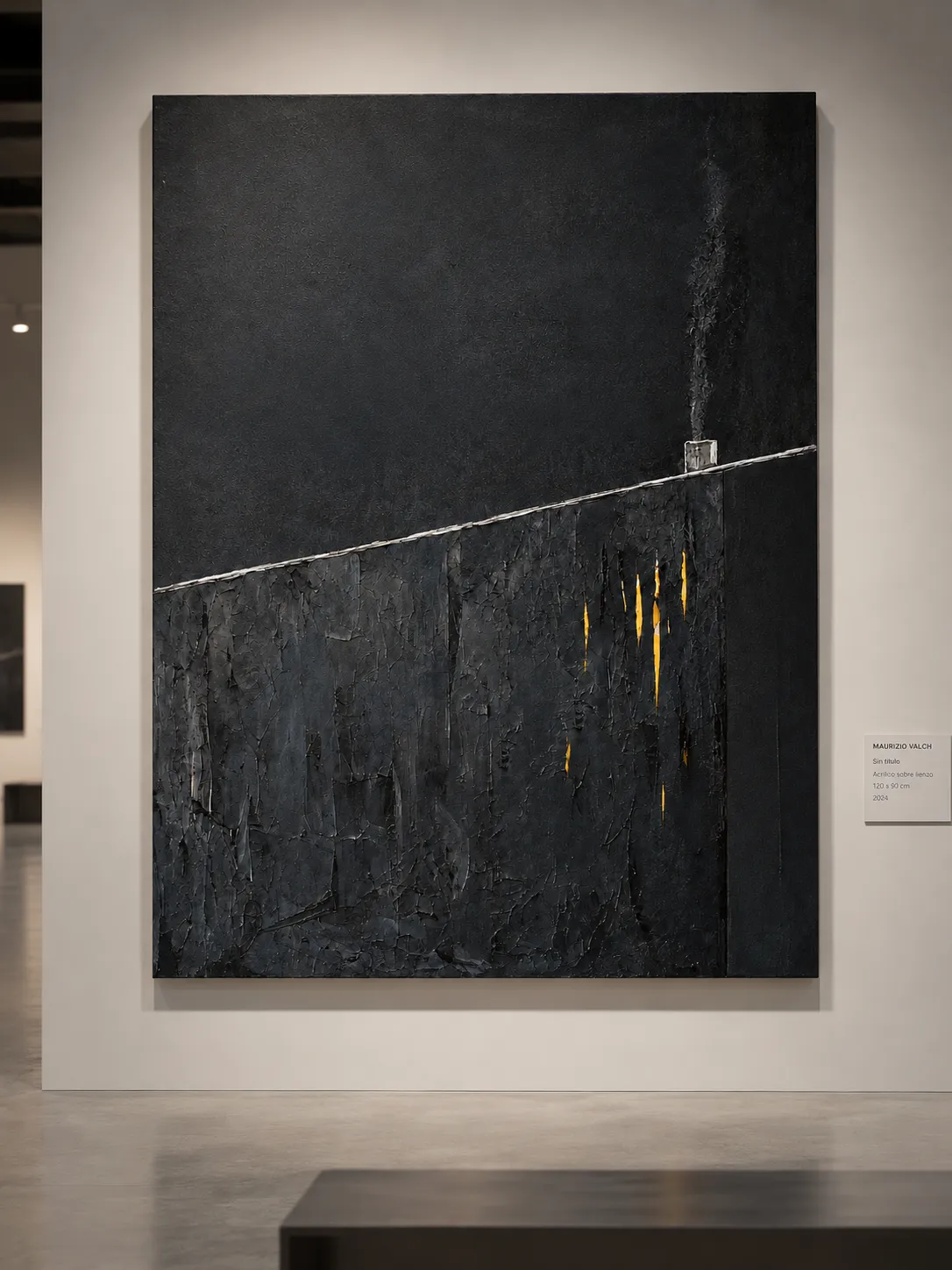
Entering Il confine del fuoco segreto demands abandoning vertical climbing and opting, instead, for a horizontal drift. In the upper half of Maurizio Valch's canvas, a suspended stillness reigns, a plane of darkness that offers itself not as a void, but as a presence both dense and weightless. There is no trace of violent pictorial gesture; the pigment seems to have settled by gravity, like cosmic dust or the deep night falling over an invisible mountain range.
This two-dimensional calm is interrupted by a bold silver scar cutting the canvas from left to right. Atop this boundary sits a tiny, solitary chimney, an almost microscopic element compared to the immensity surrounding it. From it emanates a pale thread of smoke that rises and dissolves into absolute blackness. One wonders: where does the smoke from the little chimney travel if the painting's sky is of a black so dense it seems solid?
This apparent nocturnal quietude resonates with the gaze of Nan Shepherd, a writer and walker who revolutionized nature literature by proposing that the mountain is not conquered by climbing its peak, but by stepping into its very body and geology. Under her lens, this dividing diagonal is not an abstract geometric limit, but an alpine path trodden with the body under the cold of night. For Shepherd, walking through this painting means entering its darkness slowly, feeling how the silver line marks the boundary of a territory where fire pulses hidden in the roots, invisible to those who only look in a hurry.
> When I traced that diagonal line, I felt the vertigo of someone dividing a world in two. There was no certainty in my stroke, only the pure tension of fracturing a plane that claimed its own immensity. By placing that tiny chimney on the border, I sought a vanishing point for human breath, a solitary exhalation in the midst of a black desert that threatens to absorb everything. It is a minimal landmark, but without it, the upper space would lack gravity.
The gaze inevitably shifts to the point where this weightless plane collides with the density of the ground. It is here that the space becomes sculptural, and the flat surface begins to demand a physical response from the observer.
Stratum II: The Excavation and the Ignited Wound
As the gaze descends below the diagonal, the air is extinguished and we hit rock. The lower half of the painting is a territory of accumulated, rough, and tactile matter. The black is no longer a smooth plane, but a thick crust filled with wrinkles, ridges, and furrows that seem to have endured centuries of geological pressure. If a child touched the lower half of the work with closed eyes, would they think they were touching a painting or the bark of a tree burnt by lightning?
In the midst of this telluric density, the matter breaks. Several vertical incisions reveal a background of hot, golden light, as if the paint were tearing open to show us the magma flowing beneath its crust. Here, the sensibility of Henry Moore comes into friction—the sculptor who transformed modern art by understanding that the void, the hole, and the perforation within a sculptural mass hold as much weight and mystery as solid matter. For Moore, this golden crack is not a simple application of color, but an excavated void, a hollow that reveals the interior space of the matter and demonstrates how the weight of the lower black mass dialogues with the lightness and mystery of the void pulsing at its core.
This physical contrast raises strictly sensory questions: what temperature is the silver line compared to the yellow crack? While the former is felt to be cold as alpine ice, the latter pulses with the heat of a subterranean furnace. At the same time, a visual paradox emerges: why is the smallest element of the painting (the chimney, the yellow sparks) precisely what sustains the tension of the entire black immensity?
> Working the dense matter of the base, my hands sought the resistance of the material, accumulating layers that weighed upon the canvas. But the painting did not come alive until I tore through that density to release the gold. It was a moment of surprise: light does not bathe the painting from the outside, but pulses from its depth, like a fire pushing to get out. Part of that radiance remains an undecipherable secret to me; I do not know what burns inside, I only know it needs that crack to breathe.
Valch’s 'secret source' is not resolved in a comfortable explanation. It remains there, caught between the smooth surface of the air and the deep wound of the earth, reminding us that the limit between what is shown and what is hidden is, often, a thin silver line we barely manage to touch.
- Original artwork
- Il confine del fuoco segreto
- Actual dimensions
- 31.5 × 47.2 in / 80 × 120 cm
- Presentation
- Digital contextual visualization
Context references
minimalist black and gold painting · contemporary material abstract painting · abstract minimalist chimney design · collectible minimalist wall art · strata series artworks maurizio valch
About this visualization
This visualization places the artwork within an architectural context to help collectors and viewers imagine its presence in a real space. It is an interpretive reference, not an exact reproduction: the original work remains the sole authority for scale, color, surface and material presence.