Context study / Il confine del fuoco segreto
Il confine del fuoco segreto — Context Study
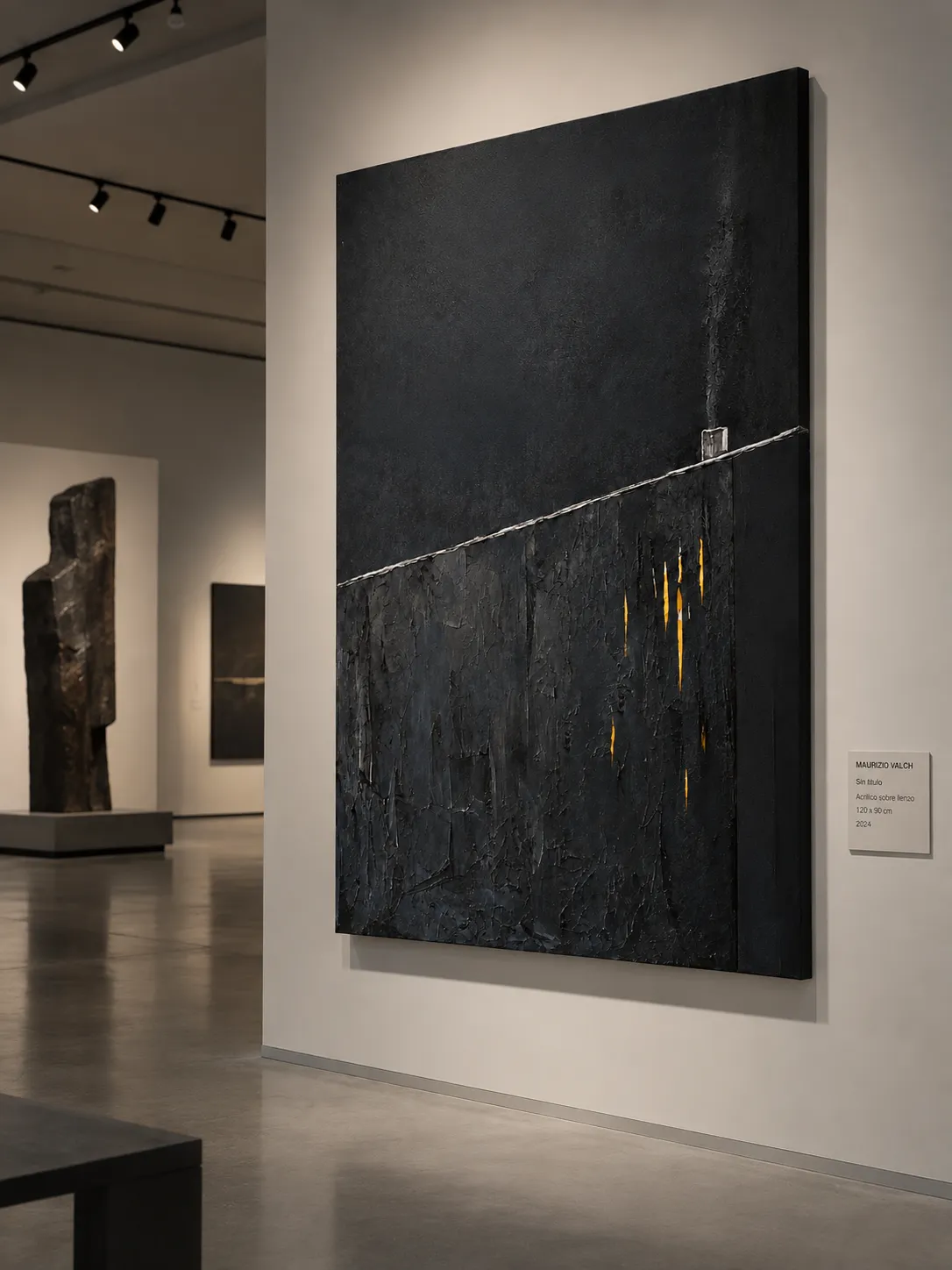
Faced with this large-format surface, the body experiences an immediate physical gravity, a silent pressure that seems to cool the air around the viewer only to, inexplicably, emit a subtle warm radiation from its cracks. The gaze cannot help but behave with the disarmed innocence of a child: one immediately wonders if that rising thread of smoke has real weight, if the house producing it is entirely buried beneath the asphalt of the night, or if we are contemplating the last breath of a world caught under a layer of black ice.
In the upper portion of the canvas, the paint unfolds like a dense, suspended void, a two-dimensional plain where time seems to have entered a state of absolute freezing. It is not an empty darkness, but an atmosphere charged with waiting. Alejo Carpentier—a man who consecrated his life to deciphering how time and wonder intertwine in the seams of Latin American history—would pause before this upper half not to see a modern geometric abstraction, but a primordial mythical ruin. For him, that tiny grayish chimney exhaling its vapor into nothingness is not a mere compositional detail, but the first sign of a latent cosmogony; the smoke of an invisible home resisting extinction in a landscape that has forgotten the day.
Alongside Carpentier, the gaze of Carl Friedrich Gauss—a genius tormented by the desire to map the invisible forces of terrestrial magnetism and the curves of the firmament—would seek a metric in this desolation. Gauss would attempt to calculate the rate of dissipation of that column of smoke, searching for an implicit equation to explain its persistence in the void. However, at Carpentier's suggestion that the smoke measures ritual rather than chronological time, the astronomer's mathematical rigidity begins to waver: the coordinate no longer defines only space, but memory.
The border dividing the canvas is not a line of truce; it is a diagonal scar, a tense suture crossing the visual plane with the precision of a geological seam. For Gauss, this dividing line immediately reveals itself as a geodesic curve or a boundary of magnetic potential, a limit where the painting's forces of attraction abruptly change sign. Carpentier's literary gaze, infected by this geometric obsession, abandons its lyricism for a moment to notice how the diagonal acts as the roof of a submerged temple or the sloping side of a dormant volcano containing immeasurable pressure. There is an almost unbearable tension at the point where the chimney rests upon this boundary: a millimeter of deviation and the entire architecture of the work would collapse under its own conceptual weight.
"When I rested my hand to trace that diagonal, I felt an almost physical vertigo, as if I were dividing not a canvas surface, but the gravity of space itself. I wanted a line that would hold the weight of the upper void without crushing what pulsed below, a precarious balance that threatened to break with every millimeter. The small chimney was not in the original sketch; it emerged suddenly, almost like a silent cry, an absolutely necessary vanishing point to relieve the immense pressure building at the edges of the composition."
Descending below the scar, matter becomes pure geology. The lower third of the work is a thick, rough, and cracked stratum that appeals directly to the viewer's sense of touch, awakening a strange urgency to trace the wounded crust of the canvas with the fingertips. Here, light does not bathe the surface; it wells up from within through vertical incisions that reveal a shimmering, golden background. Gauss observes these wounds of light and attempts to decipher whether the distribution of golden points obeys a hidden numerical order, a mathematical constellation ruling the apparent chaos of scraped matter. Carpentier, however, sees in these cracks of secret fire the persistence of a submerged history resisting burial by the dark crust of the present: it is the gold of ancient myths pulsing beneath the asphalt of oblivion.
"As I sank into the density of that lower matter, the process became a tactile excavation, a hand-to-hand struggle with opacity. I remember the trembling as I scraped away the dark layers and watched those golden veins emerge, as if the canvas held a latent fire that I had not placed there, but simply helped awaken. There is a vibration in that light that escapes my will, a luminous wound of which I remain a mere fascinated and fearful spectator."
In the end, the gazes of Gauss and Carpentier merge at the same threshold of uncertainty. The mathematician's metric obsession surrenders to the mythical scale of fire, and the novelist's prose adopts the precision of a physical equation. The gold does not translate into a single meaning—it is not salvation, nor wealth, nor simple hope—but remains as a suspended enigma. We stand before the painting with alert bodies, feeling the vibration of the secret fire pulsing beneath the black crust, knowing that some boundaries are drawn not to separate worlds, but to guard the mystery of what burns deep within.
- Original artwork
- Il confine del fuoco segreto
- Actual dimensions
- 31.5 × 47.2 in / 80 × 120 cm
- Presentation
- Digital contextual visualization
Context references
large format black abstract painting · original artwork maurizio valch · painting with relief and gold leaf · contemporary abstract art for gallery · geometry and texture in contemporary art
About this visualization
This visualization places the artwork within an architectural context to help collectors and viewers imagine its presence in a real space. It is an interpretive reference, not an exact reproduction: the original work remains the sole authority for scale, color, surface and material presence.