Context study / Il confine del fuoco segreto
Il confine del fuoco segreto — Context Study
I. The Material Below (The Wound and the Margin)
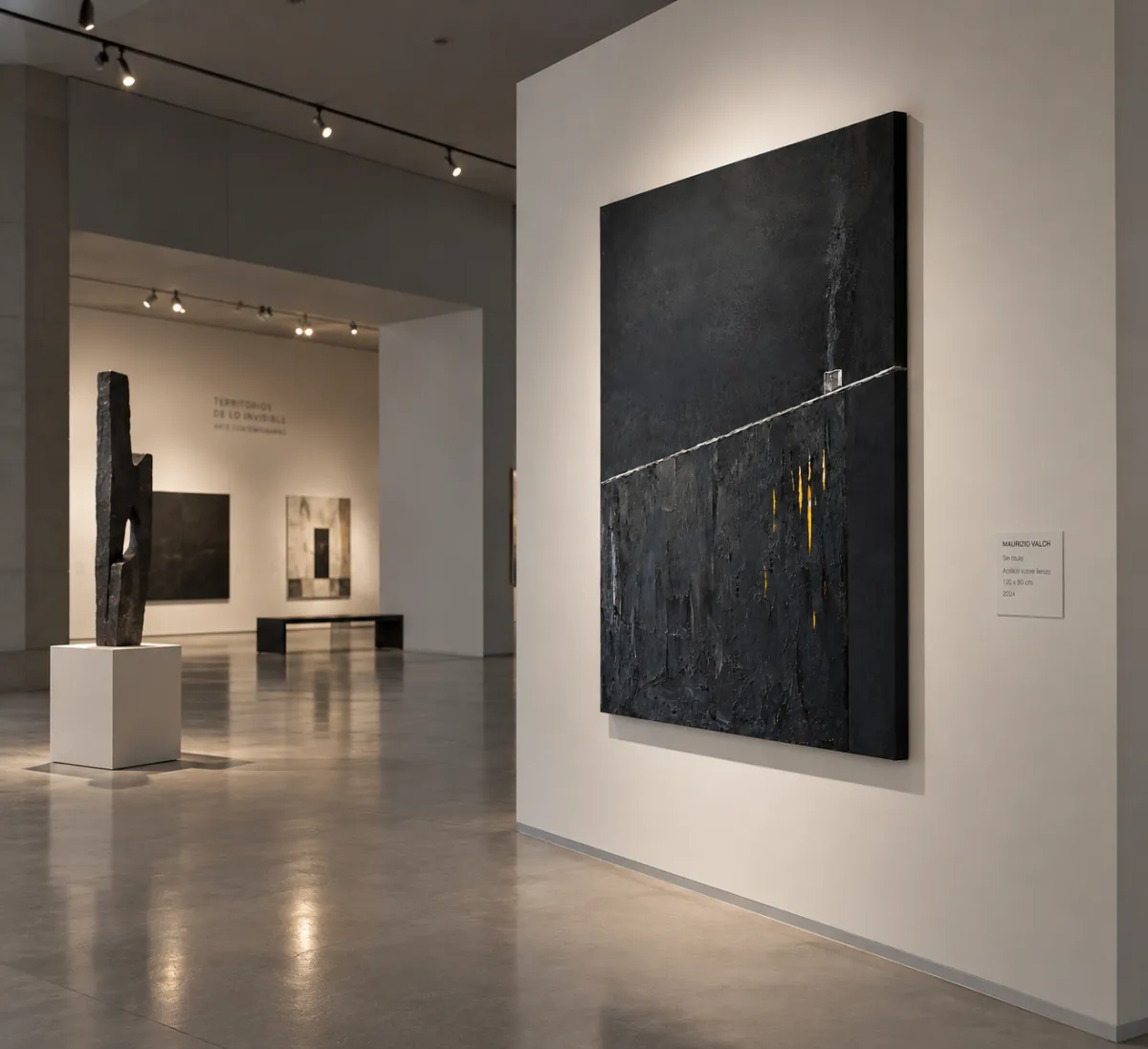
The canvas rests on a stratum of coal and geode, a geological crust that seems to have accumulated the weight of a hundred winters. Here, painting is not a two-dimensional layer, but a tactile, rough, and broken body that asks to be traced with the fingertips, defying the museum's prohibition. Amid the mineral foliage of this dense black, vertical incisions of a liquid, burning yellow burst forth, as if the canvas were bleeding light or incandescent resin.
Before this cracked crust pauses Francesca Woodman, the photographer who explored the disappearance of the body, the intimate relationship with ruined walls, and the ghostly quality of habitable space. She is the one who seeks to dissolve into the dust of forgotten rooms, peeling away the skin of space to merge with the wound of the walls. Francesca leans toward the painting, drawn by the temptation to camouflage herself in that rough material. She wonders if the human body could find refuge inside those dark fissures, or if those yellow slits are the exposed ribs of an abandoned house that still holds the warmth of those who inhabited it. For her, this lower black is not an absence of light, but a peeling wallpaper behind which one can, at last, become invisible.
From the other side of the room, bell hooks, the cultural theorist and writer who thought of the margin not as a place of deprivation but of radical openness and resistance, and who reclaimed love and passion as healing forces, contemplates the same area. She is the one who teaches us to look at edges not as an abyss of exclusion, but as the fertile territory where resistance becomes a spark and communal warmth. For hooks, those golden wounds piercing the crust are not structural weaknesses, but the indomitable strength of the margin. It is the secret fire of those who have been silenced but refuse to go out; a radical love that, under the pressure of the most oppressive coal, insists on cracking the surface to breathe and heal its surroundings.
When I sink the palette knife into this dense matter, I seek to give the painting the weight of damp earth, piling layers of black like someone burying a secret under the snow. I work blindly, scraping the surface with rage and patience, waiting for the accident. And then, suddenly, comes the almost uncontrolled surprise of seeing the yellow sprout through the cracks; it is a throb of fire I didn't fully plan, an incised golden trace tearing through the heaviness of the coal, claiming its own right to burn beneath the crust.
II. The Dividing Line (The Threshold and the Chimney)
A sharp white diagonal cuts the canvas into two worlds. It is not a peaceful line; it functions as a surgical suture, a chalk cliff separating earthly gravity from the aerial void. Right upon this slope, a tiny grey receptacle—an abstract chimney, a stone nest—breathes out a thin, vertical wisp of white smoke that rises with ghostly fragility.
Before this delicate architecture of the boundary, an open-minded observer, perhaps with the clean gaze of a child, cannot help but cast questions into the air: Where would a body slide if it slipped down that infinite diagonal? What is actually burning inside that black wall, so deep that we cannot see it? And why is the chimney so small, so fragile, if the fire pulsing below seems so large and voracious?
This threshold is the point of maximum thermal tension in the painting. Below pulses the warmth of the yellow wound; above rules an absolute, almost cosmic cold. The wisp of smoke is the only messenger between both states, a physical exhalation proving that the material below is alive, consuming itself in its own mystery as it seeks an escape into the nothingness.
III. The Void Above (Absolute Silence)
In the upper half of the canvas, the paint relinquishes relief and becomes smooth, flat, an impenetrable matte black that absorbs the room's light without casting a single reflection. It is the zone of absolute silence, a sky of soot where the body's questions no longer find an echo.
Reaching the upper half, my hand stopped, forced to renounce gesture and accumulation to surrender to a flat, mysterious surface. I decided to leave this upper space clean, flat, imposing a severe silence that freezes the air around it. While below everything is vibration and conflict, up here reigns a calm that makes me uneasy, leaving me with the constant doubt of what is actually burning beneath the chimney and if this void is the condensed smoke of a fire we can never extinguish.
Here, the dialogue between the photographer of cracked walls and the theorist of resistance meets a limit. Woodman looks at this flat void and senses the final moment of disappearance: the instant when the body no longer finds textures to hold onto and dissolves completely into the paint. bell hooks, on the other hand, contemplates this smooth, silent space not as a hostile nothingness, but as the unexplored territory left to be built once the old structures have burned down.
There is no final verdict at this border of smoke and fire. The painting remains hanging on the wall, vibrating in its double temperature, offering an exit that is, at the same time, an absolute surrender to silence. Is the chimney an emergency exit for the soul, or simply the last gasp of something that finished burning long ago?
- Original artwork
- Il confine del fuoco segreto
- Actual dimensions
- 31.5 × 47.2 in / 80 × 120 cm
- Presentation
- Digital contextual visualization
Context references
painting mockup in modern museum · contemporary art exhibition with sculpture · black painting on white gallery wall · large painting mockup in museum
About this visualization
This visualization places the artwork within an architectural context to help collectors and viewers imagine its presence in a real space. It is an interpretive reference, not an exact reproduction: the original work remains the sole authority for scale, color, surface and material presence.