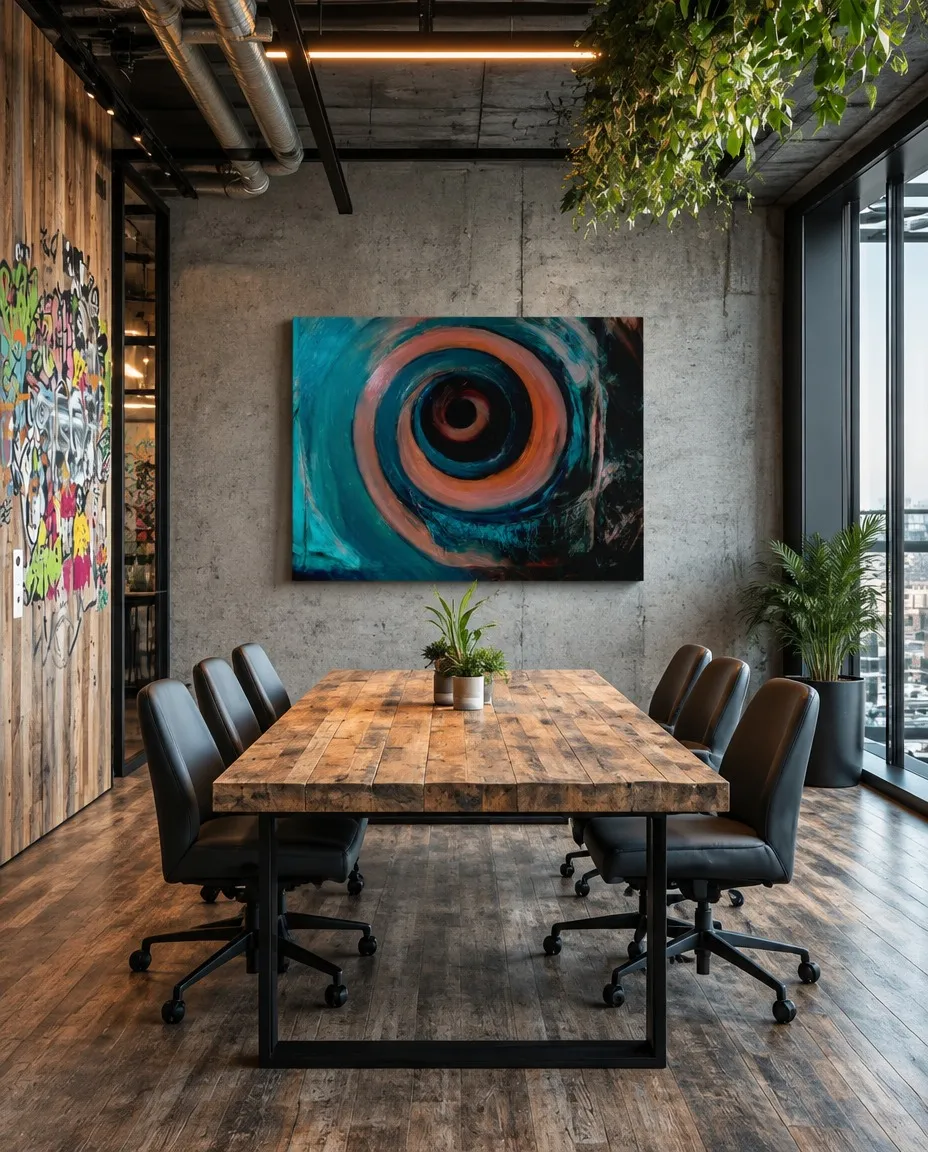
Context study / HELIX
HELIX Abstract Spiral Painting on Concrete Wall | Maurizio Valch
In "HELIX" (2026), the structural rigidity that usually governs Maurizio Valch's work fractures to make way for a dynamic whirlwind that challenges the prevailing orthogonality in contemporary architecture. The painting unfolds not as a static boundary, but as a centripetal and centrifugal vortex that sucks the gaze in through a contrast of dense chromatic layers. The vibrant blue-green framing the composition slides in a circular inertia toward a core of deep shadows, establishing a dialogue of tensions where invisible geometry yields to the impulse of the curve. This transition firmly introduces the notion of abandonment, understood here not as a loss of control or formal neglect, but as a deliberate surrender of the stroke and the pictorial matter to the physical laws of the spin. By renouncing the straight line and the compartmentalized plane, the canvas becomes a space of dispossession where rational order dissolves into the dynamism of the flow, allowing the painting to find its own drift and carry with it the fixity of the surrounding space.
In the dim light of my studio, executing this spiral demanded a strictly somatic effort, a surrender where my own body operated as the physical axis of a moving gear. I did not seek a subtle chromatic transition, but a friction of the matter on the canvas that could be registered as temperature; it is there that warmth arises. Applying the coppery, orange, and coral ring at the heart of the whirlwind, I felt how the dense accumulation of oil and acrylic ceased to be mere color and transformed into a thermal, almost carnal vibration, suddenly interrupting the industrial coldness of the exterior blue. This warm belt is the result of real friction between the palette knife, the brush, and the support, a residue of kinetic energy that remains latent in the thickness of the pigment. Painting the curve was not an act of passive contemplation, but of physical resistance, a pulse where the heat of the matter betrays the trace of the body that pushed the paint to its thermal limit.
At the absolute core of "HELIX" opens a black cavity, a chromatic abyss acting as the point of maximum gravity in the composition. Far from constituting an inert void or a simple absence of light, this dark center behaves as a receptive organ, a threshold of silent resonance introducing the concept of listening. It is here that the painting assimilates the economy of the syncopation and the interval; the black void does not speak, but listens to the friction and vibration of the dense concentric layers rotating around it. This abyss functions as a tactile shore absorbing the noise of color and the dynamism of the external stroke, becoming the space where the saturation of visual discourses ceases. Listening manifests in this zone of absolute calm, an absorbing surface inviting the viewer to halt the urgency of interpretation to tune into the low, mute frequency of the pigment accumulated on the edges of the void.
The transition from my previous series, such as STRATA, where horizontal blocks and tectonic divisions imposed a severe order, toward this helicoidal movement marked a profound transformation in my relationship with the plane. It was precisely the abandonment of the orthogonal line that allowed me to fine-tune my listening to the canvas, attending to the internal tensions that the fabric itself generates when used under a circular force. In "HELIX," the incision on the plane is no longer a sharp fracture or a wound bounding rigid territories; now it is the trace of a continuous sliding, a mark spinning on itself in search of its own center of gravity and temperature. This persistent turn is an attempt to locate the original warmth of the pigment, that material quality surviving the drying process and preserving the physical memory of the gesture when the hand has already withdrawn and the studio falls silent.
Finally, "HELIX" stands as a work of conceptual and material synthesis where the viewer is suspended in a threshold of forces in constant balance. In this space, the painting relinquishes its status as a static surface to behave as a living, pulsating body, a territory without fixed boundaries where the center and the external flow mutually claim each other. The aesthetic experience is resolved at the exact point where the detachment of formal abandonment and the thermal vibration of the coppery warmth converge and settle upon being absorbed by the depth of the central void. At the end of this circular journey, the work offers no narrative answers or lyrical ornaments, but the certainty of a physical space folding in on itself, transforming matter into a pure attitude of listening before the immensity of silence.
- Original artwork
- HELIX
- Actual dimensions
- 82.7 × 63 in / 210 × 160 cm
- Presentation
- Digital contextual visualization
Context references
abstract painting on concrete wall · brutalist minimalist art for offices · blue and orange spiral paintings · decoration with concrete walls and large format paintings · vortex series paintings maurizio valch · contemporary color contrast paintings
About this visualization
This visualization places the artwork within an architectural context to help collectors and viewers imagine its presence in a real space. It is an interpretive reference, not an exact reproduction: the original work remains the sole authority for scale, color, surface and material presence.