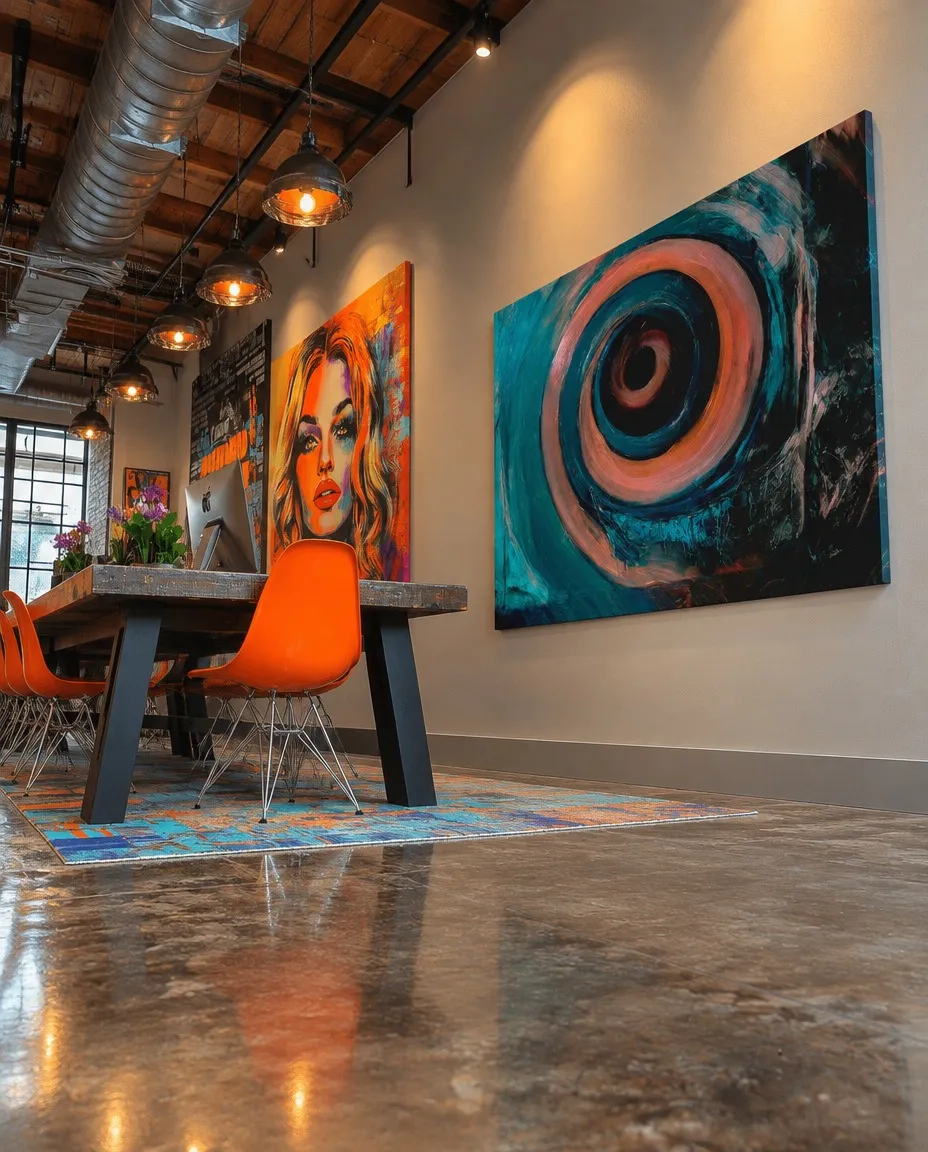
Context study / HELIX
HELIX Abstract Painting by Maurizio Valch in Design Office | VORTEX
The imposing vortex of "HELIX" asserts itself before the gaze not as a mere geometric representation, but as a physical event that alters the perception of space. On its generously sized surface, the agitation of the pigment traces a centripetal spiral where terracotta tones, dense and telluric like baked clay, intertwine with electric and abyssal turquoise blues. This rotating morphology immediately connects with humanity's most archaic memory, referring to Atlantic petroglyphs and incisions in the megalithic passages of prehistoric Europe, where the spiral functioned as a threshold between the visible and the invisible. Contemplating the violent sweeping of matter converging toward an absolute black core activates a fundamental tension in the viewer's consciousness: one struggles to decipher whether this turn represents a blind descent into the dissolution of the self in pure unconsciousness or, on the contrary, a titanic and primitive effort to impose order and structure on the formless matter of chaos.
When I face a canvas of this scale, the act of painting ceases to be a purely mental exercise and becomes a choreography of physical resistance. Spinning my arm over the support, dragging the density of oil and the speed of acrylic, requires muscular tension that translates directly into the direction of the paste. I feel the resistance of the support under the weight of the palette knife; I do not seek a polished surface, but the record of a combat. The incisions and scrapings that interrupt the paint layers are not ornamental devices, but real physical wounds inflicted on the matter to try to slow down the inertia of rotation, to leave a static trace within the speed of the whirlpool. It is a way of taming the centripetal force, of engraving on the crust of color the memory of effort and of suspended time in each turn.
From an analytical lens, the concentric movement of "HELIX" invites a confrontation between two opposing visions of psychic dynamism. On one hand, we can invoke the Swiss psychiatrist Carl Gustav Jung, who proposed the concentric turn around a sacred center as the ultimate path toward the archetypal integration of the personality. For Jung, this spiral trajectory represents the search for balance against the fragmentation of the internal world. However, this reading of self-realization clashes head-on with the warning of the Eurasian mystic George Gurdjieff, who cautioned how human beings repeat unconscious, mechanical turns, trapped in a dream from which they rarely awaken. In the face of the roughness of Valch's pictorial paste, one must wonder whether that dark, central well of the painting represents the achievement of a unified and peaceful Self, or if it constitutes the sinkhole of existential mechanicalness, an abyss absorbing unawakened consciousness in an infinite cycle of repetition.
I resist pigeonholing the process of this series into rigid psychological formulas or prefabricated mysticisms; for me, the painting is resolved in the pure vibration of its components. The true engine of this work is the thermal friction generated between the warmth of Mediterranean terracotta—a tone I extract from the visual memory of the eroded earth of Nerja, of dust and clay soil—and the relentless coldness of abyssal turquoise blue. By superimposing these chromatic bands through rotating sweeps, I do not intend to build a meditation mandala, but to record a force of territorial disorganization. "HELIX" is, in essence, the chronicle of a pictorial storm where stable geography dissolves, where the physical boundary between warm land and deep ocean collapses to make way for a fluid matter that rejects any attempt at a fixed cartography.
Ultimately, the paradox posed by this canvas is resolved by accepting that order and chaos are not mutually exclusive forces, but two sides of the same vital dynamic. This perspective resonates with the philosophy of the Indian thinker Osho, who understood turmoil and chaos not as existential dangers, but as the indispensable condition for the emergence of freedom and the creative play of being. Far from being a destructive trap, the chaos agitating the turquoise and ochre edges of the painting is the space of pure possibility where reality can be reinvented. Returning the gaze to the dense materiality of the canvas, the viewer sheds conceptual categories to confront the pure physical presence of the work: a black, dense, and silent center that offers no easy answers, but remains there, questioning our own stillness in the midst of the world's whirlwind.
- Original artwork
- HELIX
- Actual dimensions
- 82.7 × 63 in / 210 × 160 cm
- Presentation
- Digital contextual visualization
Context references
abstract paintings for modern offices · turquoise and terracotta abstract painting · large format artworks for offices · contemporary paintings vortex series maurizio valch · dining room decoration with abstract art · color spiral painting ideas
About this visualization
This visualization places the artwork within an architectural context to help collectors and viewers imagine its presence in a real space. It is an interpretive reference, not an exact reproduction: the original work remains the sole authority for scale, color, surface and material presence.