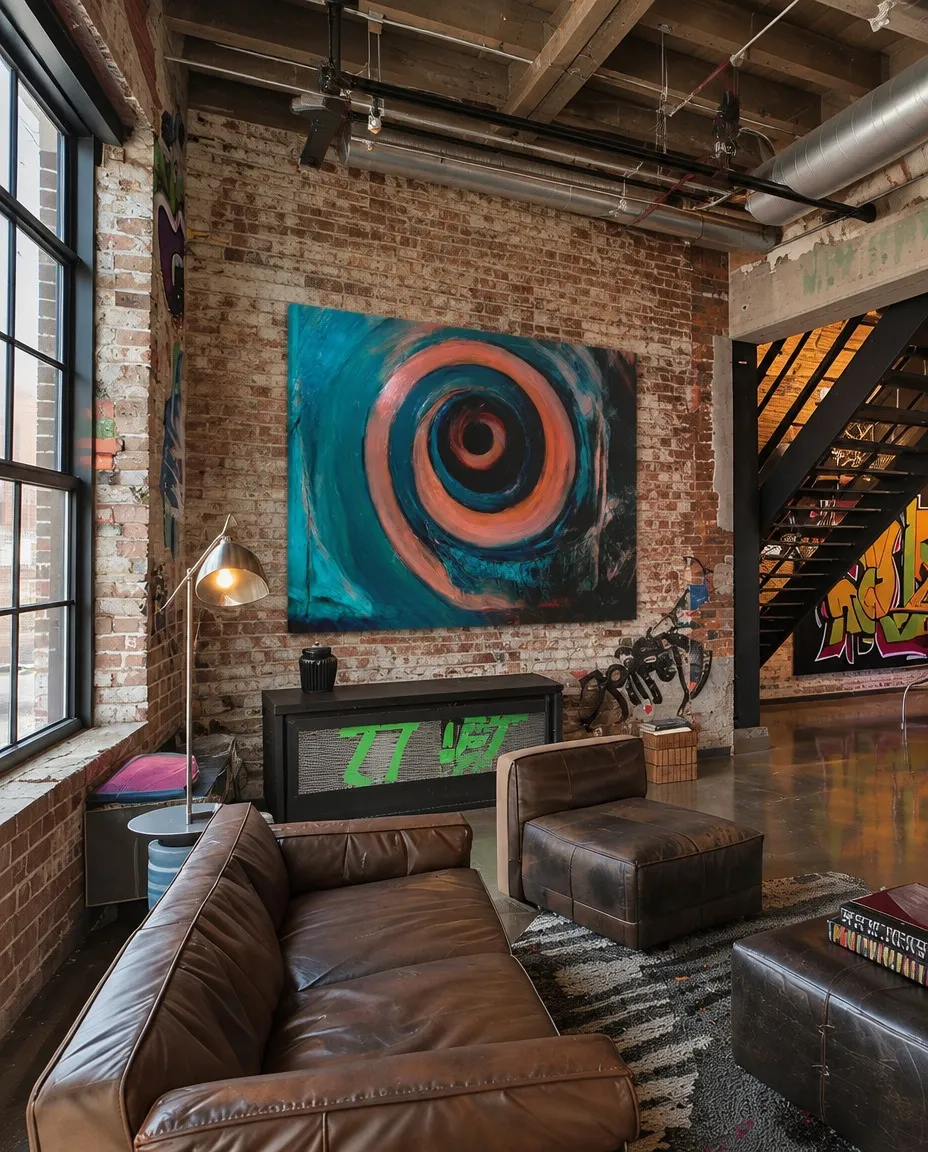
Context study / HELIX
HELIX by Maurizio Valch – Abstract Art in Brutalist Spaces
Hung on the exposed, weathered brick of an industrial wall, surrounded by exposed pipes and the urban vibration of graffiti, the imposing spiral of HELIX does not claim a sacred space to operate; it founds it. Transcendence does not require consecrated temples or liturgical iconography to manifest; it often emerges with greater force where matter presents itself in its rawest, most profane state. By renouncing traditional religious symbols, the painting entrusts its power to move to the pure force of color and the gravity of its monumental scale. The contrast between the tactile warmth of the brutalist environment and the blue and coppery magnetism of the canvas generates a zone of friction where the viewer, stripped of devotional reading guides, is pushed to halt before a presence that does not explain the world, but suspends it.
When I traced the first turn of this spiral, more than two meters wide, I was not seeking to design a spiritual allegory, but to physically record a limit of resistance. The movement of my own body when applying the pigment became a negotiation with the inertia of the canvas, an attempt to sustain the color just before speed dispersed it. In the center of this constant rotation, I decided to leave a zone of absolute darkness, a void of dense oil that functions as a silent core of attraction. There is no promise of revelation at that point, no hidden message to decipher; it is simply a space where the noise of thought is exhausted by its own weight, forcing me to remain silent before that which cannot be named.
This approach to the sacred through formal subtraction recalls the enveloping silence that Mark Rothko sought in his vast color fields, where color ceases to be a representation and becomes an atmosphere that assimilates the observer. However, while in Rothko transcendence rests on the stillness of a static presence, in Valch's painting it is reached through the paradox of continuous movement. The turquoise mass of HELIX seems to spin eternally on its axis without ever displacing itself, in an unstable equilibrium that evokes the subtle rhythms of offbeat timing or musical syncopation. By omitting the strong beat, the painting forces the viewer's nervous system to generate its own internal pulse, completing the void of the image with an intense contemplative participation.
During my long journeys on foot along the Camino de Santiago, I learned to distrust grand goals and the revelations that thought promises at the end of a long quest. The value of the journey was never in the cartographic destination, but in the accumulated fatigue, the empty rooms, and those moments of solitary walking where one no longer belongs to the place left behind but has not yet arrived anywhere. In painting, I seek to recreate this same state of suspension where inherited identities dissolve. The spiral of this canvas does not function as a map for orientation; it is a journey that folds inward, an invitation to navigate our own uncertainty without the urgency of constructing a theory to justify our presence in the world.
Faced with the verticality of the metal staircase that dominates the surrounding architectural space, the circularity of the work proposes an alternative to the effort of linear ascent. There are no rungs to climb or peaks to conquer in this liquid geography; the transcendence of HELIX is experienced in surrendering to the gravity of its own decline. By relinquishing resistance and accepting the vulnerability of the slide, the analytical distance between the subject and the represented object eventually collapses. The painting ceases to function as a window contemplated from afar, transforming instead into a tactile shore, a sensitive membrane where viewer and matter meet in an expanded present, free from the weight of interpretation.
- Original artwork
- HELIX
- Actual dimensions
- 82.7 × 63 in / 210 × 160 cm
- Presentation
- Digital contextual visualization
Context references
Paintings for exposed brick walls · Abstract art for industrial loft · Blue and orange spiral painting · Maurizio Valch original artworks · Loft decoration with contemporary art
About this visualization
This visualization places the artwork within an architectural context to help collectors and viewers imagine its presence in a real space. It is an interpretive reference, not an exact reproduction: the original work remains the sole authority for scale, color, surface and material presence.