Context study / HELIX
HELIX Painting by Maurizio Valch – Dynamics of Attraction and Matter
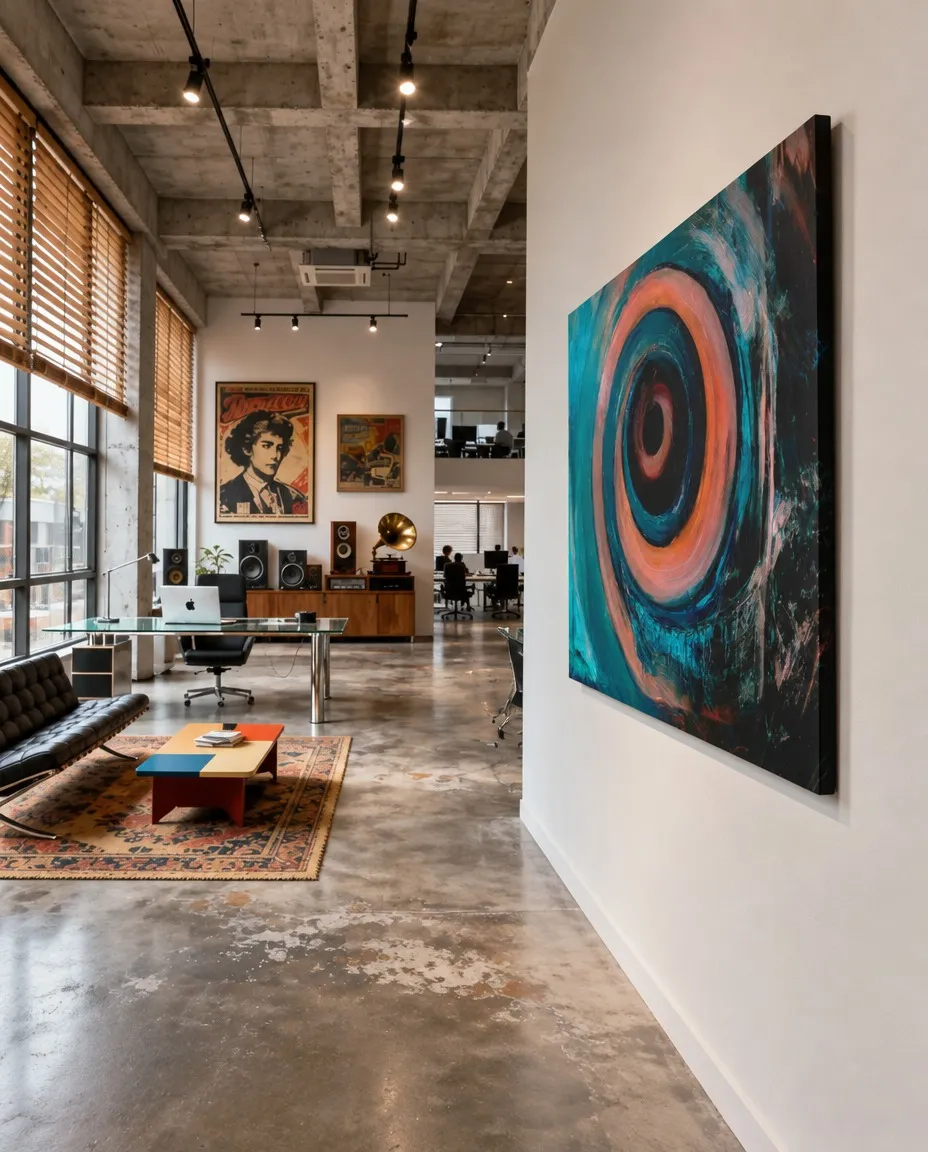
In "HELIX," the large-format pictorial plane unfolds as a geological territory subjected to an implacable centrifugal force. The great spiraling movement that dominates the canvas is not a decorative representation, but a collision of physical forces embodied in matter. At the margins, turquoise and indigo blue tones saturate the space with a cold, dense vibration, which progressively retreats toward a concentric ring of warm shades—crimson, salmon, and ochre—to finally plunge into an ellipse of absolute darkness at the center. This orbital dynamism stages a latent friction between the notion of permanence, understood here as the almost mineral consistency of the pictorial strata resisting on the surface, and the radical defenselessness generated by the attraction force of that central void. The texture of the paint, worked in thick impastos where the traces of tools and the rough grain of the support are evident, gives the spiral the character of a terrestrial crust folding over itself, revealing the vulnerability of form in the face of the imminence of its own dissolution.
When I confront the surface of two meters ten by one meter sixty, I do not seek to represent a movement, but to embody it through the weight and inertia of the pigment. I understand the act of painting as an excavation in material memory, where the systematic accumulation of acrylic and oil layers and the violent dragging of the palette knife configure a physical record of the gesture. By tracing these circular marks, I attempt to erect a solid structure, a tectonic order that I intend to associate with the permanence of memory against oblivion. However, in the course of the process, the density of the matter inevitably confronts me with the limit of my control; the dark center of the canvas opens up like an unforeseen crack. It is there that the constructive gesture breaks, and I find myself disarmed, exposed to a state of technical and conceptual defenselessness where the paint ceases to obey my directions to impose its own weight and its own physical depth.
The light structure of "HELIX" presents an anomaly that fractures any uniform reading: while the right sector of the canvas is characterized by a dark and almost brutalist atmosphere, where blacks and dark blues overlap in heavy, inert layers, the intermediate ring bursts into a crimson and ochre incandescence. At this point of maximum chromatic tension is where the dimension of wonder emerges. Far from being understood as a category linked to harmony or visual complacency, wonder is revealed here as a tactile resistance, a strictly visual joy that is sustained just at the edge of the fall. It is a warm, dense flash that acts as a centripetal force, retaining the gaze at the limit of collapse to prevent it from being devoured by the void. The revelation of this vibrant light does not annul the defenselessness of the surrounding abyss, but rather outlines it, converting chromatic friction into an optical refuge of great material intensity.
I reject any mystical or purely psychological reading of my work; for me, the value of painting resides in its factual presence, in its real scale, and in its behavior within the architectural space that houses it. Seeing the work installed, supported on the vertical plane, I understand the ring of crimson and salmon pigment not as a symbol, but as a strictly physical threshold, a tactile shore upon which the eye can find its footing. By dragging and scraping the pigment in these elliptical paths, I experienced the pragmatic wonder of seeing a configuration emerge that seemed to pre-exist on the canvas, independent of my own temporal decisions. It is the manifestation of a form that withdraws from the daily passage of time, installing itself in a coordinate-free time that borders on a condition of autonomous permanence; a purely plastic fact that survives the contingencies of my studio and is validated solely by its weight and volume in real space.
Ultimately, "HELIX" consolidates itself as a dynamic territory where conflicting forces do not seek resolution, but rather to coexist in a tense equilibrium. In this canvas, the defenselessness caused by the suction of the central void and the ignited wonder of the chromatic matter do not act as opposites, but as two necessary sides of the same permanence redefined through continuous movement. Presenting itself as a monolith of forces compacted into a surface three centimeters deep, the work offers no metaphorical answers or consolations; on the contrary, it demands from the viewer the physical resistance of holding their gaze in the eye of the storm. It is there, at the exact point where the centrifugal spin seems to suspend itself, that chronological time gives way to an infinite and material vibration that persists autonomously in the habitable space.
- Original artwork
- HELIX
- Actual dimensions
- 82.7 × 63 in / 210 × 160 cm
- Presentation
- Digital contextual visualization
Context references
Brutalist abstract painting · Turquoise and crimson painting · Abstract art for modern offices · Maurizio Valch artist · Large modern paintings
About this visualization
This visualization places the artwork within an architectural context to help collectors and viewers imagine its presence in a real space. It is an interpretive reference, not an exact reproduction: the original work remains the sole authority for scale, color, surface and material presence.