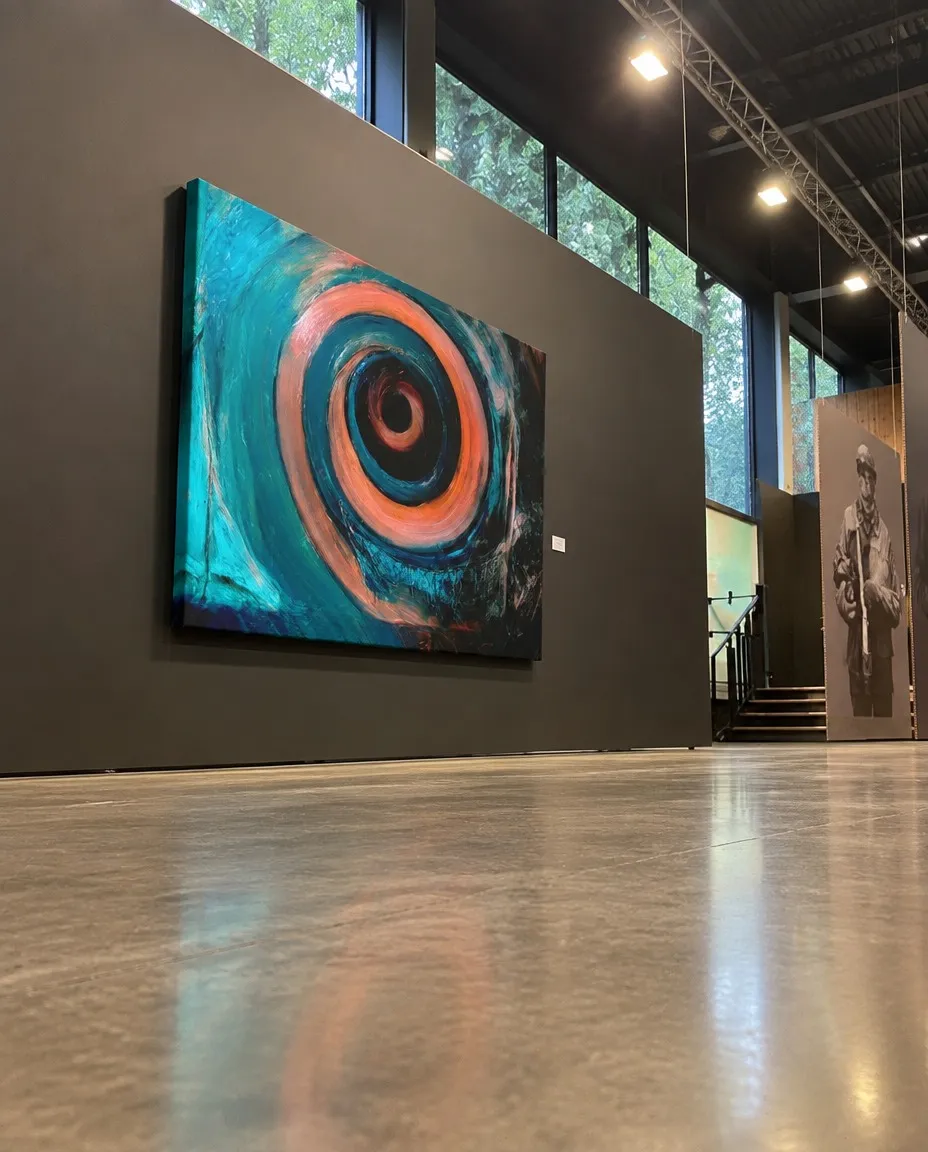
Context study / HELIX
HELIX Artwork – VORTEX Series by Maurizio Valch – Circular abstraction
When facing the imposing surface of HELIX, the viewer is swept away by a rotation that manifests not as a passive geometric shape, but as an event of material violence in full development. The chromatic and thermal contrast between the outer crust of deep turquoise blue and the warm mass of an arm in glowing copper and flesh-pink tones generates a visual friction that destabilizes the flat surface of the canvas. This centripetal push, where chromatic fluids overlap and devour each other, immediately evokes the concept of the mandala developed by Carl Gustav Jung, the celebrated Swiss psychiatrist who studied how circular symbols of organization emerge from the collective unconscious as attempts at psychic integration. However, unlike traditional mandalas aimed at inner pacification, Valch's whirlwind denies any hint of meditative stillness; here, the circular structure operates as a relentless force of attraction, a gravitational drain pulling the gaze and consciousness into an unfathomable abyss.
When I place myself before the large-format stretcher, the painting ceases to be a mere representation to become a hand-to-hand combat with the density of the material. Dragging oil and acrylic over a surface of these dimensions demands real physical effort, where each turn of the arm seeks to bend the viscosity of the wet pigment. There is no pre-planned geometric design in my mind; the spiral arises from an organic necessity, almost of survival on the canvas, searching for a center of gravity to hold and order the masses of color before they disperse into chaos. When scraping with the palette knife or plunging the brush, the incision does not function as a contour line, but as a deep, curved groove that offers resistance, accelerating the visual journey in fluid areas or stopping it abruptly where the accumulated oil becomes thick and rebellious.
This dynamic of acceleration and material resistance introduces a profound philosophical rift in the reading of the work. If on one hand the Jungian spiral suggests a journey of self-actualization, on the other stands the relentless warning of George Gurdjieff, the Eastern mystic who warned of the constitutive mechanical nature and the state of deep sleep in which human existence takes place. Before HELIX, one wonders whether this vortex is a tool of friction destined to awaken the observer's attention from their habitual lethargy, or if, on the contrary, it represents the loop of daily inertia, a perpetual and automated movement that keeps us alienated in its endless turn. The absolute black core waiting at the center, barely altered by a residual reddish glow, poses the same dilemma: we do not know if we are before the fertile void where the wakefulness of being is possible, or if we are peering into the jaws of a cosmic, impersonal mechanism that devours all traces of individuality.
During execution, my attention is obsessively focused on the textured edges surrounding that central zone of darkness, a space that is simultaneously the end and the beginning of the journey. For me, the canvas behaves like a territory where memory is not fixed as a stationary record, but as a flow that continually erodes and folds back upon itself, erasing its own footprints. The black that crowns the core is, under no circumstances, the simple negation of light or empty space on the support; it is the ultimate material condensation, a geological stratum where dozens of previous layers of blue, copper, and carmine have overlapped until they silence one another. At that point of apparent stillness, the paint becomes so dense that the original color is buried, leaving only a vibratory trace, a muted heartbeat beneath the weight of accumulated oil.
La escala de HELIX, con sus dos metros de anchura, interrumpe cualquier posibilidad de distancia intelectual o distanciamiento estético por parte del espectador, imponiendo una confrontación que se asimila directamente con el cuerpo. El tamaño de la tela desborda el campo visual inmediato, obligando a los ojos a recorrer físicamente la textura y a sentir el peso de los empastes de forma casi táctil. Al final del recorrido, queda la certeza de que el centro de la espiral es inaccesible, un territorio que no se puede poseer ni fijar con la mirada. En esta pintura, el movimiento vertiginoso y la inmovilidad absoluta no se anulan, sino que conviven bajo una tensión suspendida y vibrante, dejando al observador desubicado, varado en el umbral de una fuerza centrípeta que continúa su rotación silenciosa mucho después de haber abandonado la sala.
- Original artwork
- HELIX
- Actual dimensions
- 82.7 × 63 in / 210 × 160 cm
- Presentation
- Digital contextual visualization
Context references
Large format abstract paintings · Maurizio Valch HELIX · Rotational abstract art · Abstract painting with spiral texture · Decorating with original contemporary art
About this visualization
This visualization places the artwork within an architectural context to help collectors and viewers imagine its presence in a real space. It is an interpretive reference, not an exact reproduction: the original work remains the sole authority for scale, color, surface and material presence.