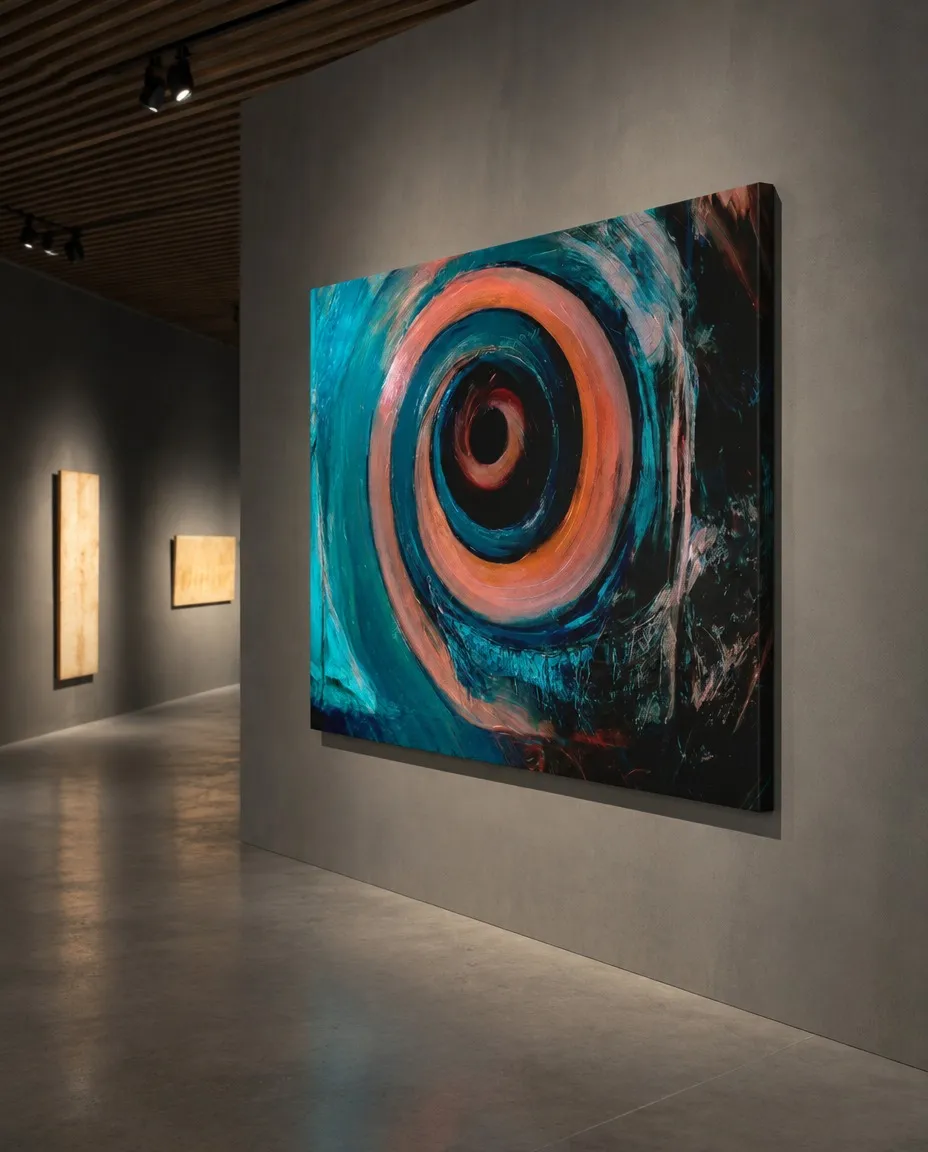
Context study / HELIX
HELIX by Maurizio Valch – Large-scale abstract painting
The immensity of HELIX, suspended over the gray wall of exposed concrete, does not ask us to decipher a story nor does it offer us the biography of a crisis. The monumentality of the artwork in this high-ceilinged space with directional lighting accentuates its character as an emotional monolith: a force field that does not describe agitation, but rather embodies it. Facing the temptation to seek a narrative—the record of a shipwreck, an external storm, or a specific psychological wound—the painting asserts itself as a pure fact of chromatic vibration. The spiral does not advance toward a resolution; it folds back upon itself to condense, in the pure friction of its limits, a tension that bypasses words to make itself felt in the body.
When I traced this turn over two meters wide, I did not have a theory of anxiety in mind, nor was I seeking to illustrate an inner conflict. I have often observed how thought rushes to construct explanations to justify what is simply a physical state, a pressure in the chest, or an accelerated heart rate. Painting the spiral was, in reality, an attempt to bypass this interpretive filter: letting the hand drag the dense matter of oil and acrylic in a centripetal movement, allowing the paint to support its own weight. In doing so, I discovered that the color and rough impasto did not need to tell a secret to reveal it; the vibration of the turquoise colliding with the copper was already all the emotion the canvas could bear.
In the visual organization of HELIX, the temperature contrasts act as an emotional barometer of great subtlety. The electric turquoises and deep blues, which seem to evoke the icy depth of an invisible ocean, enter into direct friction with the carnal warmth of the coppery tone enveloping the center. This collision does not produce chaos, but rather a tense stillness, a magnetic order reminiscent of Mark Rothko's enveloping color fields, but with a much heavier physical and geological presence. The painting does not simulate a light atmosphere; it presents itself as an eroded skin that has recorded the wear of its own rotational movement, offering the viewer a tactile surface where the gaze stumbles upon the roughness of the material.
There is a moment, when stepping back from the canvas in the silence of the studio, when I understand that this black center is neither a negation nor a menacing abyss. It is, rather, the point where the noise of the mind exhausts itself and surrenders. For years I have watched how we build defensive structures and complex theories to avoid meeting our own emptiness; however, on this canvas, that dark core functions as a necessary anchor. I do not want the observer of the work to plunge into a personal drama, but rather to experience the same halt I felt when suspending the brush just before touching the center: that instant of absolute silence that arises when the speed of the turn finally understands its own stillness.
The confrontation with HELIX from the distance imposed by the exhibition room activates a somatic resonance that goes beyond mere aesthetic appreciation. Lacking a stable horizon to hold onto, the viewer is forced to inhabit the decline of the curve, physically experiencing the pull of that core that sucks in the surrounding layers of color. The artwork thus functions as a contact membrane, a tactile shore where the boundaries between inside and outside blur. By relinquishing the need to translate the painting into concepts or diagnoses, what remains is the silent presence of matter under the light, demonstrating that an image is capable of containing the totality of an emotional state precisely where it refuses to explain it.
- Original artwork
- HELIX
- Actual dimensions
- 82.7 × 63 in / 210 × 160 cm
- Presentation
- Digital contextual visualization
Context references
Large format abstract painting · Turquoise and copper abstract paintings · Maurizio Valch VORTEX · Abstract spiral painting · Abstract wall art for designer living room
About this visualization
This visualization places the artwork within an architectural context to help collectors and viewers imagine its presence in a real space. It is an interpretive reference, not an exact reproduction: the original work remains the sole authority for scale, color, surface and material presence.