Context study / HELIX
HELIX Artwork by Maurizio Valch | Abstraction and Texture
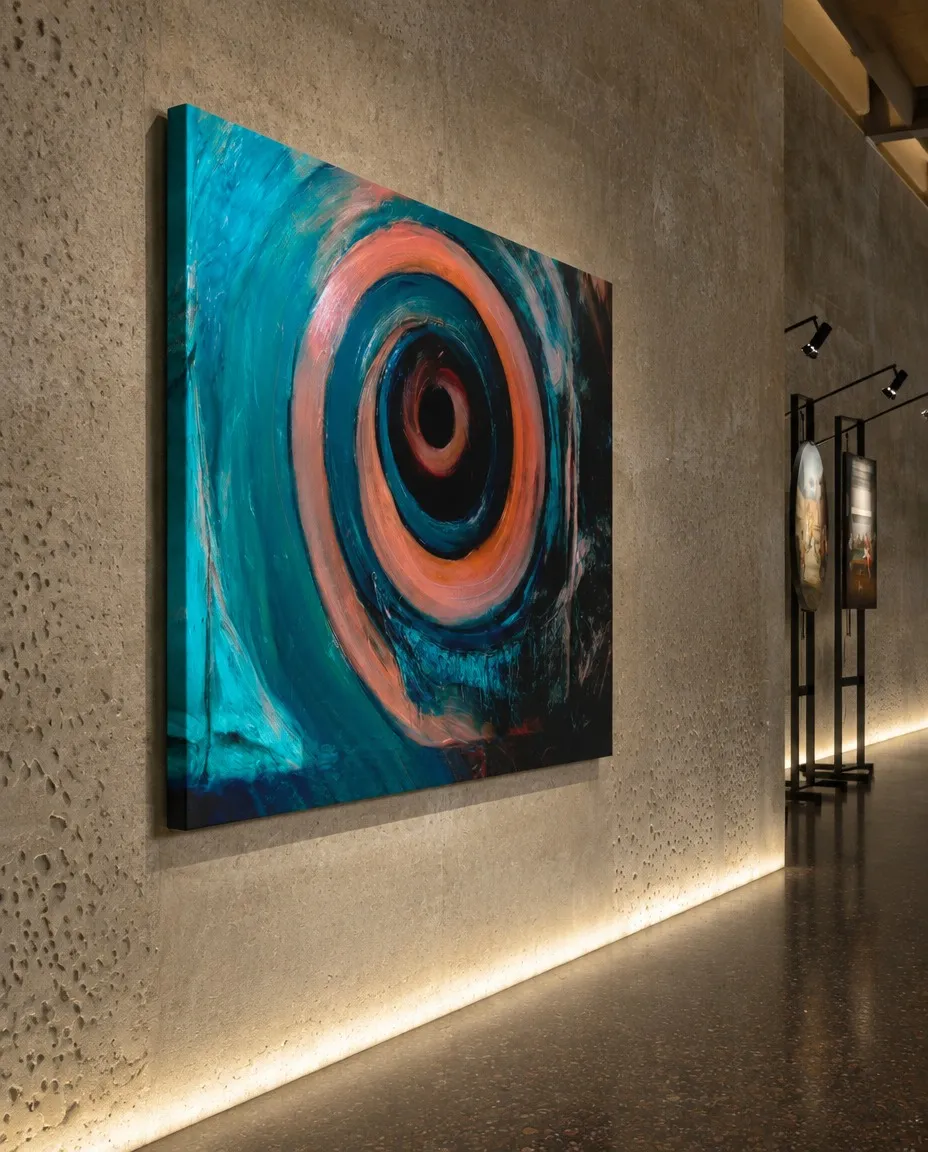
From a certain distance, HELIX refuses to be reduced to its circular form. Measuring 210 × 160 cm, it occupies the visual field like a presence that demands a somatic positioning: one must stop, step back slightly, and allow the rectangle to breathe against the wall. The spiral seems held in tension between two incompatible actions. It opens. It rushes. Its rings do not entirely obey a reliable geometry; they widen, brush against one another, veer off course, as if each turn had arrived too late or too early for the next. The eye seeks a stable path, but the painting offers a tilt.
The turquoise does not function here as a peaceful background. It moves with a humid, almost electric energy that seems to push from the margins toward the center and, at the same time, escape through the corners. Opposite it, the coral and orange do not appear to “warm” the image: they press. They form a band that approaches the darkness without ever quite touching it, an irregular orbit whose temperature seems to rise as it loses its contour. The turquoise opens up space; the coral narrows it. One blows outward. The other pulls back.
Thus begins the first loss: the eye stops looking like someone cataloging colors, lines, and zones. It must abandon the habit of keeping everything in its place. Yet it must not lose itself entirely just yet. The spiral demands lateral attention: not just looking toward the center, but noticing how, on the lower edge, the turquoise becomes thicker and darker; how certain light abrasions seem to have been swept along by an unseen current; how the coral, as it approaches black, ceases to be a band and becomes an irregular breath.
Mercedes Sosa was an Argentine singer whose voice made one feel that a single breath could belong to many people. Before HELIX, her intelligence would not search for an ascending melody, but rather a chorus that returns altered with every turn. The coral ring reappears, yes, but it never arrives identical: sometimes it seems to support the spiral, other times it seems to tire of it, like a sustained note that trembles because it knows it cannot last alone. In this oscillation, the painting acquires a throat. Not a throat that emits a sound, but one that learns how much air is needed to border what does not respond.
The central darkness interrupts the tilt. It is not large, but it organizes everything. The more one looks at it, the less it functions as a destination. It looks like a cavity, though it also looks like an interruption of that cavity; a place where the paint does not deliver a clear depth, but rather holds back the question of depth. What does that black listen to? The coral push reaching toward it? The brushing turquoise folding back? The viewer's breath when they realize they are holding it?
It is best not to conquer this center with words. To say “abyss” would be to cover it too soon. To say “eye” would be to give it an anatomy it might not possess. Yet, something there seems to look out without a pupil. A child might ask: “Why doesn't the whirlpool fall into its own hole?” The question is disarming because it does not assume the hole is passive. Rather, it supposes that the spiral is sustained by a strange rule: it rotates around something that could swallow it, but for now keeps it suspended.
Something in the spiral forces us to hear, without ceremony, the voice of Maurizio Valch:
I watch how the form insists on pulling away from me. It does not quite obey the hand that imagined it, nor the gaze that would order it. The turquoise seems to want to escape the turn, the coral seems to return to prevent it, and in the middle remains a darkness I do not feel as an answer. Sometimes the surface strikes me as having found its own direction; other times it seems to resist any direction. This contradiction keeps me close.
The spiral becomes visible again after this confession, but no longer as a self-sufficient figure. Its rings become decisions that never quite decide. The central black shifts in meaning: before, it seemed like the threat of absorption; now, it seems like that which forces each color to discover how far it can go. Perhaps what the eye must lose is not vision, but its impatience to resolve the distance between edge and center.
Luis Barragán was a Mexican architect who understood color and shadow as spaces to inhabit with the body. From this sensitivity, the center of HELIX might seem like an impossible room: an entrance without a facade, a door that leads not behind the canvas but toward an unknown orientation. Barragán would perhaps want to measure that black with slow steps, to wonder where its threshold begins, if the coral is a curved wall, if the turquoise lets in an oblique light from some unseen place.
But the painting does not fully grant him that architecture. The darkness does not seem stable enough to house a room. It offers no floor, ceiling, or scale. Mercedes Sosa would mistrust it once more: there is no space to occupy, her way of listening would say; there is a pause that admits no owner. The black does not wait to be inhabited. It listens to how the colors reach it and veer off. Barragán, then, would have to abandon the idea of an entrance; Sosa, that of an absolute silence. Between the two, another way of approaching emerges: not to enter, not merely to border, but to allow the spiral to change the rhythm of the gaze.
Now the painting no longer seems to lead only inward. It also expels. The peripheral turquoise, especially where it blends with shadows and more muted strokes, seems to cast the gaze back toward the edges of the rectangle. There, the spiral reveals itself as less perfect, less certain of its center. There are areas where the rotation wears thin, where a coral band is interrupted, where the color seems to have grazed a limit and returned without explanation. The vortex is not a closed machine: it lets clues escape.
I no longer expect the darkness to open like a door, nor the spiral to let itself be sung into familiarity. I see it as a presence that also displaces me outward: it makes me notice the edge, the wall, the interval between one turn and the next. I do not know what that center holds, and perhaps the painting does not know either. But I recognize that it does not ask me to disappear into it; it asks me to lose the security of looking from a stationary place.
There remains, near the bottom right edge, an area where the turquoise muddies against the shadow and the turn seems to falter slightly. It is not a decorative detail. It is a small disobedience: a part of the spiral that does not quite return to the circle, as if it had heard something from outside the painting and were about to veer off course once again.
- Original artwork
- HELIX
- Actual dimensions
- 82.7 × 63 in / 210 × 160 cm
- Presentation
- Digital contextual visualization
Context references
textured abstract paintings with relief · spiral painting for concrete wall · original gallery abstract art · minimalist blue and orange painting · contemporary art collecting
About this visualization
This visualization places the artwork within an architectural context to help collectors and viewers imagine its presence in a real space. It is an interpretive reference, not an exact reproduction: the original work remains the sole authority for scale, color, surface and material presence.