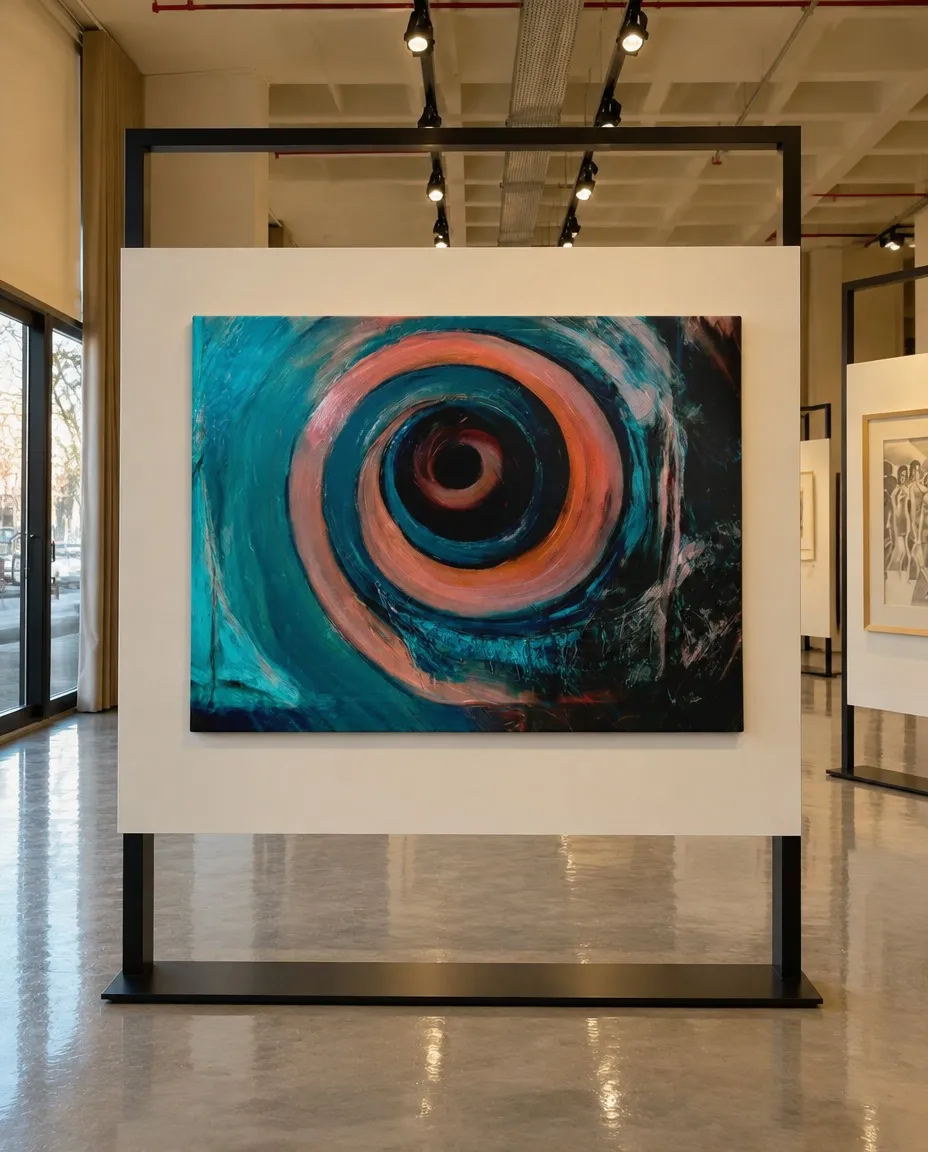
Context study / HELIX
Abstract Painting HELIX - Maurizio Valch | VORTEX Series
How do you write a life when you renounce the comfort of a chronological narrative? In HELIX, Maurizio Valch’s biography does not unfold through domestic milestones, relocation dates, or labeled geographies, but is instead condensed into the pure tension of a centripetal force. The large format, two hundred and ten centimeters wide, does not illustrate a diary of moves or losses; rather, it behaves like the seismographic record of a body subjected to the inertia of constant change. Anyone observing the monumental spiral of turquoise and copper tones will not find a chronicle of the five Caminos de Santiago walked by the artist, nor the tally of thousands of kilometers cycled across Europe, but they will experience the fatigue, the retreat, and the vibration of an existence that has learned to belong provisionally to places before being pushed back into motion.
I have lived so many times that exact moment when one no longer belongs to the territory just abandoned, but has not yet arrived at the destination either. That uncomfortable suspension, that state of not being from anywhere while walking for hours under skies that shift in density, is what truly sediments in my painting. In tracing the curve of this helix, I do not seek to represent an external storm or a specific psychological conflict; I simply record the memory of the body rotating on its own axis to sustain itself. The spiral is not an ornamental metaphor: it is the only possible path when firm ground vanishes and the mind is forced to build a refuge with the material at hand, even if that material is as unstable as fresh oil paint.
The presence of HELIX in this room, suspended on a free-standing metal structure that divides the space of transition, accents its character as an autobiographical threshold. It does not function as a decorative painting limited to dressing a wall, but as a monolithic presence that interrupts the clean architecture and forces viewers to negotiate their physical distance from the black void at the center. Like the enclosed compartment of the box in The Little Prince or the mute blocks of his SITUS series, this dark core does not easily allow itself to be translated. Life appears here stripped of recognizable anecdotes, presenting itself in its most rigorous dimension: as an accumulation of covered, scraped, and repainted layers, where the peripheral incisions act as scars of decisions made in the elements.
For a long time I believed that existence was a heroic quest, a climb toward a place of ultimate recognition that would justify all the accumulated weariness. But painting, in an implacable way, has gradually disarmed me of that armor. Facing this canvas in the studio, obsessed with adjusting the revolutions of color so they would not collapse into chaos, I understood that the urgency to construct complete theories about who I am only serves to bury the fact under its interpretations. Sometimes, the truth of an entire day is reduced to observing the rotation of the spiral and stopping the brush right at the edge of the black mass, accepting that peace does not wait at the end of any pending task, but in the capacity to look at the noise without trying to correct it.
In this dialogue between material rotation and emptiness, Valch’s practice distances itself from traditional readings of lyrical abstraction to approach a visual stoicism. While Alberto Burri’s sutures heal the accident upon the inert surface, the dynamism of HELIX keeps the wound open and in motion, suggesting that identity is not a static sediment, but a structure transformed under pressure. The canvas, exposed to the shifting light of the large side window, reveals that the first step of this turn already contains the entirety of its drift. In the end, what remains before the viewer is not the explanation of a biography, but its physical trace: a rough surface that reminds us that living is a dynamic balance sustained, precisely, in the honesty of its own fall.
- Original artwork
- HELIX
- Actual dimensions
- 82.7 × 63 in / 210 × 160 cm
- Presentation
- Digital contextual visualization
Context references
decorating with large abstract paintings · modern abstract painting spiral · solo painting exhibition · original work by maurizio valch · modern design paintings for living room
About this visualization
This visualization places the artwork within an architectural context to help collectors and viewers imagine its presence in a real space. It is an interpretive reference, not an exact reproduction: the original work remains the sole authority for scale, color, surface and material presence.