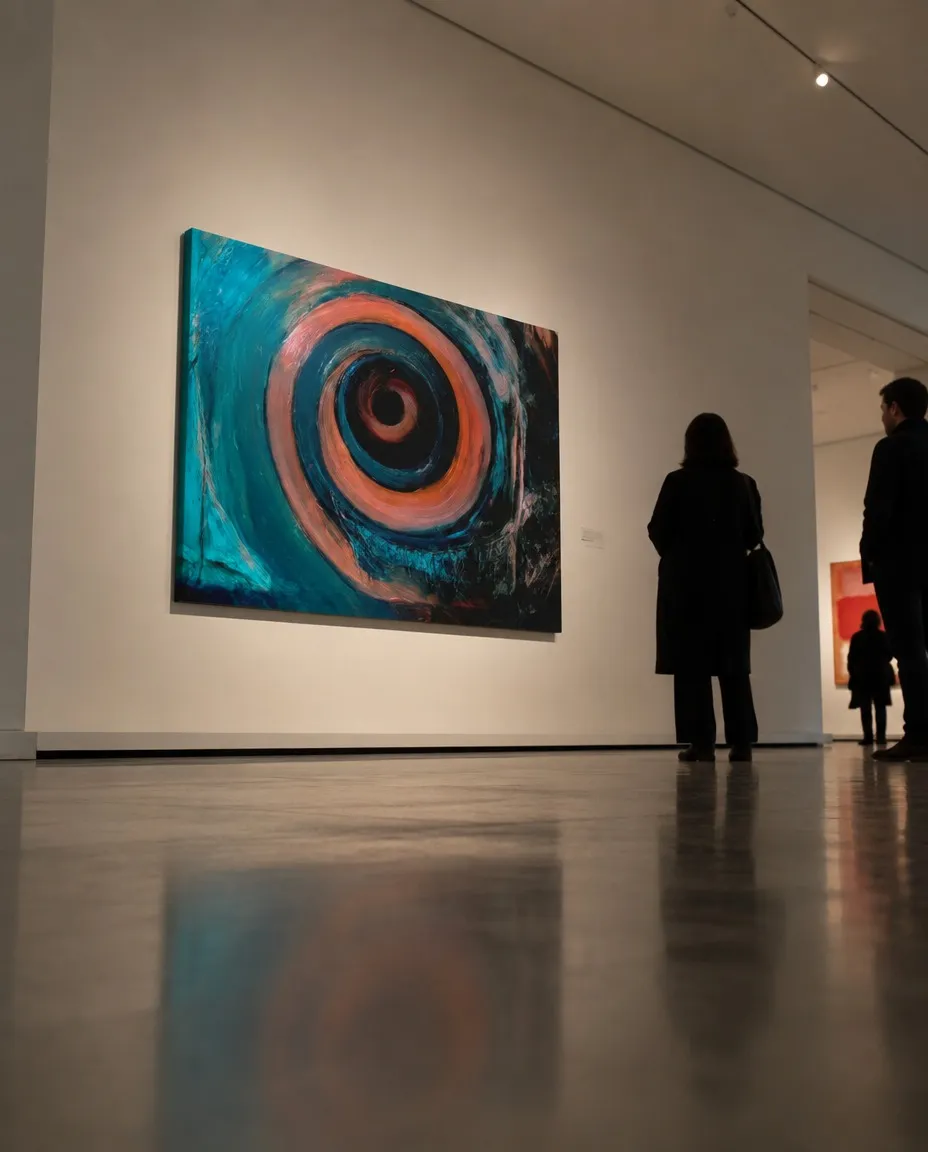
Context study / HELIX
HELIX by Maurizio Valch - VORTEX Series | Material Abstraction
The materiality of HELIX immediately asserts itself through a surface where oil and acrylic fight a battle of densities and chromatic tensions. The violent contrast between the coldness of the indigo blue and turquoise green that dominate the outer plane collides abruptly with the carnal warmth of a helical band in copper and terracotta tones. At the edges of the whirlpool, the traces of energetic scraping scrape away fresh paint to reveal underlying layers—an archaeology of gesture leading to a deep, dark core, a black abyss acting as a visual drain. In analyzing this centripetal structure, it is inevitable to evoke the thought of Carl Gustav Jung, the Swiss psychiatrist who defined the archetypes of the collective unconscious and studied circular representations as maps of the psyche. While the traditional mandala analyzed by Jung functions as a symbol of order, symmetry, and spiritual integration, Maurizio Valch’s off-center, turbulent vortex subverts this promise of balance; it does not seek to pacify the observer’s spirit, but drags it into an inevitable descent into the Shadow, turning the canvas into a space of disintegration and confrontation with the unknown.
When facing a canvas measuring two meters ten centimeters by one meter sixty high, I know that painting cannot be a purely mental act, but a physical demand that engages my entire body. To trace the trajectory of this spiral, I must drag the dense oil and acrylic pastes in a continuous semicircular movement, feeling the violent resistance offered by the grain of the stretched canvas. Each pass of the medium demands a muscular effort that is recorded on the fabric: I use wide palette knives and my own hands to gouge the wet material, tearing open the deep blue so that, like open wounds, the terracotta and copper tones lying hidden beneath emerge. Reaching the center of the composition, I decide to interrupt the gesture and suspend the color; I leave an absolute black void there, a core of dense, opaque oil that does not reflect light, expressly conceived to absorb the viewer's gaze and return the silence of the material in its purest state.
The formal oscillation of this painting raises a question about the inertia of human behavior and the limits of visual perception. To delve deeper into this tension between perpetual rotation and the release of consciousness, it is necessary to introduce the ideas of George Gurdjieff, the mystic and philosopher who postulated that the ordinary human being lives in a state of deep sleep, behaving like a machine subject to external influences and repetitive automatisms. From this perspective, the spiral in Valch's work can be interpreted as the visual representation of that alienating loop of everyday automaticity, where the viewer's eye is trapped in a predictable orbit of attraction and repetition. However, the compositional instability of the painting itself, with its material tears and off-center axis, generates a friction that breaks the inertia; the painting does not put the viewer to sleep, but acts as that necessary shock of vertigo that Gurdjieff considered indispensable to provoke the "self-remembering" and awaken from automatism.
For me, this constant rotation is not a mere geometric abstraction or an optical composition game, but the decantation of my memory of the deep Mediterranean, the physical record of geological forces and marine currents that I experienced in the cliffs and caves of Nerja. I remember the invisible push of underground currents, the suction of the abysses eroding the rock, and the way ancient peoples, from the Minoans to the Iberians, rendered these spirals on their vessels and stone reliefs to dialogue with the flow of time. In painting, I want the canvas to function in the same way: as a tectonic force that erodes the territory of the canvas, where each layer of acrylic and oil deposited represents a temporal sediment, a fragment of earth and water swept away by a movement that transcends me and connects the contemporary gesture with a very ancient physical memory.
Shifting our gaze back to the physical boundaries of the painting, it becomes clear that the movement of the spiral does not fade away gently, but collides violently with the dark corners of the frame, where the vibration of the blue is extinguished and the dynamism seems imprisoned by the orthogonality of the wood. This contrast highlights the fragility of any human attempt to structure the chaos of pictorial matter under a rigid geometric order. The true tension of the work does not reside in the illusion of movement generated by the whirlpool, but in the real weight of the pigment accumulated on its edges and in the disconcerting stillness that inhabits the interior of its black core. It is in this motionless center, surrounded by the turbulence of color, where the painting abandons its representative character and manifests solely as a physical, silent presence that resists the rush of the surrounding world.
- Original artwork
- HELIX
- Actual dimensions
- 82.7 × 63 in / 210 × 160 cm
- Presentation
- Digital contextual visualization
Context references
blue and terracotta spiral painting · two-meter abstract painting · abstract artworks for living rooms · maurizio valch painter · brutalist contemporary art
About this visualization
This visualization places the artwork within an architectural context to help collectors and viewers imagine its presence in a real space. It is an interpretive reference, not an exact reproduction: the original work remains the sole authority for scale, color, surface and material presence.