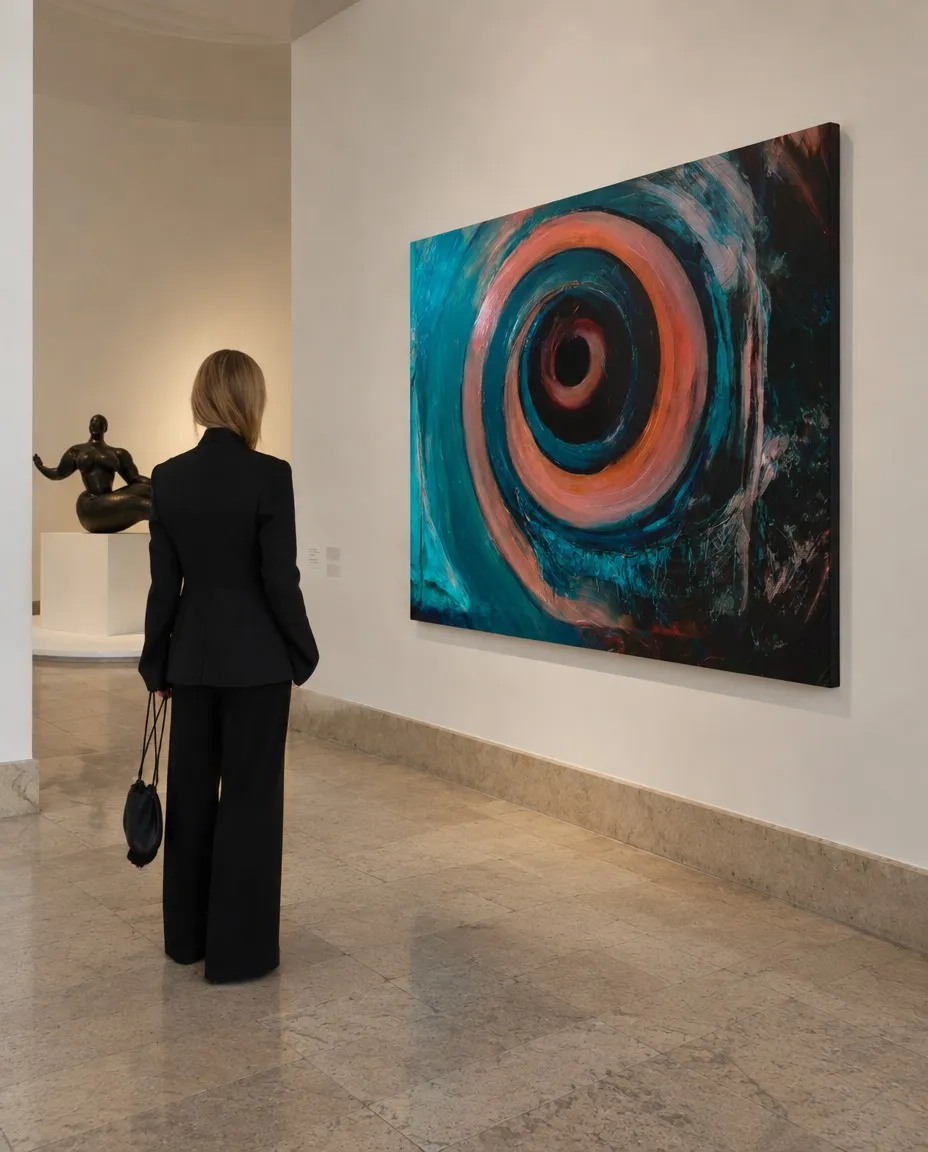
Context study / HELIX
Maurizio Valch - HELIX (VORTEX Series) | Large-Format Abstract Painting
HELIX stands before the viewer as a monumental vortex of opposing forces, a 210 x 160 centimeter canvas where paint seems to organize itself under a magnetic and turbulent gravity. From the outer edges of the support, a violent turquoise blue and a luminous indigo clash like ocean currents in perpetual conflict, colliding abruptly with a dense circular band of salmon and copper tones that curves decisively inward. At the heart of this centripetal and centrifugal storm rests a black, absolute, and velvety core—an abyss that acts simultaneously as a visual drain and a space of silence. It is precisely in this formal transition where the search for protection materializes: the gaze, overwhelmed by the chromatic agitation of the periphery, seeks refuge in folding toward this dark center, which evokes the stillness of the womb or the safety of an original cavity. However, this core presents an indissoluble tension: we do not know if this black void is an imminent threat of dissolution that will eventually swallow the matter of the painting or if it is, on the contrary, the only absolute and true safeguard against the chaotic dispersion of the exterior.
Facing the blank canvas with a loaded palette knife and wet brush, I immediately understood that HELIX would not be a surface for passive contemplation, but rather a territory of transit for my own body. Painting this large spiral demanded a resolute physical commitment from me—a firm, circular sweep of the arm that required holding the stroke without hesitation, placing blind trust in the very inertia of the pigment on the canvas. As I glided the oil and acrylic, allowing the textures of the turquoise to overlap and drag the underlying layers of copper, I deliberately relinquished absolute control to embrace the drift of liquid matter. In this somatic choreography, the stretcher ceases to be a static plane and becomes a dynamic field where color seeks and finds its own physical path. This trust is not a passive concept; it is the voluntary surrender to the force of movement, the certainty that the pictorial gesture, once unleashed, possesses a wisdom of its own that the painter must only accompany and enhance along its path.
Shifting our attention to the outer edges of the spiral, particularly in its relationship with the dark, dense, and textured background that dominates the right flank of the painting, we run directly into the paradox of belonging. Through overlapping glazes, circular scrapings, and suttle drag marks, the vortex seems to struggle in a constant battle: on one hand, it fights to break free from the pictorial plane to project itself into real space; on the other, it desperately seeks to root itself in the very materiality of the support. This tension questions our ability to inhabit a territory in permanent rotation. Belonging in HELIX is not articulated from the rigidity of firm ground or a static border, but from the assimilation of movement. The matter, with its accumulated imperfections and visible grooves, demonstrates physically that belonging to a place does not mean remaining unaltered, but rather accepting the constant somatic and geological transformation of the environment we inhabit.
As the creator of this centrifugal universe, configuring this helix has irreversibly transformed my own perception of protection and belonging. Standing in the center of this chromatic hurricane, applying overlapping layers that threatened to overflow the physical boundaries of the frame, I could not help but wonder if this pictorial exercise functioned as a protective shield against external hostility or if, in reality, it was a deep incision, a circular wound exposing me completely. I have learned that true refuge does not lie in sterile isolation within the black core of the painting, but in bravely accepting that my body, my gesture, and my memory belong entirely to this continuous and turbulent flow of paint. I am not an external agent observing the storm from a distance; I belong to the rotation of the matter, I am part of the palette knife's drag, and my only safeguard is to merge with the current that I myself have unleashed on the canvas.
In its final resolution, HELIX imposes itself upon the viewer as a dynamic monolith, a tactile shore that irreversibly captures the eye and body of whoever contemplates it. The visual path is inevitable: we are pulled from the cold and vibrant luminosity of the outer turquoise, we pass through the warmth of the copper, and we arrive at the unfathomable silence of the dark core. Through this transition, the artwork achieves a poetic synthesis that strips trust, protection, and belonging of their static definitions and their character as immutable refuges, transforming them into active, vector forces. Maurizio Valch's painting does not offer a safe harbor or a rigid structure to shelter in; on the contrary, it stands as a living experience where viewers discover, through the physical vibration of color and form, that the only possible refuge against the uncertainty of the world is to surrender, without resistance, to the constant heartbeat and eternal rotation of matter.
- Original artwork
- HELIX
- Actual dimensions
- 82.7 × 63 in / 210 × 160 cm
- Presentation
- Digital contextual visualization
Context references
large abstract paintings for living room · turquoise and copper abstract painting · spanish contemporary art spiral · maurizio valch helix vortex · buy original abstract painting
About this visualization
This visualization places the artwork within an architectural context to help collectors and viewers imagine its presence in a real space. It is an interpretive reference, not an exact reproduction: the original work remains the sole authority for scale, color, surface and material presence.