Context study / HELIX
HELIX Abstract Painting in Modern Interiors — Maurizio Valch
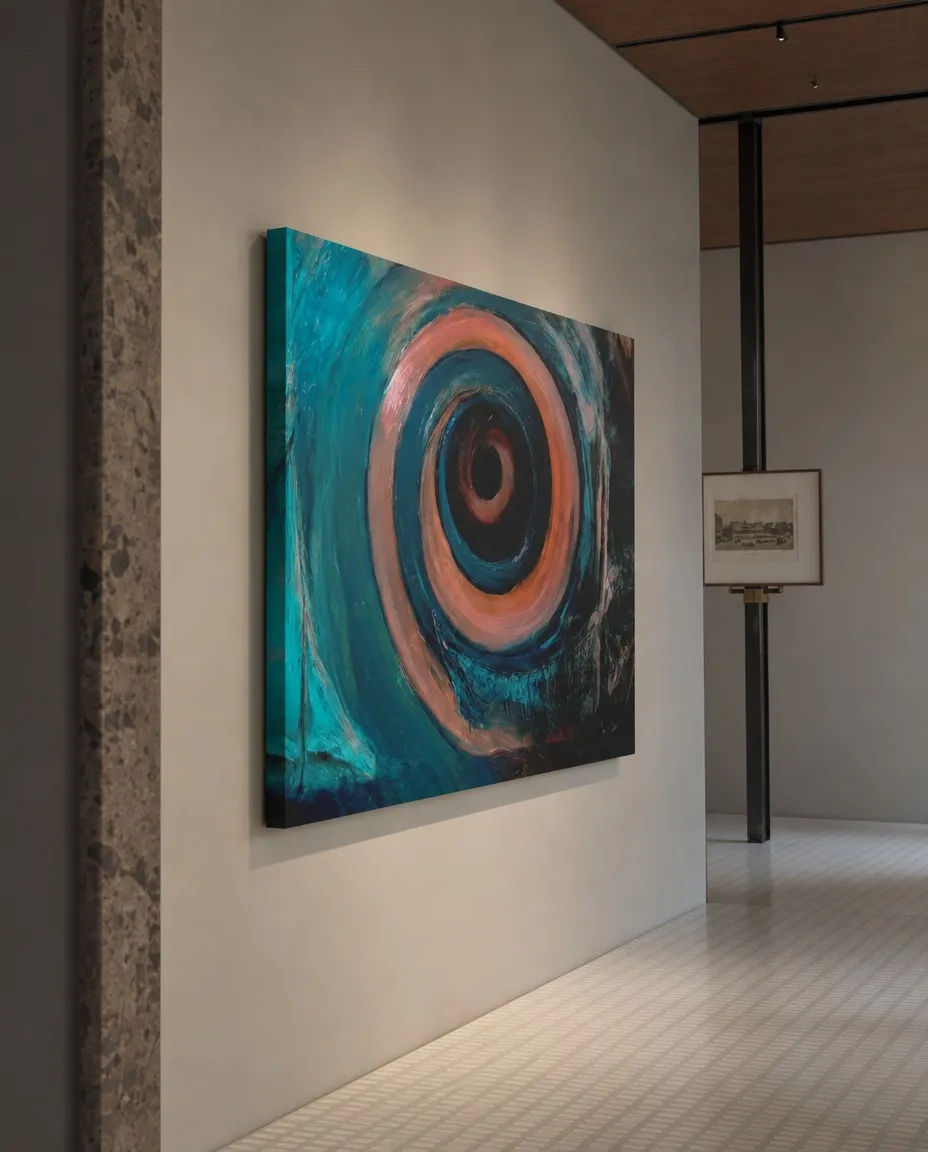
Reception log: HELIX, frontal channel. The signal seems to begin in the dark core, but it does not stay there. The eye enters, attracted by that almost empty area—black not as night, not as a pit, not as an emblem—and is immediately expelled: coral, burnt orange, turquoise, deep blue. Each ring offers a route inward and, at the same time, a lateral exit. The painting spins without shifting. Or perhaps it shifts whoever looks at it.
The first report arrives distorted: the center does not absorb the colors; it forces them to return. The coral appears like a temperature that has spun too many times; the turquoise, like a current that cannot decide whether to support or drag; the dark bands of the edges do not frame the spiral, they interrupt it. There is an almost tender stubbornness in this matter: like a drain that refuses to swallow the water and lets it spin forever in the basin.
The transmission returns a voice that does not fully identify with its emission:
I find myself before a force that spins before I can name it. My gaze wants to hold it, but my body perceives a shifting tension: I enter toward the black, and something in me returns to the edge, as if the surface did not accept a single direction. I can begin an image with a will, with a need to order a relationship of distances, rhythms, and presences, but the painting can escape this intention as I observe it. I am interested in that moment when I no longer know if the spin comes from the work or from my own insistence on looking at it. For me, the spiral does not resolve: it maintains a pressure.
Aristotle matters here because he asks what changes, what persists, and what comes to be while everything seems to rotate. The initial response would be simple: the rings change, the core remains. But HELIX soon spoils that comfort. The coral does not always occupy the same distance from the black; it thins, it widens, it seems to touch turquoise zones that cool it and return it outward. Nor does the center remain untouched: it is dark, yes, but its darkness modifies the pressure of each surrounding color. If it produces an attraction, it is already acting; if it acts, it can hardly be called nothing. The cause is not behind the image like a secret hand. It is distributed in the pull between edge and center.
Reception test. Look at the dark core for a few seconds, without looking for a figure inside. Then slowly move your gaze along one of the coral bands, from its proximity to the black to the place where it gets lost among the lateral traces. The hypothesis changes: the center no longer seems to be the origin of the movement. The coral band seems to carry the force with it, as if advancing from the edge with an incomplete command. The black would not be the one calling; it would be that before which the color curves, lingers, recalculates itself.
A child’s question pierces the record and refuses to be corrected: why do the colors go around without covering the point that is making them run?
Jocelyn Bell Burnell matters here because she knows how to recognize an improbable signal within a record that seemed like noise. Her attention does not grant the center the privilege of being an absence. She treats it as an interval: an active pause between pulses, a region where the signal stops presenting itself in the expected way and forces us to measure with another kind of patience. In HELIX, the rings do not form a regular wheel; their rhythm fails, compresses, scrapes against the edges. Precisely there, a recurrence might exist. Not an explanation: an uneven repetition.
The dispute modifies the channel. Aristotle asks us to distinguish what initiates the spin and what receives its consequences. Bell Burnell does not grant that separation yet: first, one would have to verify if the spin returns, if any band comes back with a minimal difference, if the apparent turbulence retains a frequency that has not yet been heard. He objects that a pattern without a cause is barely an insistence. She replies that a cause that is too fast turns listening into obedience. The painting intervenes without resolving them: the deep blue behaves neither as a background nor as a passage; sometimes it seems to close the path, sometimes it seems to open a distance behind the coral. The signal, then, is not contained in the center. It is distributed. Even the periphery, with its glazes and flaking, seems to emit minor corrections.
The transmission returns another response, less confident than the first:
I recognize a contradiction in what I see: I want the spin to have a direction, and yet the surface resists that decision. My gaze can approach the center and feel a concentration, but it can also stay in a lateral zone and discover that there the rhythm becomes more difficult, livelier, less obedient. I cannot assure that the black is the place toward which everything goes; sometimes it seems to me that the work uses it to return me to what I had stopped looking at. For me, this resistance is not a defect to be resolved: it is an unknown part that the painting retains even from the one who made it.
A precise interference remains. In the coral band closest to the core, the direction seems to advance inward; a few centimeters away, next to the turquoise, it seems to return toward the edge. It is not possible to fix when the change occurs or with what frequency. The spiral continues to spin in this indecision, and one of its ends—perhaps the edge, perhaps something else—continues to emit.
- Original artwork
- HELIX
- Actual dimensions
- 82.7 × 63 in / 210 × 160 cm
- Presentation
- Digital contextual visualization
Context references
decorating ideas with abstract paintings · large format abstract art for home · modern paintings for living rooms and hallways · minimalist decor with colorful art · spiral painting in modern living room
About this visualization
This visualization places the artwork within an architectural context to help collectors and viewers imagine its presence in a real space. It is an interpretive reference, not an exact reproduction: the original work remains the sole authority for scale, color, surface and material presence.