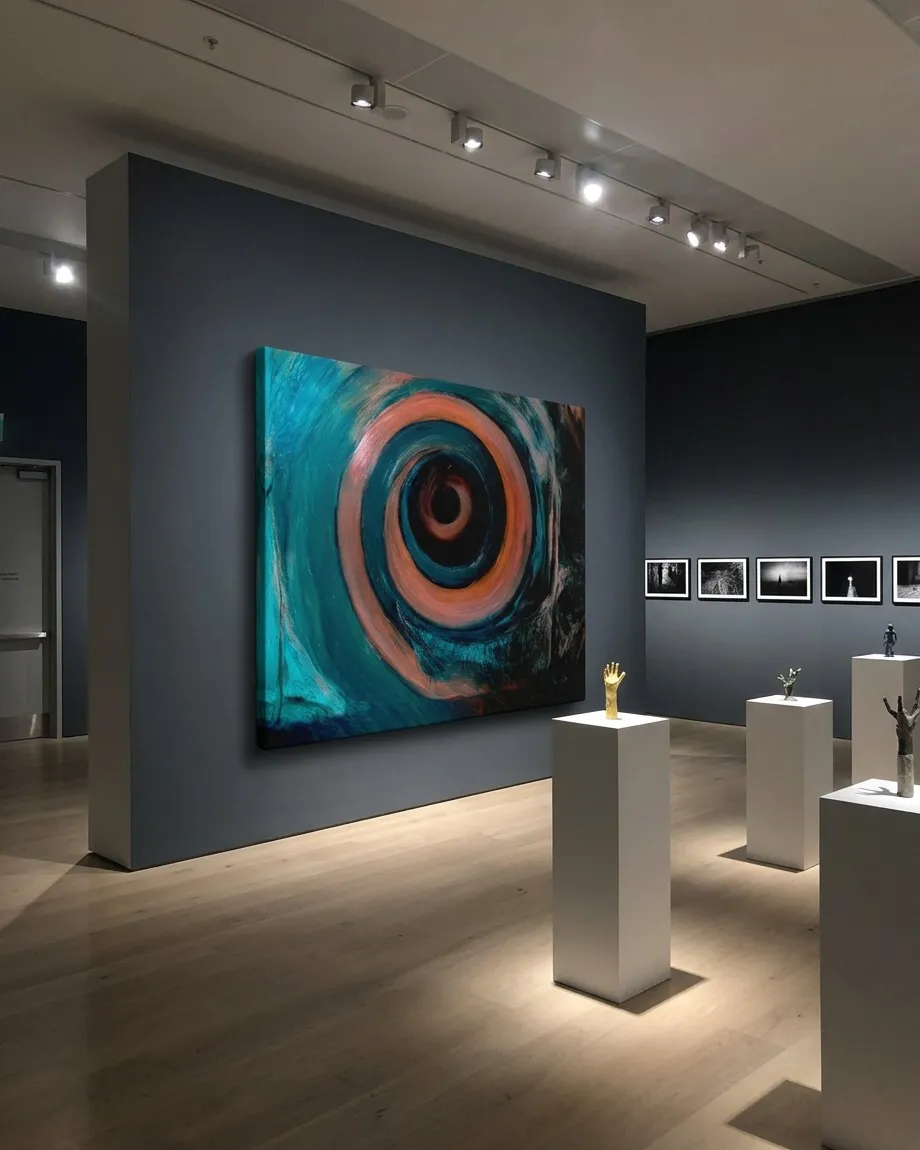
Context study / HELIX
HELIX Painting in Gallery Exhibition — Maurizio Valch
The surface of HELIX imposes itself on the viewer as a field of chromatic forces in open confrontation, where coppery orange and indigo and turquoise blues do not merely coexist, but mutually strangle and feed on each other in their concentric trajectory. Visually, the composition draws the gaze toward a magnetic black core, an absolute void that subverts the promise of order traditionally offered by circular geometry. From the perspective of Carl Gustav Jung—the famous Swiss psychiatrist who analyzed the mandala as an archetypal symbol of the Self and the integration of the psyche—this helix could suggest a map of individuation or a return to the center of one's being. However, in Maurizio Valch's work, this epicenter is far from a space of harmonious stillness; on the contrary, it manifests as an open wound, a gravitational abyss where the Shadow is not integrated to pacify the subject, but threatens to devour them, transforming the search for inner order into a free fall into the unnamable.
Faced with the immensity of this canvas over two meters high, my entire body had to become the axis of that rotation; each stroke demanded a physical effort that still resonates in my joints and in the accumulated fatigue of my arm. I did not paint with the distance of a spectator, but submerged in the density of the acrylic and the viscosity of the oil, dragging the palette knife with force and scraping successive layers to reveal the color sediments underlying the canvas. The matter itself resisted the spin, opposing a rough inertia that forced me to battle with every millimeter of the helix, which is why I decided to make violent incisions along the edges—raw marks that desperately sought to halt that centripetal force threatening to suck the entire painting into the center of the canvas. In the studio, territory ceased to be an external representation and became a real tectonic force, a direct combat between the weight of my hands and a spiral current that I had unleashed but could no longer control.
This material friction opens up a fundamental debate between destructive repetition and the liberation of being. On the one hand, the helix embodies the warning of George Gurdjieff, the influential mystic who denounced the automatism and mechanical nature of the human being trapped in their own unconscious habits; from this perspective, the constant rotation of the painting is the visual representation of a sleeping man walking in circles within his own mental prison, unable to break the inertia to awaken. On the other hand, the painting rebels against this inertia through the perspective of Osho, the mystic philosopher who celebrated creative chaos and the dissolution of the mind's rigid structures in favor of a pure and free bodily experience. The canvas thus becomes a battlefield where institutionalized order collapses before the primordial dance of matter, a tension made visible in the eroded textures and scraped pigments that connect the helix to the archaeological memory of the petroglyphs of the European Atlantic coast and the ritual markings of Newgrange, as if those ancient megalithic incisions in stone sought, once again, to place a human limit on the untamable flow of time.
When the movement ceases and silence returns to the walls of my studio, I am left only to contemplate the latent duality of what has been fixed: the warm light that seems to pulse from the copper and the irreversible cold of that dark center reclaiming its space. I wonder now if my true intention when facing this canvas was to erect a containment structure to protect my own vulnerability, or if, on the contrary, I was looking to open an insurmountable breach in the surface of reality to see what lay behind. In the end, the painting has ceased to belong to me and stands on its own, revealing itself not as a decorative object, but as a threshold where my personal memory dissolves to connect with a much older collective ground, a shared geological stratum where time does not pass, but winds up on itself.
Far from offering a complacent spiritual resolution or an easy way out toward transcendence, HELIX establishes itself as a strictly physical threshold, a place of transit where the gaze remains suspended on the edge of a material abyss. The painting does not simulate the void; it constructs it through the thickness of its textures, its surface scars, and the violent vibration of its competing colors. The viewer who stops before this canvas from the VORTEX series does not find a mystical refuge, but an unstable topography that wears away before their eyes. At the end of this phenomenological journey, we are left with the direct confrontation with the helix and its silent magnetism, an experience suspended before that black eye that seems to stare back at us to remind us that, in Valch's painting, the surface is always the territory where memory and matter mutually erode.
- Original artwork
- HELIX
- Actual dimensions
- 82.7 × 63 in / 210 × 160 cm
- Presentation
- Digital contextual visualization
Context references
museum abstract paintings · large abstract painting exhibition · artworks in modern galleries · contemporary art installation · maurizio valch helix gallery
About this visualization
This visualization places the artwork within an architectural context to help collectors and viewers imagine its presence in a real space. It is an interpretive reference, not an exact reproduction: the original work remains the sole authority for scale, color, surface and material presence.