Context study / HAUSTUS
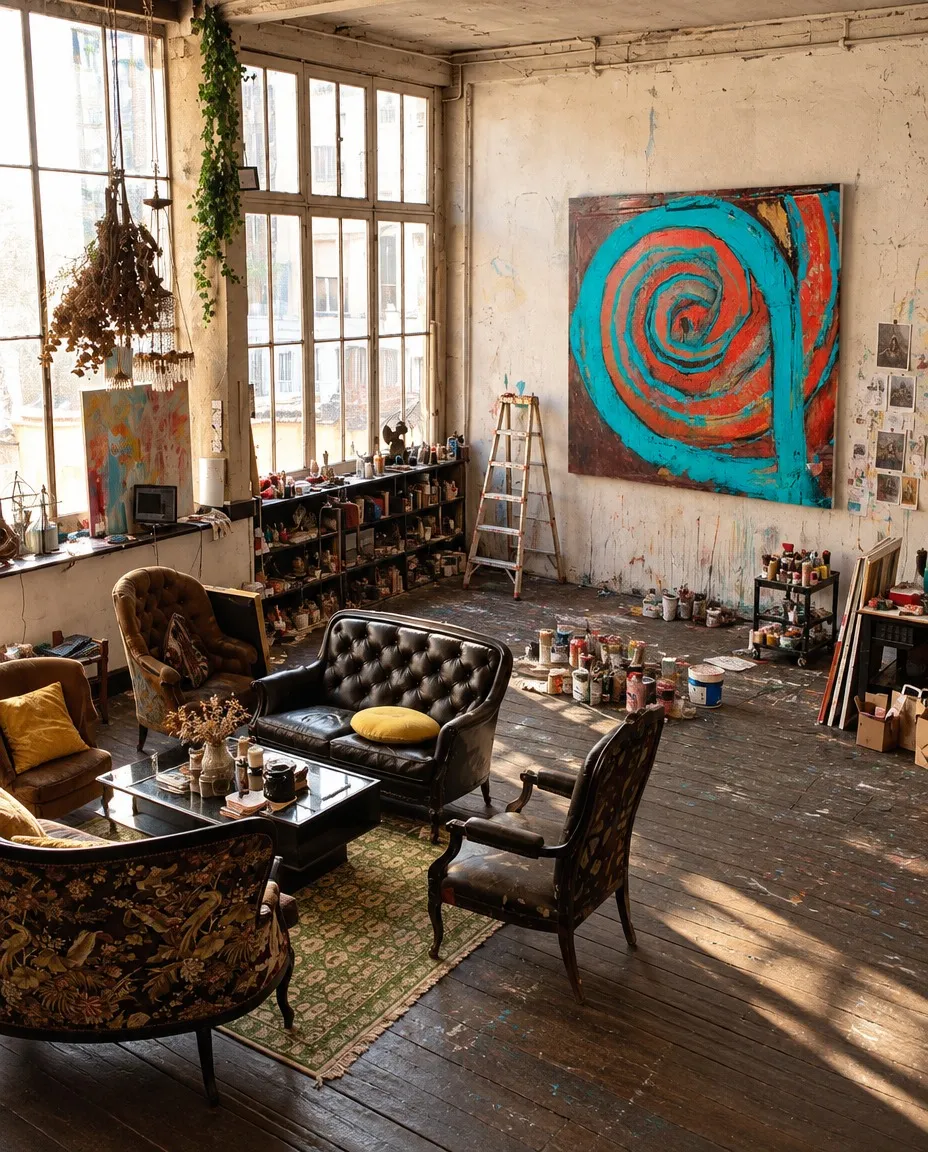
Monumental Painting HAUSTUS – Maurizio Valch in Artist Studio
Hanging in the dim light of a studio where light enters sideways through industrial windows, HAUSTUS imposes a presence that suspends the murmur of everyday objects. Its monumental dimensions—a perfect square of more than two meters per side—do not seek the spectacular nature of an altarpiece, but rather the scale of a wall that halts one's step and forces a reordering of the breath. In this space of exposed beams, accumulated paint cans, and worn leather sofas, the large canvas functions as a threshold where the everyday surrenders. The immense turquoise spiral, spinning over a background of dense reds and dark earth tones, does not resort to any recognizable sign from the repertoire of faith, yet the sober vibration of its material and the gravity with which it sits on the peeling plaster wall generate an almost monastic space of contemplation, a stillness where the gaze no longer needs to decipher, but simply to remain.
When I faced the canvas with the turquoise pigment, I had no map or dogma to illustrate; there was only the physical gesture, the arm that spins and tires, repeating a trajectory that seeks its own consistency. I have always been suspicious of solemn theories that attempt to explain creation before having touched the material. In tracing this spiral that coils inward, I discovered that silence is not imposed by an exercise of will, but arrives when the hand understands and exhausts its own noise on the canvas. In each irregular turn, in every zone where the oil piles up or detours, there is a renunciation of convincing. I do not seek to show a path of external salvation, but to register the trace of a movement that, having lost its horizon, is forced to search for its own center.
This renunciation of traditional iconography is precisely what allows the painting to function as a space of non-intellectual transit. As in the instrumental music of Arvo Pärt, where the repetition of an austere structure and the value of intervals open a dimension of pure expectation, in HAUSTUS the chromatic journey operates through accumulation and emptying. Turquoise is not a decorative color; it acts as an incised and dilated line dividing the territory of the fabric, creating a spatial tension that evokes the color fields of Mark Rothko, but with a geological and physical harshness that returns us to the earth. Finding no figures to translate nor stories to remember, the observer is left disarmed, exposed to a materiality that beats without explaining why, inviting an experience that exceeds the limits of language and rests in mere contemplation of the unfinished.
Looking now at that dark nucleus in the middle of the whirlwind, I realize it is neither a black hole nor a conquered goal; it is the zone of my painting that refuses to be caught by words. It reminds me of those long days of silent walking during my Caminos de Santiago, where the fatigue of walking for hours with apparently nothing happening ended up dissolving the character who needed every step to have a justification or a reward. The center of HAUSTUS is that instant when you stop pushing the stone up the hill and accept that peace does not wait beyond the peak, but in the capacity to look at the void without immediately converting it into a mental conflict. I painted that point to remind myself that there are things that only remain alive if we do not try to colonize them with explanations.
Ultimately, the true approach to the ineffable does not occur outside this world, but in the friction with its humblest remnants. The presentation of the work in the studio, surrounded by dirty brushes, wooden ladders, and the creaking floorboards, underlines that the elevation of the mind does not demand an immaculate temple. HAUSTUS feeds on this proximity to the everyday; its rough material, weathered by successive layers that resemble a skin that has withstood the elements, reminds us that the experience of wholeness is, at its core, a redoubled attention to what is visibly present. It is the gaze that renounces the tyranny of the self and accepts the muteness of a form spinning on itself, proving that, when thought falls silent, the entire territory begins to breathe.
- Original artwork
- HAUSTUS
- Actual dimensions
- 82.7 × 82.7 in / 210 × 210 cm
- Presentation
- Digital contextual visualization
Context references
textured abstract spiral painting · brutalist abstract painting · textured monumental canvas · contemporary art for collectors · decorating with rustic studio art · vortex series works valch
About this visualization
This visualization places the artwork within an architectural context to help collectors and viewers imagine its presence in a real space. It is an interpretive reference, not an exact reproduction: the original work remains the sole authority for scale, color, surface and material presence.